11:57 pm, Wednesday, 15 April 2026

Bangladesh garment output down up to 30pc amid energy crisis

Garment production and shipments in Bangladesh’s key industrial hubs have been severely disrupted by an ongoing energy crisis, with factory output falling sharply due to shortages of gas and electricity, industry leaders have said.

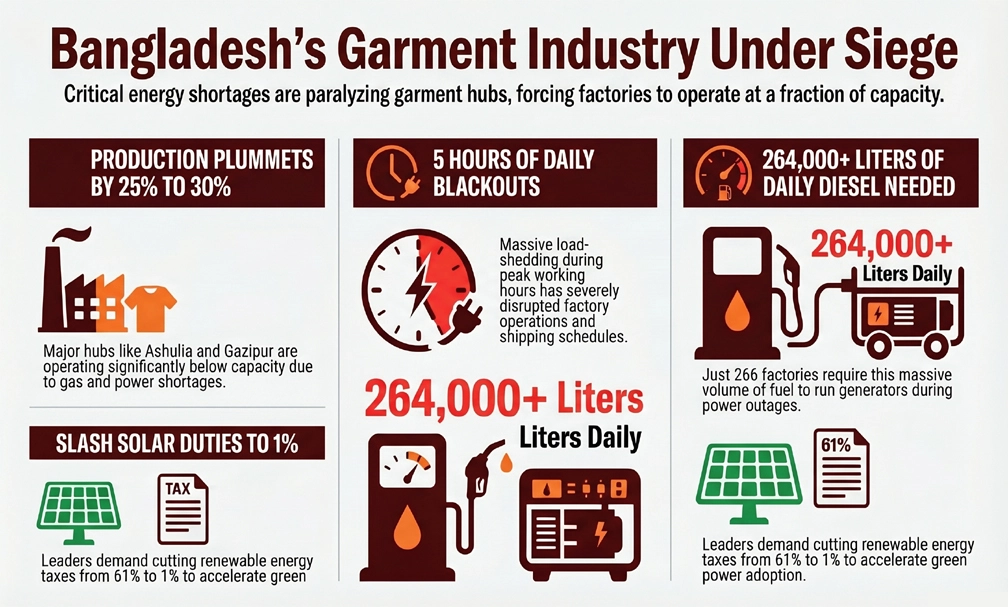
Factories in the Ashulia and Gazipur belts–two of the country’s largest readymade garment (RMG) clusters–are operating at 25 to 30 per cent below capacity as they struggle to secure adequate power supply, according to sector insiders.

The issue was raised at a high-level meeting on April 13 between leaders of the Bangladesh Garment Manufacturers and Exporters Association and officials from the Ministry of Power, Energy and Mineral Resources.

The industry body urged the government to ensure uninterrupted energy supply and extend support to overcome the ongoing crisis.

The BGMEA delegation, led by its president Mahmud Hasan Khan, met Power, Energy and Mineral Resources Minister Iqbal Hasan Mahmud and State Minister Anindya Islam Amit.

Energy Secretary Mohammad Saiful Islam and BGMEA vice-presidents Selim Rahman and Mizanur Rahman were also present.

According to the BGMEA, factories in Ashulia and Gazipur require between 400 and 450 litres of diesel on average to run generators during load-shedding of up to four hours.

In a recent assessment, 266 factories reported a combined daily requirement of approximately 264,174 litres of diesel under such conditions.

BGMEA president said the industry, which had begun to regain buyer confidence following the recent election, is again facing headwinds amid global uncertainty linked to tensions in the Middle East.

He warned that Bangladesh’s garment sector is in a fragile state due to energy shortages, particularly as competing countries maintain stronger energy security.

‘Production capacity has declined by 25-30 per cent as factories are not receiving the required gas and electricity,’ BGMEA president said, adding that shipments are being delayed due to insufficient diesel supplies to operate generators during outages.

Rising fuel and raw material costs, alongside higher transport expenses, have further increased production costs, placing additional pressure on manufacturers, he said.

Speaking separately, BGMEA vice-president Mizanur Rahman said factories are experiencing four to five hours of load-shedding during working hours, significantly disrupting operations.

Industry leaders have called for a series of urgent measures, including special arrangements to ensure timely diesel supply from filling stations.

The government has indicated it is considering introducing fuel cards to allow factories to access diesel from designated nearby outlets.

The BGMEA also proposed emergency gas connections for small and medium-sized factories, particularly those with boiler capacities between 300kg and 500kg, and called for equitable gas distribution across industrial zones in the outskirts of Dhaka.

Among longer-term measures, the association urged the rapid installation of at least two additional floating storage and regasification units (FSRUs) to boost liquefied natural gas supply, as well as the expansion of electronic volume corrector (EVC) metering in the industrial sector.

To ease cost pressures, the trade body recommended the withdrawal of taxes and value-added tax on imported fuel at both import and consumer levels, arguing this would reduce production costs and lessen the government’s subsidy burden.

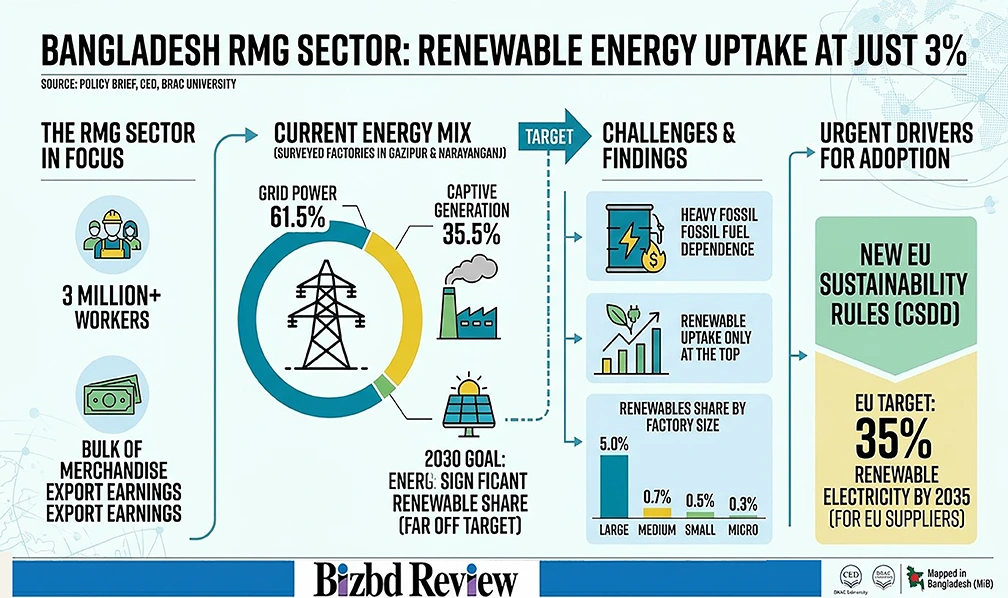
The BGMEA also emphasised the need to accelerate renewable energy adoption, proposing significant duty reductions on solar photovoltaic equipment—including panels, inverters, DC cables and battery energy storage systems—to as low as 1 per cent, from the current range of 28.73 per cent to 61.80 per cent.

Bangladesh garment output down up to 30pc amid energy crisis

Update Time : 06:14:10 am, Tuesday, 14 April 2026

Garment production and shipments in Bangladesh’s key industrial hubs have been severely disrupted by an ongoing energy crisis, with factory output falling sharply due to shortages of gas and electricity, industry leaders have said.

Factories in the Ashulia and Gazipur belts–two of the country’s largest readymade garment (RMG) clusters–are operating at 25 to 30 per cent below capacity as they struggle to secure adequate power supply, according to sector insiders.

The issue was raised at a high-level meeting on April 13 between leaders of the Bangladesh Garment Manufacturers and Exporters Association and officials from the Ministry of Power, Energy and Mineral Resources.

The industry body urged the government to ensure uninterrupted energy supply and extend support to overcome the ongoing crisis.

The BGMEA delegation, led by its president Mahmud Hasan Khan, met Power, Energy and Mineral Resources Minister Iqbal Hasan Mahmud and State Minister Anindya Islam Amit.

Energy Secretary Mohammad Saiful Islam and BGMEA vice-presidents Selim Rahman and Mizanur Rahman were also present.

According to the BGMEA, factories in Ashulia and Gazipur require between 400 and 450 litres of diesel on average to run generators during load-shedding of up to four hours.

In a recent assessment, 266 factories reported a combined daily requirement of approximately 264,174 litres of diesel under such conditions.

BGMEA president said the industry, which had begun to regain buyer confidence following the recent election, is again facing headwinds amid global uncertainty linked to tensions in the Middle East.

He warned that Bangladesh’s garment sector is in a fragile state due to energy shortages, particularly as competing countries maintain stronger energy security.

‘Production capacity has declined by 25-30 per cent as factories are not receiving the required gas and electricity,’ BGMEA president said, adding that shipments are being delayed due to insufficient diesel supplies to operate generators during outages.

Rising fuel and raw material costs, alongside higher transport expenses, have further increased production costs, placing additional pressure on manufacturers, he said.

Speaking separately, BGMEA vice-president Mizanur Rahman said factories are experiencing four to five hours of load-shedding during working hours, significantly disrupting operations.

Industry leaders have called for a series of urgent measures, including special arrangements to ensure timely diesel supply from filling stations.

The government has indicated it is considering introducing fuel cards to allow factories to access diesel from designated nearby outlets.

The BGMEA also proposed emergency gas connections for small and medium-sized factories, particularly those with boiler capacities between 300kg and 500kg, and called for equitable gas distribution across industrial zones in the outskirts of Dhaka.

Among longer-term measures, the association urged the rapid installation of at least two additional floating storage and regasification units (FSRUs) to boost liquefied natural gas supply, as well as the expansion of electronic volume corrector (EVC) metering in the industrial sector.

To ease cost pressures, the trade body recommended the withdrawal of taxes and value-added tax on imported fuel at both import and consumer levels, arguing this would reduce production costs and lessen the government’s subsidy burden.

The BGMEA also emphasised the need to accelerate renewable energy adoption, proposing significant duty reductions on solar photovoltaic equipment—including panels, inverters, DC cables and battery energy storage systems—to as low as 1 per cent, from the current range of 28.73 per cent to 61.80 per cent.