4:02 pm, Monday, 4 May 2026

Bangladesh exports dip by 2pc in July-April

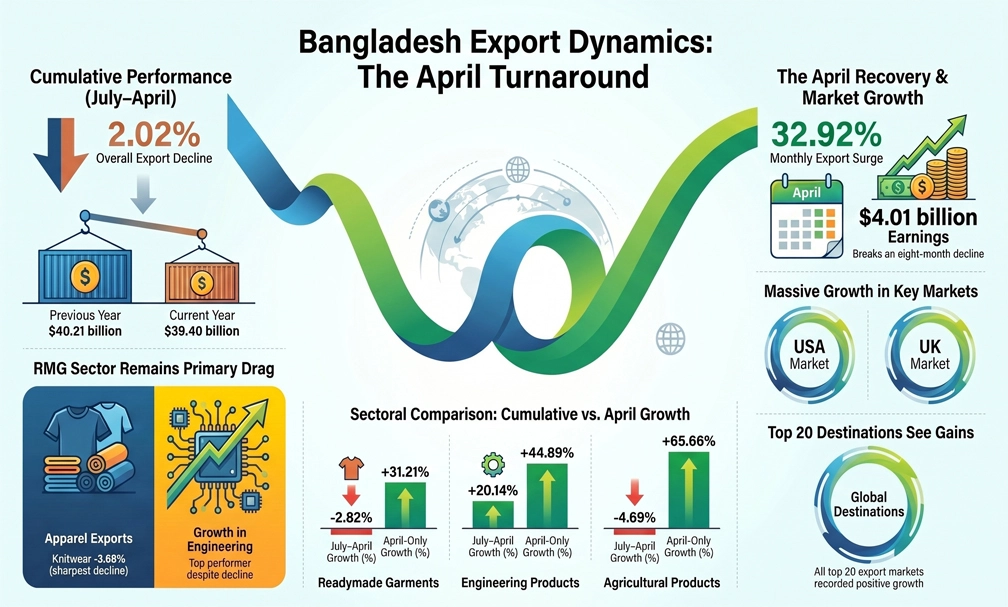
Bangladesh’s export earnings declined modestly in the first ten months (July-April) of the financial year 2025–26, although a sharp surge in April signalled a strong turnaround driven by recovering global demand and resilient sectoral performance.

Data released by the Export Promotion Bureau on April 3, showed that total merchandise exports stood at $39.40 billion during July–April FY2025–26, down 2.02 per cent from $40.21 billion in the same period of FY2024-26.

Despite the cumulative dip, the sector broke an eight-month streak of decline in April, with exports rising 32.92 per cent year-on-year to $4.01 billion from $3.02 billion.

The readymade garments (RMG) sector remained the primary drag on overall performance during the ten-month period.

Apparel exports fell by 2.82 per cent year-on-year to $31.72 billion, compared with $32.64 billion a year earlier.

Knitwear exports declined by 3.68 per cent to $16.81 billion, while woven garments dropped by 1.83 per cent to $14.90 billion.

However, the sector demonstrated strong resilience in April, with RMG exports surging 31.21 per cent year-on-year to $3.14 billion, up from $2.39 billion in April 2025.

Knitwear and woven garments recorded robust growth of 30.02 per cent and 32.65 per cent respectively during the month, indicating improved order flows and better shipment execution.

Beyond apparel, several sectors posted steady growth, helping to cushion the overall decline.

Home textile exports rose by 3.46 per cent to $766.08 million in the July–April period, with April shipments jumping by 48.61 per cent.

Leather and leather products expanded by 5.95 per cent to $988.06 million, driven by a 17.28 per cent increase in leather goods, while footwear exports grew modestly.

Engineering products emerged as a standout performer, registering a 20.14 per cent rise to $537.50 million, alongside strong monthly growth of 44.89 per cent in April.

Plastic products also recorded a 4.89 per cent increase to $258.31 million, with April exports surging by over 65 per cent.

Performance across traditional sectors remained mixed. Agricultural exports in July-April period declined by 4.69 per cent to $818.66 million, reflecting softer global demand, although April saw a strong rebound of 65.66 per cent.

Jute and jute goods rose by 2.52 per cent to $701.76 million in the forst eight months of the FY26, supported by a 43.58 per cent increase in April exports.

Specialised textiles edged down by 1.83 per cent to $320.52 million in July-April period, but recorded more than 50 per cent growth in April.

In the fisheries segment, frozen and live fish exports increased by 2.73 per cent to $382.88 million, while shrimp exports remained subdued, declining marginally over the period and posting a sharp fall of 22.61 per cent in April.

Export destinations also showed encouraging signs, with key markets registering strong growth.

Shipments to the United States increased by 43.01 per cent year-on-year, while exports to the United Kingdom rose by 23.46 per cent.

Notably, all of Bangladesh’s top 20 export destinations recorded positive growth, reflecting broad-based recovery in demand and improved market diversification.

Bangladesh exports dip by 2pc in July-April

Update Time : 06:28:53 pm, Sunday, 3 May 2026

Bangladesh’s export earnings declined modestly in the first ten months (July-April) of the financial year 2025–26, although a sharp surge in April signalled a strong turnaround driven by recovering global demand and resilient sectoral performance.

Data released by the Export Promotion Bureau on April 3, showed that total merchandise exports stood at $39.40 billion during July–April FY2025–26, down 2.02 per cent from $40.21 billion in the same period of FY2024-26.

Despite the cumulative dip, the sector broke an eight-month streak of decline in April, with exports rising 32.92 per cent year-on-year to $4.01 billion from $3.02 billion.

The readymade garments (RMG) sector remained the primary drag on overall performance during the ten-month period.

Apparel exports fell by 2.82 per cent year-on-year to $31.72 billion, compared with $32.64 billion a year earlier.

Knitwear exports declined by 3.68 per cent to $16.81 billion, while woven garments dropped by 1.83 per cent to $14.90 billion.

However, the sector demonstrated strong resilience in April, with RMG exports surging 31.21 per cent year-on-year to $3.14 billion, up from $2.39 billion in April 2025.

Knitwear and woven garments recorded robust growth of 30.02 per cent and 32.65 per cent respectively during the month, indicating improved order flows and better shipment execution.

Beyond apparel, several sectors posted steady growth, helping to cushion the overall decline.

Home textile exports rose by 3.46 per cent to $766.08 million in the July–April period, with April shipments jumping by 48.61 per cent.

Leather and leather products expanded by 5.95 per cent to $988.06 million, driven by a 17.28 per cent increase in leather goods, while footwear exports grew modestly.

Engineering products emerged as a standout performer, registering a 20.14 per cent rise to $537.50 million, alongside strong monthly growth of 44.89 per cent in April.

Plastic products also recorded a 4.89 per cent increase to $258.31 million, with April exports surging by over 65 per cent.

Performance across traditional sectors remained mixed. Agricultural exports in July-April period declined by 4.69 per cent to $818.66 million, reflecting softer global demand, although April saw a strong rebound of 65.66 per cent.

Jute and jute goods rose by 2.52 per cent to $701.76 million in the forst eight months of the FY26, supported by a 43.58 per cent increase in April exports.

Specialised textiles edged down by 1.83 per cent to $320.52 million in July-April period, but recorded more than 50 per cent growth in April.

In the fisheries segment, frozen and live fish exports increased by 2.73 per cent to $382.88 million, while shrimp exports remained subdued, declining marginally over the period and posting a sharp fall of 22.61 per cent in April.

Export destinations also showed encouraging signs, with key markets registering strong growth.

Shipments to the United States increased by 43.01 per cent year-on-year, while exports to the United Kingdom rose by 23.46 per cent.

Notably, all of Bangladesh’s top 20 export destinations recorded positive growth, reflecting broad-based recovery in demand and improved market diversification.