9:56 pm, Friday, 22 May 2026

Nearly one in 10 factories still owe April wages before eid

Nearly 10 per cent of units in eight industrial zones have yet to disburse April wages, with authorities warning of potential labour unrest during the holiday period

Authorities in Bangladesh have raised the alarm over delayed wage payments in hundreds of factories ahead of Eid-ul-Azha, as concerns grow that the failure to clear April salaries and festival allowances in time could ignite labour unrest across the country’s critical industrial zones.

Labour Minister Ariful Haque Chowdhury on May 14 directed all factory owners to pay festival allowances by May 21 and ensure timely disbursement of monthly wages in line with labour law.

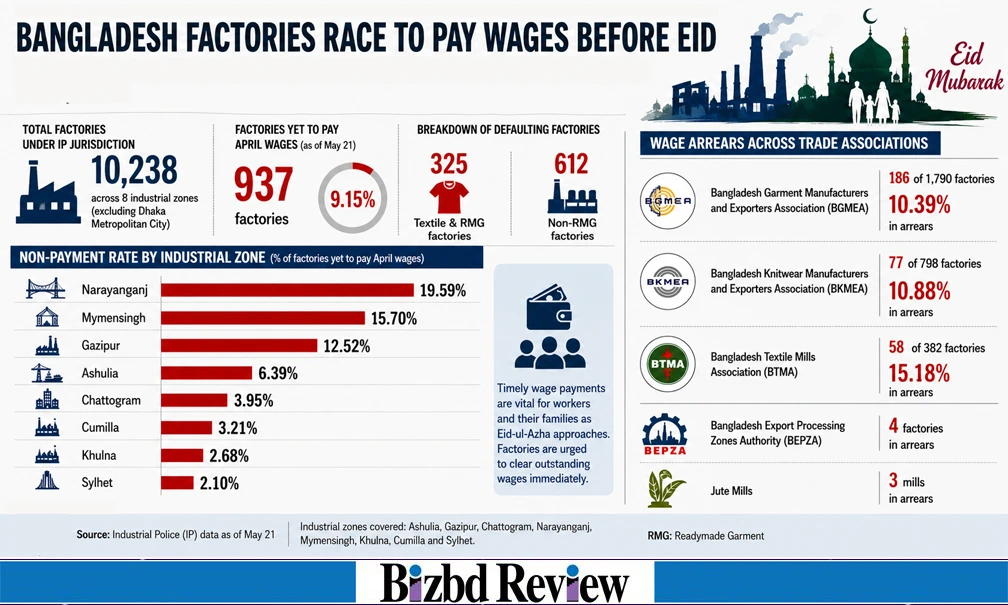
Industrial Police data show that 937 factories–representing 9.15 per cent of the 10,238 units operating under the agency’s jurisdiction across eight industrial zones–had still not paid workers their April wages as of May 21.

The affected zones span Ashulia, Gazipur, Chattogram, Narayanganj, Mymensingh, Khulna, Cumilla and Sylhet, excluding Dhaka Metropolitan City.

Of the defaulting factories, 325 are textile and readymade garment (RMG) units, with the remaining 612 classified as non-RMG operations.

The non-payment rate is highest in Narayanganj, where 19.59 per cent of factories have yet to settle April wages, followed by Mymensingh at 15.70 per cent, Gazipur at 12.52 per cent and Ashulia at 6.39 per cent.

Across the country’s principal trade associations, the picture is similarly troubling.

More than 10 per cent–some 186 factories–of the 1,790 units listed with the Bangladesh Garment Manufacturers and Exporters Association (BGMEA) are in arrears.

Within the Bangladesh Knitwear Manufacturers and Exporters Association (BKMEA), 77 of 708 registered factories, or 10.88 per cent, have failed to pay.

Fifty-eight member mills under the Bangladesh Textile Mills Association (BTMA), out of a total of 382, are also in default.

Four factories under the Bangladesh Export Processing Zones Authority (BEPZA) and three jute mills had not released April wages by May 21, according to IP data.

At a high-level meeting convened on May 20 with major trade bodies, including BGMEA, BKMEA, BTMA and BEPZA, Additional Inspector General of Industrial Police Gazi Jasim urged factory owners to clear all outstanding wages and Eid bonuses before the holiday period begins.

‘Some factories may fail to pay wages and festival allowances ahead of Eid,’ Jasim warned, calling on owners of at-risk units to hold urgent consultations with industry leaders and government agencies to ensure timely disbursements.

He also appealed to factory owners not to lay off workers in the lead-up to the holiday–a period when job losses carry heightened financial and social consequences for millions of working families.

Jasim further directed Industrial Police unit commanders to take all necessary steps to prevent workers from blocking roads and highways in protest over unpaid wages and bonuses, while ensuring strict adherence to government directives on the matter.

Trade body representatives at the meeting offered their own assessments of the crisis.

BGMEA Vice-President Rezwan Selim called on the government to intensify monitoring of subcontracting factories, a segment widely seen as more vulnerable to wage compliance failures,  and pledged that the association would also step up its own supervision of such units.

BKMEA Director Md Belayet Hossain Ripon struck a more contentious note, alleging that smooth factory operations were being undermined by vested quarters among certain labour leaders.

He also requested stronger police patrols across industrial areas during night hours.

Bangladesh’s garment and textile industries are the backbone of its export economy, accounting for the overwhelming majority of the country’s foreign exchange earnings.

The sector employs millions of workers, a large proportion of them women, who depend heavily on timely wages– and especially on festival allowances–to meet essential costs during major religious holidays.

With Eid-ul-Azha approaching, the stakes are high. Labour leaders have previously warned that any failure to meet wage obligations in the pre-Eid period risks triggering protests and work stoppages that could disrupt production and damage Bangladesh’s standing with international buyers.

Authorities are pressing to resolve the backlog before the holiday window closes.
Nearly one in 10 factories still owe April wages before eid

Update Time : 10:30:13 am, Friday, 22 May 2026
Nearly 10 per cent of units in eight industrial zones have yet to disburse April wages, with authorities warning of potential labour unrest during the holiday period

Authorities in Bangladesh have raised the alarm over delayed wage payments in hundreds of factories ahead of Eid-ul-Azha, as concerns grow that the failure to clear April salaries and festival allowances in time could ignite labour unrest across the country’s critical industrial zones.

Labour Minister Ariful Haque Chowdhury on May 14 directed all factory owners to pay festival allowances by May 21 and ensure timely disbursement of monthly wages in line with labour law.

Industrial Police data show that 937 factories–representing 9.15 per cent of the 10,238 units operating under the agency’s jurisdiction across eight industrial zones–had still not paid workers their April wages as of May 21.

The affected zones span Ashulia, Gazipur, Chattogram, Narayanganj, Mymensingh, Khulna, Cumilla and Sylhet, excluding Dhaka Metropolitan City.

Of the defaulting factories, 325 are textile and readymade garment (RMG) units, with the remaining 612 classified as non-RMG operations.

The non-payment rate is highest in Narayanganj, where 19.59 per cent of factories have yet to settle April wages, followed by Mymensingh at 15.70 per cent, Gazipur at 12.52 per cent and Ashulia at 6.39 per cent.

Across the country’s principal trade associations, the picture is similarly troubling.

More than 10 per cent–some 186 factories–of the 1,790 units listed with the Bangladesh Garment Manufacturers and Exporters Association (BGMEA) are in arrears.

Within the Bangladesh Knitwear Manufacturers and Exporters Association (BKMEA), 77 of 708 registered factories, or 10.88 per cent, have failed to pay.

Fifty-eight member mills under the Bangladesh Textile Mills Association (BTMA), out of a total of 382, are also in default.

Four factories under the Bangladesh Export Processing Zones Authority (BEPZA) and three jute mills had not released April wages by May 21, according to IP data.

At a high-level meeting convened on May 20 with major trade bodies, including BGMEA, BKMEA, BTMA and BEPZA, Additional Inspector General of Industrial Police Gazi Jasim urged factory owners to clear all outstanding wages and Eid bonuses before the holiday period begins.

‘Some factories may fail to pay wages and festival allowances ahead of Eid,’ Jasim warned, calling on owners of at-risk units to hold urgent consultations with industry leaders and government agencies to ensure timely disbursements.

He also appealed to factory owners not to lay off workers in the lead-up to the holiday–a period when job losses carry heightened financial and social consequences for millions of working families.

Jasim further directed Industrial Police unit commanders to take all necessary steps to prevent workers from blocking roads and highways in protest over unpaid wages and bonuses, while ensuring strict adherence to government directives on the matter.

Trade body representatives at the meeting offered their own assessments of the crisis.

BGMEA Vice-President Rezwan Selim called on the government to intensify monitoring of subcontracting factories, a segment widely seen as more vulnerable to wage compliance failures,  and pledged that the association would also step up its own supervision of such units.

BKMEA Director Md Belayet Hossain Ripon struck a more contentious note, alleging that smooth factory operations were being undermined by vested quarters among certain labour leaders.

He also requested stronger police patrols across industrial areas during night hours.

Bangladesh’s garment and textile industries are the backbone of its export economy, accounting for the overwhelming majority of the country’s foreign exchange earnings.

The sector employs millions of workers, a large proportion of them women, who depend heavily on timely wages– and especially on festival allowances–to meet essential costs during major religious holidays.

With Eid-ul-Azha approaching, the stakes are high. Labour leaders have previously warned that any failure to meet wage obligations in the pre-Eid period risks triggering protests and work stoppages that could disrupt production and damage Bangladesh’s standing with international buyers.

Authorities are pressing to resolve the backlog before the holiday window closes.