12:13 am, Monday, 25 May 2026

Global brands pay Bangladesh half the T-shirt price of 25 years ago

Major apparel brands continue to drive down sourcing prices in Bangladesh even as they tout human rights commitments, with the real value of a cotton T-shirt now half what it was 25 years ago

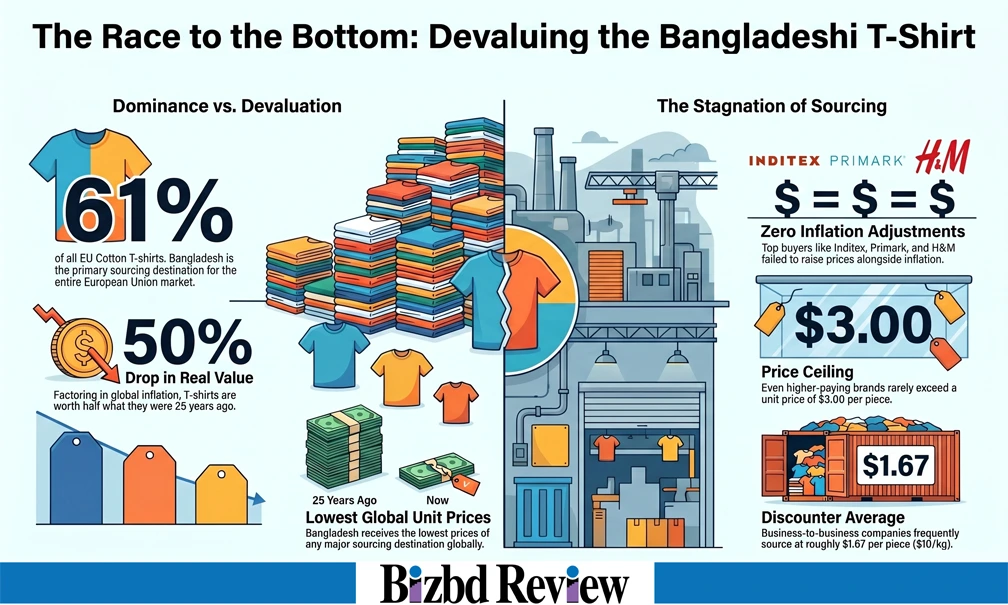
Global apparel brands are sourcing the largest volumes of cotton T-shirts from Bangladesh for the European Union market whilst paying the lowest prices, keeping manufacturing costs at unsustainably low levels that fail to account for inflation, according to a new study published on May 21.

The research, conducted jointly by human rights NGO Public Eye and the Clean Clothes Campaign, found that once global inflation is factored in, brands are effectively purchasing cotton T-shirts at half their value from 25 years ago.

Bangladesh now accounts for 61 per cent of all cotton T-shirts imported into the EU, a figure that underlines the country’s central role in global fashion supply chains.

Yet despite this dominance, it receives the lowest unit prices of any major sourcing destination.

The average EU import price for a cotton T-shirt in 2025 stood at $ 2.67 (EUR 2.36).

For garments sourced specifically from Bangladesh, that figure fell further still, to $ 2.06 (EUR 1.83).

Many buyers, the study noted, procure standard cotton T-shirts at between $ 2.0 and $ 3.0 per piece, with unit prices below $ 1.0 persisting in some segments of the market.

Drawing on trade data and interviews with suppliers and merchandisers, the report revealed that brands typically entered negotiations with fixed target prices already determined.

It said that, given the highly competitive market environment, factories that refused those terms were quickly replaced by those willing to accept them, leaving suppliers with little meaningful leverage.

The report further argued that the consequence was that factories were compelled to take orders that did not reflect the true cost of responsible production.

It said that since suppliers had minimal control over material or energy costs, labour conditions were invariably the first to suffer, manifesting in reduced spending on workplace safety or the imposition of forced overtime at poverty-level wages.

‘Margins for basic items are razor thin or even non-existent. Producers frequently still take such orders simply to keep the production running and ensure they can pay workers’ salaries,’ the report stated.

An examination of the six highest-volume buyers of cotton T-shirts from Bangladesh over the past five years, including Inditex (Zara), Primark and H&M, has found that not one had raised its sourcing prices in line with global inflation.

Even among comparatively higher-paying brands, it found that sourcing prices from Bangladesh rarely exceeded $18 per kilogram (approximately $3.0 per piece).

It revealed that discounters and business-to-business companies frequently sourced at $10 per kilogram or below.

‘Relentlessly low sourcing prices are the organising principle of today’s garment industry, shaping sourcing geographies, buyer behaviour and structurally locking in poverty wages. A transition towards a just and sustainable fashion system based on two-dollar shirts and other dirt-cheap clothing is impossible, full stop,’ said David Hachfeld of Public Eye, one of the report’s authors.

The report called for a fundamental overhaul of the garment pricing system, shifting from the existing top-down, cost-cutting model to a bottom-up, cost-covering framework in which living wages and decent working conditions were treated as non-negotiable prerequisites rather than aspirational targets.

It further stressed that, given brands were unlikely to act of their own accord, policy intervention would be necessary to bring about such a shift.

‘The fashion brands which brag about human rights policies actively contribute to the continuation of poverty wages by their downward pricing policy. Higher prices are needed for living wages, safe workplaces, and sustainable production,’ Bangladesh Garment and Industrial Workers Federation president Kalpona Akter, said.

Bangladesh Knitwear Manufacturers and Exporters Association (BKMEA) president Mohammad Hatem confirmed that Bangladeshi manufacturers consistently received the lowest prices.

He alleged that buyers offered higher rates for identical products manufactured in other countries such as Vietnam, describing the disparity as a clear ‘double standard.’

The BKMEA president said that buyers frequently demanded extensive compliance measures and were fully aware of the true cost of production, yet consistently pushed for the lowest possible rates– a practice he attributed to a lack of ethical standards on the part of purchasing brands.

‘For low product prices, factories face a number of problems including non-payment of timely wages, which might result in the closure of units,’ Hatem said, adding that many manufacturers accept such orders simply to stay operational.
Global brands pay Bangladesh half the T-shirt price of 25 years ago

Update Time : 01:02:37 pm, Sunday, 24 May 2026
Major apparel brands continue to drive down sourcing prices in Bangladesh even as they tout human rights commitments, with the real value of a cotton T-shirt now half what it was 25 years ago

Global apparel brands are sourcing the largest volumes of cotton T-shirts from Bangladesh for the European Union market whilst paying the lowest prices, keeping manufacturing costs at unsustainably low levels that fail to account for inflation, according to a new study published on May 21.

The research, conducted jointly by human rights NGO Public Eye and the Clean Clothes Campaign, found that once global inflation is factored in, brands are effectively purchasing cotton T-shirts at half their value from 25 years ago.

Bangladesh now accounts for 61 per cent of all cotton T-shirts imported into the EU, a figure that underlines the country’s central role in global fashion supply chains.

Yet despite this dominance, it receives the lowest unit prices of any major sourcing destination.

The average EU import price for a cotton T-shirt in 2025 stood at $ 2.67 (EUR 2.36).

For garments sourced specifically from Bangladesh, that figure fell further still, to $ 2.06 (EUR 1.83).

Many buyers, the study noted, procure standard cotton T-shirts at between $ 2.0 and $ 3.0 per piece, with unit prices below $ 1.0 persisting in some segments of the market.

Drawing on trade data and interviews with suppliers and merchandisers, the report revealed that brands typically entered negotiations with fixed target prices already determined.

It said that, given the highly competitive market environment, factories that refused those terms were quickly replaced by those willing to accept them, leaving suppliers with little meaningful leverage.

The report further argued that the consequence was that factories were compelled to take orders that did not reflect the true cost of responsible production.

It said that since suppliers had minimal control over material or energy costs, labour conditions were invariably the first to suffer, manifesting in reduced spending on workplace safety or the imposition of forced overtime at poverty-level wages.

‘Margins for basic items are razor thin or even non-existent. Producers frequently still take such orders simply to keep the production running and ensure they can pay workers’ salaries,’ the report stated.

An examination of the six highest-volume buyers of cotton T-shirts from Bangladesh over the past five years, including Inditex (Zara), Primark and H&M, has found that not one had raised its sourcing prices in line with global inflation.

Even among comparatively higher-paying brands, it found that sourcing prices from Bangladesh rarely exceeded $18 per kilogram (approximately $3.0 per piece).

It revealed that discounters and business-to-business companies frequently sourced at $10 per kilogram or below.

‘Relentlessly low sourcing prices are the organising principle of today’s garment industry, shaping sourcing geographies, buyer behaviour and structurally locking in poverty wages. A transition towards a just and sustainable fashion system based on two-dollar shirts and other dirt-cheap clothing is impossible, full stop,’ said David Hachfeld of Public Eye, one of the report’s authors.

The report called for a fundamental overhaul of the garment pricing system, shifting from the existing top-down, cost-cutting model to a bottom-up, cost-covering framework in which living wages and decent working conditions were treated as non-negotiable prerequisites rather than aspirational targets.

It further stressed that, given brands were unlikely to act of their own accord, policy intervention would be necessary to bring about such a shift.

‘The fashion brands which brag about human rights policies actively contribute to the continuation of poverty wages by their downward pricing policy. Higher prices are needed for living wages, safe workplaces, and sustainable production,’ Bangladesh Garment and Industrial Workers Federation president Kalpona Akter, said.

Bangladesh Knitwear Manufacturers and Exporters Association (BKMEA) president Mohammad Hatem confirmed that Bangladeshi manufacturers consistently received the lowest prices.

He alleged that buyers offered higher rates for identical products manufactured in other countries such as Vietnam, describing the disparity as a clear ‘double standard.’

The BKMEA president said that buyers frequently demanded extensive compliance measures and were fully aware of the true cost of production, yet consistently pushed for the lowest possible rates– a practice he attributed to a lack of ethical standards on the part of purchasing brands.

‘For low product prices, factories face a number of problems including non-payment of timely wages, which might result in the closure of units,’ Hatem said, adding that many manufacturers accept such orders simply to stay operational.