3:35 pm, Wednesday, 13 May 2026
ILO REPORT

Deteriorating working conditions, falling wages threaten press freedom

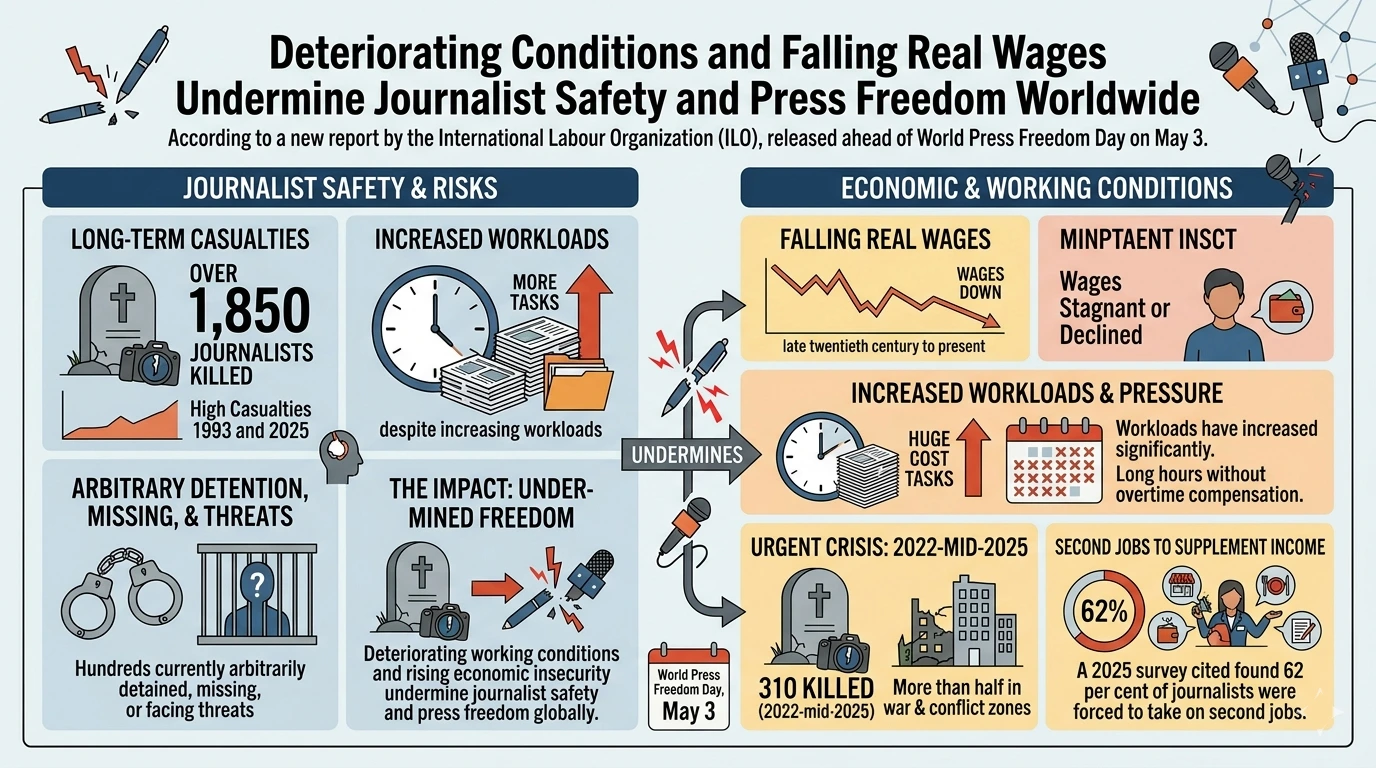
Journalists and media workers across the world continue to face killings, violence, harassment and growing legal threats, while their wages have either declined or remained stagnant despite increasing workloads, according to a new report by the International Labour Organization.

The report warned that deteriorating working conditions and rising economic insecurity were undermining both journalist safety and press freedom globally.

It said hundreds of journalists are currently detained, missing or under threat, while most killings of media workers remain unresolved.

The study also highlighted the growing risks of online abuse, gender-based violence and psychological trauma faced by journalists in an increasingly hostile working environment.

According to the ILO, more than 1,850 journalists have been killed since 1993, while hundreds more are currently arbitrarily detained, missing or facing threats.

Between 2022 and mid-2025 alone, 310 journalists were killed, with more than half of the victims covering wars and conflict zones.

The study said that 87 per cent of journalist killings worldwide remained unresolved, creating a ‘culture of impunity’ that encouraged further violence and fuelled self-censorship among media professionals.

The report, released ahead of World Press Freedom Day on May 3, examined the labour rights dimension of protecting journalists and media workers and argued that journalist safety depended not only on freedom of expression but also on access to fundamental labour protections, including collective bargaining rights, workplace safety, social protection and safeguards against discrimination.

‘Journalists are key defenders of human and labour rights. They are also workers, and labour rights offer an important tool for protecting journalists at work.’ ,’ said Frank Hagemann, director of sectoral policies at the ILO.

The ILO is part of the United Nations Plan of Action on the Safety of Journalists and the Issue of Impunity, adopted by the UN System Chief Executives Board for Coordination in 2012.

The report painted a bleak picture of the conditions facing journalists globally, identifying a wide range of interconnected threats, including physical violence, legal intimidation, online abuse, economic hardship and psychological trauma.

It said governments in many countries were increasingly using ‘fake news’ laws, cybercrime legislation and ‘foreign agent’ rules to suppress dissent and restrict media freedom.

The report also highlighted the growing use of Strategic Lawsuits Against Public Participation, or SLAPPs, which burdened journalists with costly legal proceedings intended to silence critical reporting.

According to the report, defamation remained a criminal offence in at least 160 countries, with some cases carrying punishments involving forced or compulsory labour, practices the ILO said violated international labour standards.

The study also warned of rising digital threats, saying journalists were increasingly facing coordinated online harassment campaigns, doxing, surveillance and hacking, while artificial intelligence technologies were making it easier to create deepfakes and conduct targeted abuse.

According to the report, women working in media were 3.5 times more likely to experienced sexual harassment than their male counterparts, while online attacks against women journalists were increasingly linked to offline physical violence.

The report also pointed to continuing gender pay inequality in the profession.

Economic precarity emerged as another major concern. The ILO said the media industry’s changing business model has resulted in increasing reliance on freelance and contract workers who often lack legal protections, social security coverage and union representation.

Real wages for journalists have either declined or remained stagnant since the late twentieth century, even as workloads have increased significantly.

A 2025 survey cited in the report found that 62 per cent of journalists were forced to take on second jobs to supplement their income.

The pressure to break news quickly has also led to journalists working long hours without overtime compensation, while many freelancers remain excluded from health insurance, unemployment benefits and pension schemes.

The report identified five key categories of fundamental labour principles applicable to journalists regardless of their employment status, including freedom of association and collective bargaining, elimination of forced labour, elimination of discrimination, safe and healthy working environments, and abolition of child labour.

It emphasised that journalists had the right to form and join unions to negotiate wages, working conditions, training opportunities and safety protections without fear of retaliation or blacklisting.

The report also noted that occupational safety and health standards, recognised by the ILO in 2022 as a fundamental principle and right at work, required employers to provide adequate protective equipment and information on workplace risks.

It stressed that journalists must have the right to refuse dangerous assignments without facing penalties.

Psychological trauma was identified as another major challenge in the profession. The report estimated that between 80 and 100 per cent of journalists have experienced work-related traumatic events during their careers.

Around 60 per cent reported suffering from burnout, while many face post-traumatic stress disorder and anxiety.

Freelancers were found to be especially vulnerable because they often lack institutional support systems and access to mental health services available in larger media organisations.

The ILO outlined a three-pronged strategy centred on prevention, protection and prosecution to improve journalist safety globally.

Preventive measures include legislative reforms, hostile environment and first aid training, and stronger social dialogue between governments, unions and employers.

The report cited examples from countries including the United Kingdom and Somalia, where cooperation between unions and authorities helped develop national action plans for journalist safety.

The report concluded that protecting journalists requires coordinated action from governments, media employers and workers’ organisations. It said international labour standards provide an important framework for addressing the physical, psychological and economic risks threatening independent journalism and public access to information worldwide.
ILO REPORT

Deteriorating working conditions, falling wages threaten press freedom

Update Time : 11:06:32 pm, Friday, 8 May 2026

Journalists and media workers across the world continue to face killings, violence, harassment and growing legal threats, while their wages have either declined or remained stagnant despite increasing workloads, according to a new report by the International Labour Organization.

The report warned that deteriorating working conditions and rising economic insecurity were undermining both journalist safety and press freedom globally.

It said hundreds of journalists are currently detained, missing or under threat, while most killings of media workers remain unresolved.

The study also highlighted the growing risks of online abuse, gender-based violence and psychological trauma faced by journalists in an increasingly hostile working environment.

According to the ILO, more than 1,850 journalists have been killed since 1993, while hundreds more are currently arbitrarily detained, missing or facing threats.

Between 2022 and mid-2025 alone, 310 journalists were killed, with more than half of the victims covering wars and conflict zones.

The study said that 87 per cent of journalist killings worldwide remained unresolved, creating a ‘culture of impunity’ that encouraged further violence and fuelled self-censorship among media professionals.

The report, released ahead of World Press Freedom Day on May 3, examined the labour rights dimension of protecting journalists and media workers and argued that journalist safety depended not only on freedom of expression but also on access to fundamental labour protections, including collective bargaining rights, workplace safety, social protection and safeguards against discrimination.

‘Journalists are key defenders of human and labour rights. They are also workers, and labour rights offer an important tool for protecting journalists at work.’ ,’ said Frank Hagemann, director of sectoral policies at the ILO.

The ILO is part of the United Nations Plan of Action on the Safety of Journalists and the Issue of Impunity, adopted by the UN System Chief Executives Board for Coordination in 2012.

The report painted a bleak picture of the conditions facing journalists globally, identifying a wide range of interconnected threats, including physical violence, legal intimidation, online abuse, economic hardship and psychological trauma.

It said governments in many countries were increasingly using ‘fake news’ laws, cybercrime legislation and ‘foreign agent’ rules to suppress dissent and restrict media freedom.

The report also highlighted the growing use of Strategic Lawsuits Against Public Participation, or SLAPPs, which burdened journalists with costly legal proceedings intended to silence critical reporting.

According to the report, defamation remained a criminal offence in at least 160 countries, with some cases carrying punishments involving forced or compulsory labour, practices the ILO said violated international labour standards.

The study also warned of rising digital threats, saying journalists were increasingly facing coordinated online harassment campaigns, doxing, surveillance and hacking, while artificial intelligence technologies were making it easier to create deepfakes and conduct targeted abuse.

According to the report, women working in media were 3.5 times more likely to experienced sexual harassment than their male counterparts, while online attacks against women journalists were increasingly linked to offline physical violence.

The report also pointed to continuing gender pay inequality in the profession.

Economic precarity emerged as another major concern. The ILO said the media industry’s changing business model has resulted in increasing reliance on freelance and contract workers who often lack legal protections, social security coverage and union representation.

Real wages for journalists have either declined or remained stagnant since the late twentieth century, even as workloads have increased significantly.

A 2025 survey cited in the report found that 62 per cent of journalists were forced to take on second jobs to supplement their income.

The pressure to break news quickly has also led to journalists working long hours without overtime compensation, while many freelancers remain excluded from health insurance, unemployment benefits and pension schemes.

The report identified five key categories of fundamental labour principles applicable to journalists regardless of their employment status, including freedom of association and collective bargaining, elimination of forced labour, elimination of discrimination, safe and healthy working environments, and abolition of child labour.

It emphasised that journalists had the right to form and join unions to negotiate wages, working conditions, training opportunities and safety protections without fear of retaliation or blacklisting.

The report also noted that occupational safety and health standards, recognised by the ILO in 2022 as a fundamental principle and right at work, required employers to provide adequate protective equipment and information on workplace risks.

It stressed that journalists must have the right to refuse dangerous assignments without facing penalties.

Psychological trauma was identified as another major challenge in the profession. The report estimated that between 80 and 100 per cent of journalists have experienced work-related traumatic events during their careers.

Around 60 per cent reported suffering from burnout, while many face post-traumatic stress disorder and anxiety.

Freelancers were found to be especially vulnerable because they often lack institutional support systems and access to mental health services available in larger media organisations.

The ILO outlined a three-pronged strategy centred on prevention, protection and prosecution to improve journalist safety globally.

Preventive measures include legislative reforms, hostile environment and first aid training, and stronger social dialogue between governments, unions and employers.

The report cited examples from countries including the United Kingdom and Somalia, where cooperation between unions and authorities helped develop national action plans for journalist safety.

The report concluded that protecting journalists requires coordinated action from governments, media employers and workers’ organisations. It said international labour standards provide an important framework for addressing the physical, psychological and economic risks threatening independent journalism and public access to information worldwide.