Bizbd Reporrt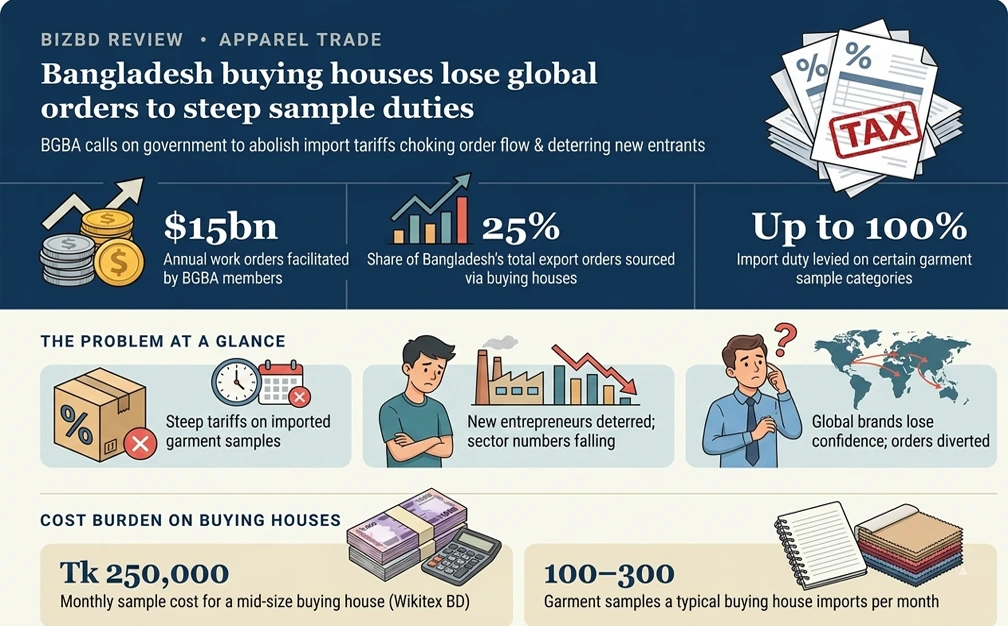
Excessive duties on clothing prototypes are deterring international brands from placing orders through local intermediaries, imposing crippling costs and eroding buyers’ trust, industry representatives say
Steep import tariffs on garment samples are preventing buying houses from securing work orders from global apparel brands, placing a significant financial strain on the sector and undermining the confidence of overseas buyers, according to industry representatives.
The Bangladesh Garment Buying House Association (BGBA) has called on the government to abolish the import duty, arguing that the levy is holding back sector growth, discouraging new entrants to the trade, and making it harder for local intermediaries to win orders from international clothing brands.
Garment samples are physical or digital prototypes of clothing used during apparel production to verify fit, design, and quality. They serve as the critical link between initial design concepts and full-scale manufacturing, ensuring the finished product meets agreed specifications.
The BGBA has also put forward a proposal to issue passbooks to its members, similar to those already afforded to members of the Bangladesh Garment Manufacturers and Exporters Association (BGMEA) and the Bangladesh Knitwear Manufacturers and Exporters Association (BKMEA), enabling them to bring in sample garments free of duty.
In a recent pre-budget submission to the National Board of Revenue, BGBA president Abdul Hamid noted that the association has long played a vital role in opening up foreign markets for domestically produced ready-made garments and other goods.
BGBA members collectively help to generate roughly 25 per cent — or approximately US$15 billion — of the country’s export work orders by attracting international buyers and securing purchase orders for garments manufactured in Bangladeshi factories and exported overseas.
‘A wide range of high duties on samples is creating serious obstacles in obtaining purchase orders from foreign buyers — and this is a particularly acute burden for new entrepreneurs.’
Mr Hamid explained that a typical buying house works with between five and ten buyers, importing at least 100 to 300 ready-made garment samples each month depending on requirements and the season.
However, he warned that the broad scope and high level of import tariffs — reaching as much as 100 per cent on certain items — are creating serious barriers to winning orders from abroad, with the costs proving especially prohibitive for newer businesses.
AKM Saifur Rahman, vice president of the BGBA, said that because of the high duties and the costs associated with releasing samples from customs, fresh entrants are being deterred from joining the trade — and the number of active buying houses is in fact declining, despite considerable commercial opportunities remaining in the sector.
Mr Rahman, who is also managing director of Wikitex BD, said his company spends approximately Tk 250,000 per month on samples alone — an outlay that many smaller houses simply cannot sustain.
He noted that buying houses typically receive samples at their registered business addresses as part of their standard commercial operations.
He confirmed that BGBA has around 2,000 registered members who, he argued, could be issued passbooks along the lines of those given to BGMEA members, allowing them to import garment samples duty-free for the purpose of securing purchase orders.
Mr Rahman further suggested the government could impose an annual ceiling — either by value or by volume — permitting each buying house to import between 350 and 400 garment samples per year without attracting customs duty.
He proposed that the Ministry of Textiles and Jute could rigorously oversee the arrangement to guard against abuse, or alternatively that permitted samples be rendered unsaleable — for instance through deliberate damage — so that they cannot enter the domestic retail market.