3:35 pm, Wednesday, 13 May 2026

Bangladesh high-tariff regime pushes $20bn annual cost on consumers

Bangladesh’s trade policy is imposing a heavy hidden cost on consumers while distorting incentives across the economy, with economists warning of an entrenched anti-export bias, excessively high tariffs and an annual consumer burden estimated at more than $20 billion.

The concerns were raised at a roundtable organised by the Policy Research Institute of Bangladesh (PRI) titled ‘Trade Policy, Industrial Protection, Investment Impacts, and Consumer Welfare’, held at the PRI office in Dhaka on May 11.

Presenting the keynote, PRI Chairman Dr Zaidi Sattar warned that Bangladesh’s trade policy framework has become a ‘hotchpotch’ of conflicting objectives, creating a significant ‘protection tax’ that was ultimately borne by consumers through higher prices across a wide range of goods while constraining broader economic growth.

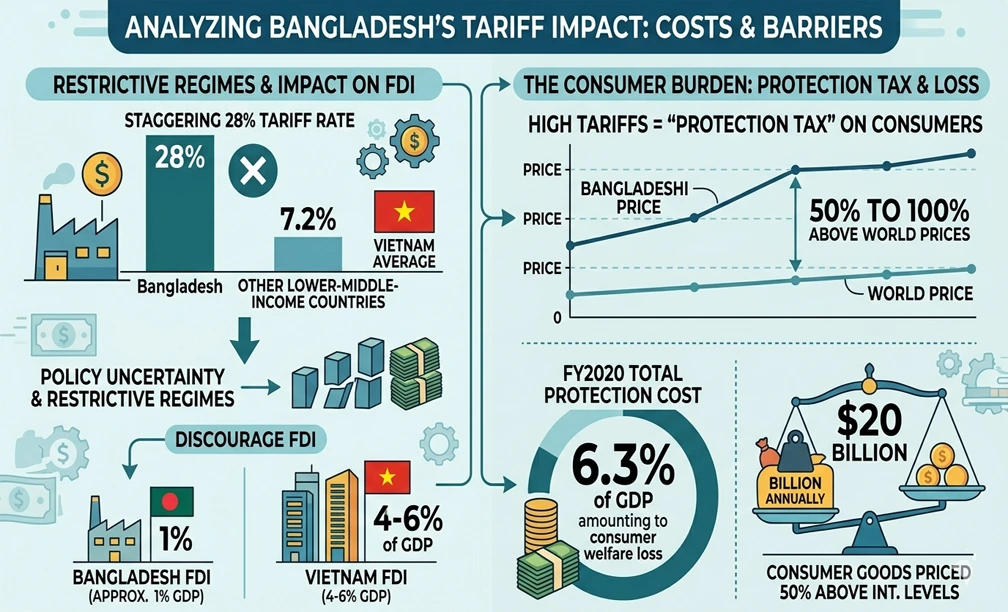
He estimated that import protection pushed domestic prices 50 to 100 per cent above global levels, resulting in an annual consumer welfare loss of more than $20 billio–equivalent to over 5 per cent of GDP.

‘Consumers are the biggest stakeholders in trade policy, yet they remain the most ignored,’ Dr Sattar said, adding that protection effectively transfers income from households to producers.

Dr Sattar highlighted that Bangladesh’s average tariff rate stands at around 28 per cent, nearly four times higher than the average for other lower-middle-income countries.

When para-tariffs such as Supplementary Duties and Regulatory Duties are included, the effective protection rises further.

He described the system as increasingly complex, with para-tariffs now accounting for nearly half of total nominal protection, offsetting decades of gradual tariff liberalisation.

‘This is not a simple tariff structure; it is a layered system that has become increasingly opaque and distortionary,’ he noted.

The PRI report also identified a persistent anti-export bias, where high protection on domestic industries made local sales more profitable than exporting.

Dr Sattar said this has contributed to stagnation in non-garment exports and reinforced dependence on the ready-made garment sector, which operates under a relatively liberal import regime.

‘This is trade policy dualism—an open export enclave alongside a highly protected domestic economy,’ he said.

Chowdhury Ashik Mahmud Bin Harun, Executive Chairman of the Bangladesh Investment Development Authority (BIDA), warned that protectionism cannot be sustained as Bangladesh prepares for graduation from Least Developed Country (LDC) status.

‘We have to accept that protectionism cannot continue forever,’ he said. ‘Our goal should be to build industries that can stand on their own in a competitive global environment.’

He also stressed the need to resolve energy constraints, improve governance, and strengthen institutional accountability to support long-term investment.

Consumers Association of Bangladesh President A H M Shafiquzzaman said the current system disproportionately burdens consumers and called for rationalisation of tariffs on essential goods.

He also emphasised the importance of energy security and institutional coordination to attract foreign direct investment.

Dhaka Chamber of Commerce & Industry President Taskeen Ahmed criticised weak policy coordination between the National Board of Revenue (NBR) and other agencies, warning that excessive protection has hindered export diversification.

Former NBR Member Md Farid Uddin said tariff protection is uneven across sectors and called for a more balanced and coherent policy approach, noting that the revenue authority should focus on implementation rather than policy formulation.

Campaign for Popular Education (CAMPE) Executive Director Rasheda K Chowdhury highlighted the need for reliable energy supply and stronger local industrial capacity, particularly in pharmaceuticals, to reduce costs for consumers.

Policy Exchange Bangladesh Chairman M Masrur Reaz called for an export-led growth strategy supported by coordinated trade, industrial, and fiscal policies. He warned that high protectionism risks undermining both investment and consumer welfare.

The PRI called for full implementation of the National Tariff Policy 2023, alongside a structured roadmap to reduce tariffs towards international benchmarks.

Dr Sattar also urged closer coordination between exchange rate management and trade policy, noting that macroeconomic misalignment is worsening competitiveness pressures.

He further recommended shifting towards a trade-neutral regime, introducing time-bound and performance-based protection, and prioritising consumer welfare alongside export promotion.
Bangladesh high-tariff regime pushes $20bn annual cost on consumers

Update Time : 08:08:46 pm, Monday, 11 May 2026

Bangladesh’s trade policy is imposing a heavy hidden cost on consumers while distorting incentives across the economy, with economists warning of an entrenched anti-export bias, excessively high tariffs and an annual consumer burden estimated at more than $20 billion.

The concerns were raised at a roundtable organised by the Policy Research Institute of Bangladesh (PRI) titled ‘Trade Policy, Industrial Protection, Investment Impacts, and Consumer Welfare’, held at the PRI office in Dhaka on May 11.

Presenting the keynote, PRI Chairman Dr Zaidi Sattar warned that Bangladesh’s trade policy framework has become a ‘hotchpotch’ of conflicting objectives, creating a significant ‘protection tax’ that was ultimately borne by consumers through higher prices across a wide range of goods while constraining broader economic growth.

He estimated that import protection pushed domestic prices 50 to 100 per cent above global levels, resulting in an annual consumer welfare loss of more than $20 billio–equivalent to over 5 per cent of GDP.

‘Consumers are the biggest stakeholders in trade policy, yet they remain the most ignored,’ Dr Sattar said, adding that protection effectively transfers income from households to producers.

Dr Sattar highlighted that Bangladesh’s average tariff rate stands at around 28 per cent, nearly four times higher than the average for other lower-middle-income countries.

When para-tariffs such as Supplementary Duties and Regulatory Duties are included, the effective protection rises further.

He described the system as increasingly complex, with para-tariffs now accounting for nearly half of total nominal protection, offsetting decades of gradual tariff liberalisation.

‘This is not a simple tariff structure; it is a layered system that has become increasingly opaque and distortionary,’ he noted.

The PRI report also identified a persistent anti-export bias, where high protection on domestic industries made local sales more profitable than exporting.

Dr Sattar said this has contributed to stagnation in non-garment exports and reinforced dependence on the ready-made garment sector, which operates under a relatively liberal import regime.

‘This is trade policy dualism—an open export enclave alongside a highly protected domestic economy,’ he said.

Chowdhury Ashik Mahmud Bin Harun, Executive Chairman of the Bangladesh Investment Development Authority (BIDA), warned that protectionism cannot be sustained as Bangladesh prepares for graduation from Least Developed Country (LDC) status.

‘We have to accept that protectionism cannot continue forever,’ he said. ‘Our goal should be to build industries that can stand on their own in a competitive global environment.’

He also stressed the need to resolve energy constraints, improve governance, and strengthen institutional accountability to support long-term investment.

Consumers Association of Bangladesh President A H M Shafiquzzaman said the current system disproportionately burdens consumers and called for rationalisation of tariffs on essential goods.

He also emphasised the importance of energy security and institutional coordination to attract foreign direct investment.

Dhaka Chamber of Commerce & Industry President Taskeen Ahmed criticised weak policy coordination between the National Board of Revenue (NBR) and other agencies, warning that excessive protection has hindered export diversification.

Former NBR Member Md Farid Uddin said tariff protection is uneven across sectors and called for a more balanced and coherent policy approach, noting that the revenue authority should focus on implementation rather than policy formulation.

Campaign for Popular Education (CAMPE) Executive Director Rasheda K Chowdhury highlighted the need for reliable energy supply and stronger local industrial capacity, particularly in pharmaceuticals, to reduce costs for consumers.

Policy Exchange Bangladesh Chairman M Masrur Reaz called for an export-led growth strategy supported by coordinated trade, industrial, and fiscal policies. He warned that high protectionism risks undermining both investment and consumer welfare.

The PRI called for full implementation of the National Tariff Policy 2023, alongside a structured roadmap to reduce tariffs towards international benchmarks.

Dr Sattar also urged closer coordination between exchange rate management and trade policy, noting that macroeconomic misalignment is worsening competitiveness pressures.

He further recommended shifting towards a trade-neutral regime, introducing time-bound and performance-based protection, and prioritising consumer welfare alongside export promotion.