10:05 am, Tuesday, 19 May 2026

Bangladesh RMG factories fall behind in renewable energy transition

A survey of nearly 900 RMG factories finds that renewable energy accounts for just 3 per cent of total consumption, with smaller factories almost entirely dependent on the national grid — even as policy ambition and global buyer pressure mount

Bangladesh’s readymade garment sector, one of the country’s largest industrial consumers of electricity, remains overwhelmingly reliant on conventional power sources, with renewable energy accounting for a mere 3 per cent of total energy use across surveyed factories– a finding that sits uneasily against the government’s growing climate ambitions and the sustainability demands of global buyers.

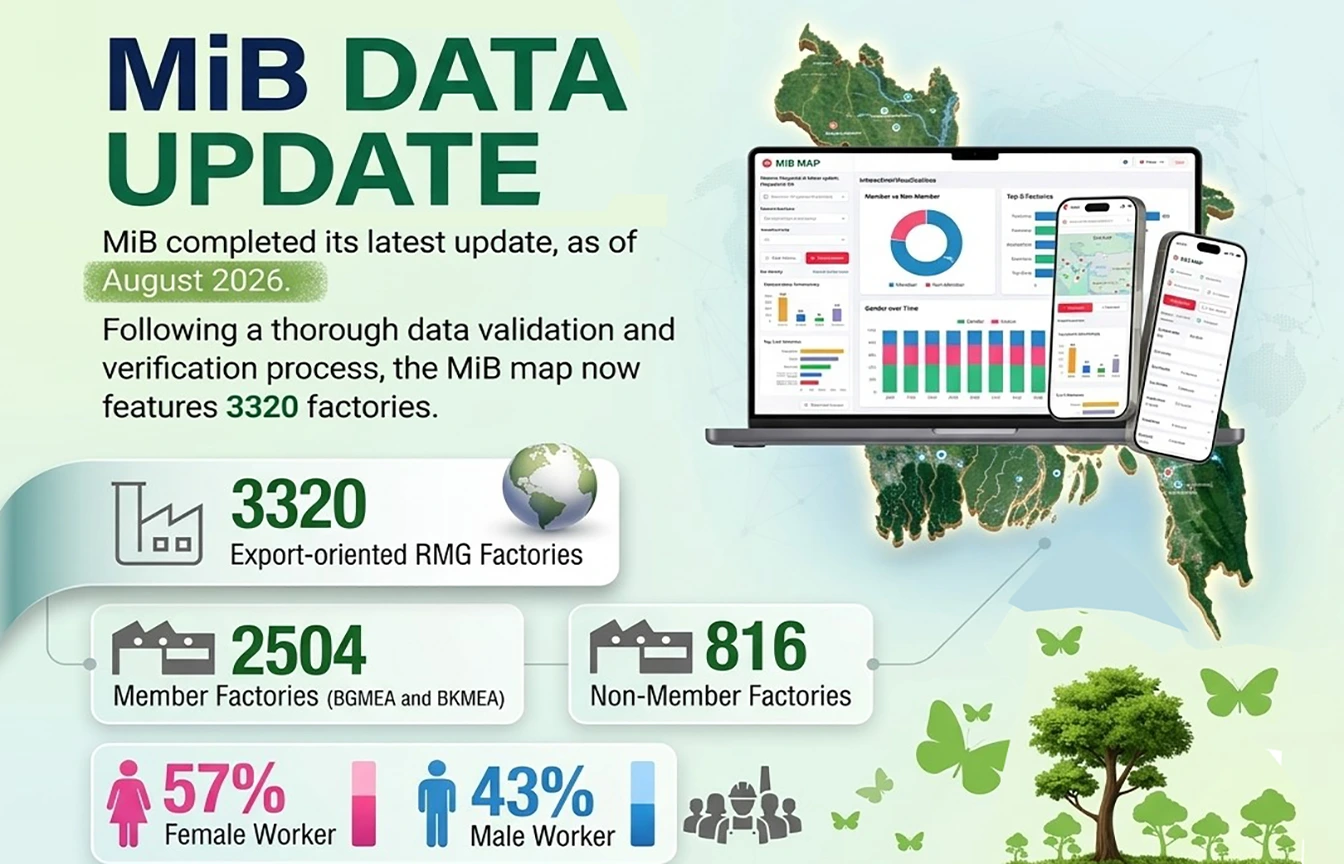
A survey of 878 RMG factories across the Gazipur and Narayanganj industrial clusters, conducted by Mapped in Bangladesh (MiB) — a programme implemented by the Centre for Entrepreneurship Development (CED) at BRAC University — revealed stark disparities in energy sourcing and a yawning gap between renewable energy potential and actual adoption.

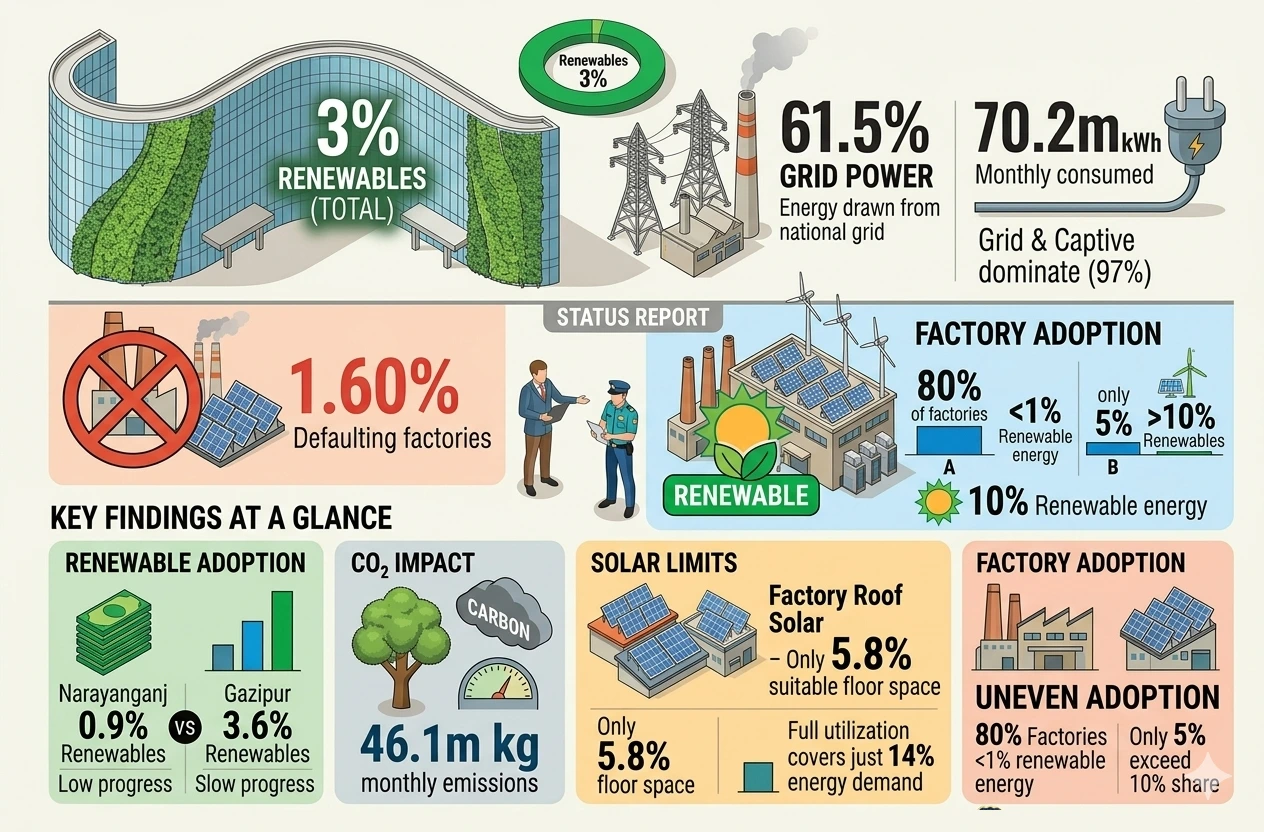
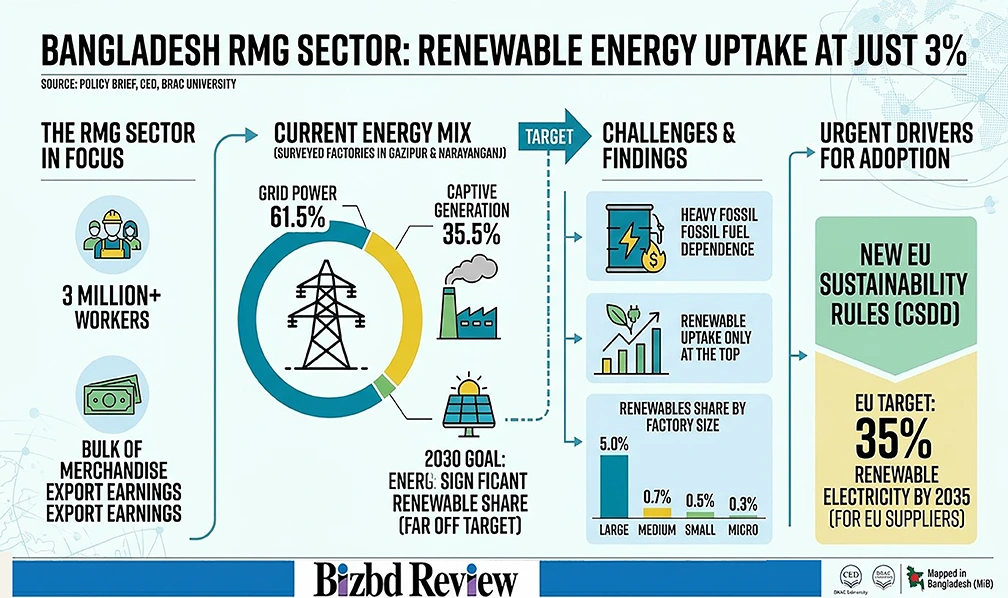
The surveyed factories draw 61.5 per cent of their energy from the national grid and a further 35.5 per cent from captive power generation, leaving renewables to cover just 3 per cent of total consumption.

The picture is considerably bleaker in Narayanganj, where renewable adoption stands at only 0.9 per cent, compared with 3.6 per cent in Gazipur.

Approximately 80 per cent of factories derive less than 1 per cent of their total energy from renewable sources, whilst only 5 per cent source more than 10 per cent of their requirements from clean energy.

Larger factories show greater diversification in energy sourcing, but small and micro factories remain almost entirely grid-dependent, with renewable adoption consistently below 1 per cent.

The environmental toll is substantial. The surveyed factories consume approximately 70.2 million kWh of electricity per month, generating an estimated 46.1 million kilograms of CO₂ emissions each month.

Rooftop solar has been widely promoted as the most accessible route to renewable energy for industrial facilities, yet the survey’s findings suggest its potential is frequently overstated.

Only around 5.8 per cent of total factory floor space is currently suitable for solar installations.

Even if every available rooftop were fully utilised, the resulting generation could cover no more than 14 per cent of total energy demand at current efficiency levels — a figure that underscores the need for complementary policy tools, alternative procurement models, and investment beyond rooftop solar alone.

The findings arrive at a significant moment for Bangladesh’s energy policy.

The government is advancing its clean energy agenda through the Renewable Energy Policy 2025 and its updated climate commitments under NDC 3.0, both of which set out ambitions to expand renewables’ share of national electricity generation and encourage rooftop solar adoption across industrial facilities.

The RMG sector sits at the heart of this transition. It is not only one of Bangladesh’s most energy-intensive industries but also the backbone of the country’s export earnings.

As global buyers and international brands increasingly require credible sustainability credentials — and as the European Union tightens its due diligence and responsible sourcing legislation — the pressure on Bangladeshi factories to decarbonise is growing rapidly.

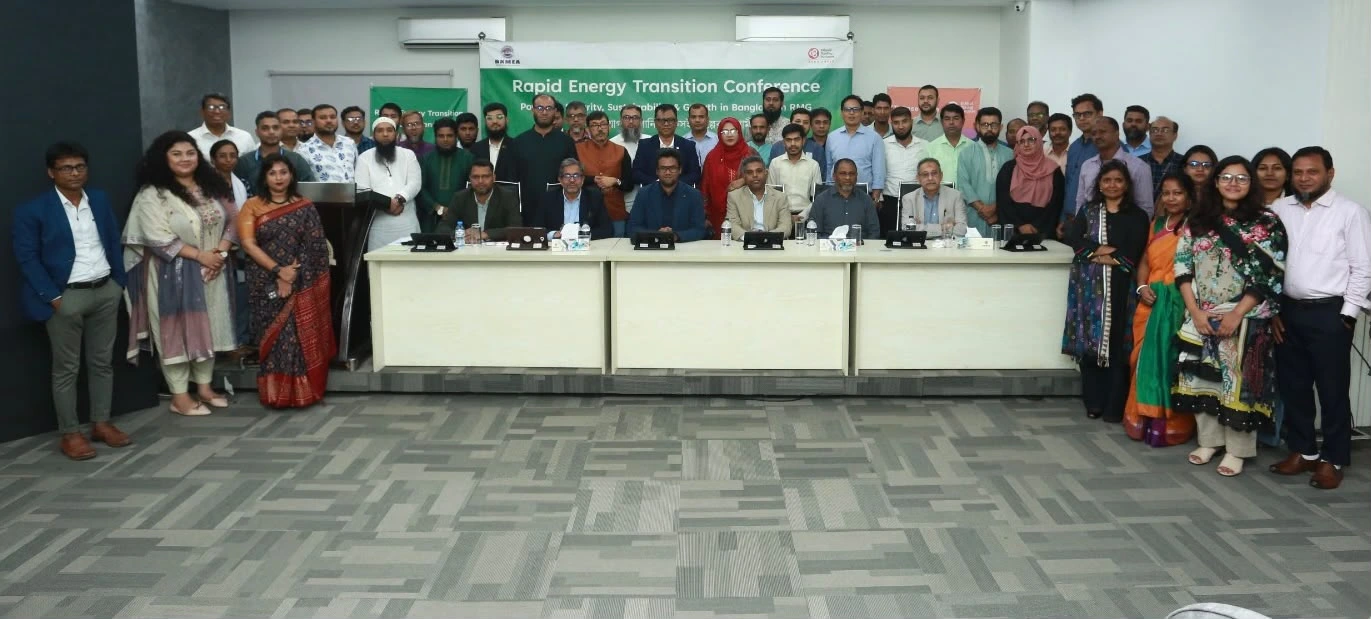
The MiB survey is intended to underpin a forthcoming policy dialogue that will bring together policymakers, industry representatives, development partners, renewable energy specialists, financial institutions, academic researchers, and service providers.

The aim is to translate field-level evidence into concrete, actionable recommendations.

Among the questions the dialogue is expected to address: how Bangladesh can accelerate renewable adoption despite rooftop and infrastructure constraints; what policy reforms are needed to strengthen net-metering mechanisms; how green financing can be made more accessible to small and medium-sized factories; and what coordinated public-private collaboration is required to align industrial transition with the country’s national climate targets.

Participants will also examine how international buyers and brands can actively support industrial decarbonisation, and how data-driven platforms such as MiB can be deployed to improve emissions tracking and sector-wide sustainability planning.

The discussion is expected to help convert on-the-ground evidence into a coherent policy framework — one capable of driving a renewable energy transition that is equitable, effective, and commercially viable for Bangladesh’s garment industry as a whole.
Bangladesh RMG factories fall behind in renewable energy transition

Update Time : 09:56:48 am, Tuesday, 19 May 2026
A survey of nearly 900 RMG factories finds that renewable energy accounts for just 3 per cent of total consumption, with smaller factories almost entirely dependent on the national grid — even as policy ambition and global buyer pressure mount

Bangladesh’s readymade garment sector, one of the country’s largest industrial consumers of electricity, remains overwhelmingly reliant on conventional power sources, with renewable energy accounting for a mere 3 per cent of total energy use across surveyed factories– a finding that sits uneasily against the government’s growing climate ambitions and the sustainability demands of global buyers.

A survey of 878 RMG factories across the Gazipur and Narayanganj industrial clusters, conducted by Mapped in Bangladesh (MiB) — a programme implemented by the Centre for Entrepreneurship Development (CED) at BRAC University — revealed stark disparities in energy sourcing and a yawning gap between renewable energy potential and actual adoption.

The surveyed factories draw 61.5 per cent of their energy from the national grid and a further 35.5 per cent from captive power generation, leaving renewables to cover just 3 per cent of total consumption.

The picture is considerably bleaker in Narayanganj, where renewable adoption stands at only 0.9 per cent, compared with 3.6 per cent in Gazipur.

Approximately 80 per cent of factories derive less than 1 per cent of their total energy from renewable sources, whilst only 5 per cent source more than 10 per cent of their requirements from clean energy.

Larger factories show greater diversification in energy sourcing, but small and micro factories remain almost entirely grid-dependent, with renewable adoption consistently below 1 per cent.

The environmental toll is substantial. The surveyed factories consume approximately 70.2 million kWh of electricity per month, generating an estimated 46.1 million kilograms of CO₂ emissions each month.

Rooftop solar has been widely promoted as the most accessible route to renewable energy for industrial facilities, yet the survey’s findings suggest its potential is frequently overstated.

Only around 5.8 per cent of total factory floor space is currently suitable for solar installations.

Even if every available rooftop were fully utilised, the resulting generation could cover no more than 14 per cent of total energy demand at current efficiency levels — a figure that underscores the need for complementary policy tools, alternative procurement models, and investment beyond rooftop solar alone.

The findings arrive at a significant moment for Bangladesh’s energy policy.

The government is advancing its clean energy agenda through the Renewable Energy Policy 2025 and its updated climate commitments under NDC 3.0, both of which set out ambitions to expand renewables’ share of national electricity generation and encourage rooftop solar adoption across industrial facilities.

The RMG sector sits at the heart of this transition. It is not only one of Bangladesh’s most energy-intensive industries but also the backbone of the country’s export earnings.

As global buyers and international brands increasingly require credible sustainability credentials — and as the European Union tightens its due diligence and responsible sourcing legislation — the pressure on Bangladeshi factories to decarbonise is growing rapidly.

The MiB survey is intended to underpin a forthcoming policy dialogue that will bring together policymakers, industry representatives, development partners, renewable energy specialists, financial institutions, academic researchers, and service providers.

The aim is to translate field-level evidence into concrete, actionable recommendations.

Among the questions the dialogue is expected to address: how Bangladesh can accelerate renewable adoption despite rooftop and infrastructure constraints; what policy reforms are needed to strengthen net-metering mechanisms; how green financing can be made more accessible to small and medium-sized factories; and what coordinated public-private collaboration is required to align industrial transition with the country’s national climate targets.

Participants will also examine how international buyers and brands can actively support industrial decarbonisation, and how data-driven platforms such as MiB can be deployed to improve emissions tracking and sector-wide sustainability planning.

The discussion is expected to help convert on-the-ground evidence into a coherent policy framework — one capable of driving a renewable energy transition that is equitable, effective, and commercially viable for Bangladesh’s garment industry as a whole.