Bizbd Report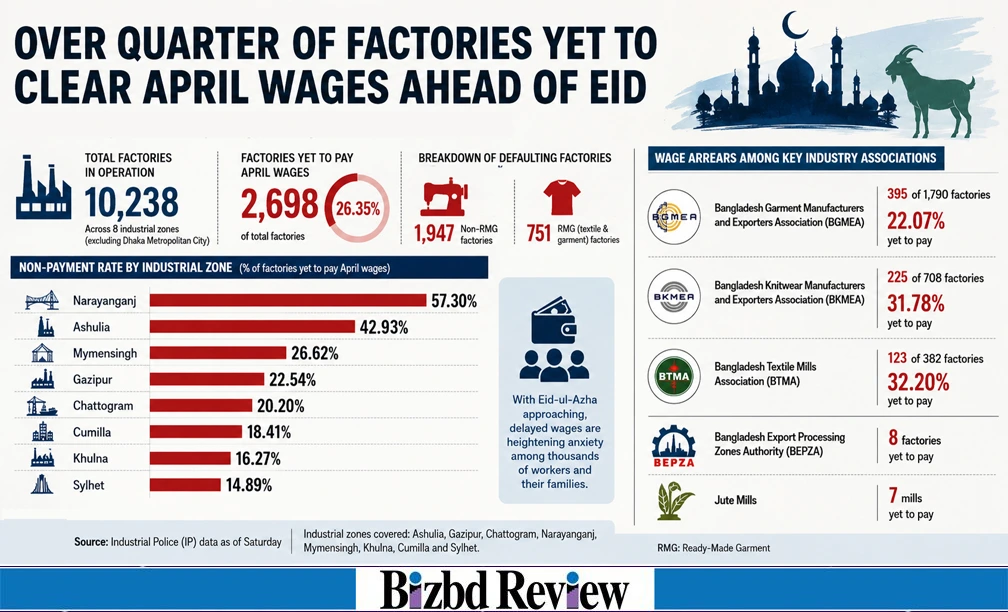
More than a quarter of all factories operating under the jurisdiction of Industrial Police across Bangladesh’s major industrial zones have still not paid workers their wages for the month of April, raising concerns ahead of the Eid-ul-Azha festival.
According to data from the Industrial Police, some 10,238 factories are currently in operation across eight industrial zones — Ashulia, Gazipur, Chattogram, Narayanganj, Mymensingh, Khulna, Cumilla and Sylhet — excluding Dhaka Metropolitan City.
Of these, 2,698 units, representing 26.35 per cent of the total, had yet to disburse April wages as of Saturday.
The defaulting factories comprise 1,947 non-RMG units and 751 textile and garment operations.
The situation is particularly acute in Narayanganj, where 57.30 per cent of factories have withheld wages, the highest non-payment rate among all monitored zones.
Ashulia follows at 42.93 per cent, while Mymensingh stands at 26.62 per cent and Gazipur at 22.54 per cent.
More than 22 per cent–some 395 factories–out of 1,790 units listed with the Bangladesh Garment Manufacturers and Exporters Association (BGMEA) remain in arrears.
Within the Bangladesh Knitwear Manufacturers and Exporters Association (BKMEA), 225 of 708 registered factories, or 31.78 per cent, have yet to pay.
Meanwhile, 123 members of the Bangladesh Textile Mills Association (BTMA) out of 382 are similarly in default.
Eight factories under the Bangladesh Export Processing Zones Authority (BEPZA) and seven jute mills have also failed to release April wages, IP data confirmed.
The figures have alarmed labour leaders, who used a recent tripartite consultative committee (TCC) meeting to sound a stark warning: the failure to pay wages and festival allowances in the run-up to Eid-ul-Azha could trigger widespread labour unrest across the country’s industrial belts.
Labour Minister Ariful Haque Chowdhury on May 14 directed all factory owners to pay festival allowances by May 21 and ensure timely disbursement of monthly wages in line with labour law.
The move was aimed at preventing any deterioration in industrial relations ahead of the eid.
During the same TCC meeting, labour representatives called on the government to take direct action against factory managements continuing to withhold dues and monthly wages, urging stronger enforcement to protect workers’ rights — particularly as the eeid holiday approaches and financial pressures on working families intensify.