Bizbd Report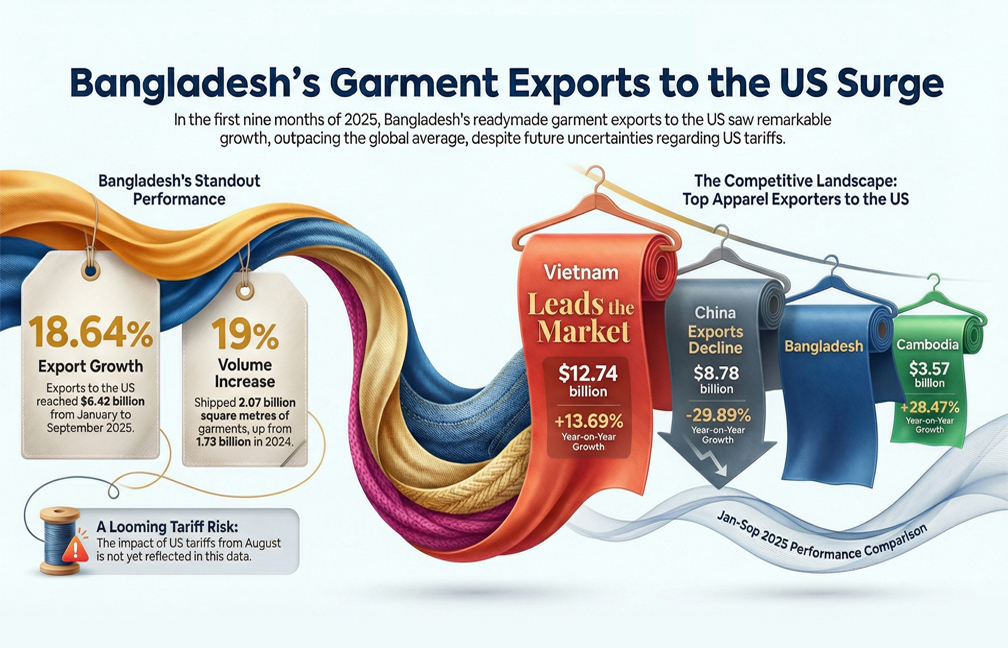
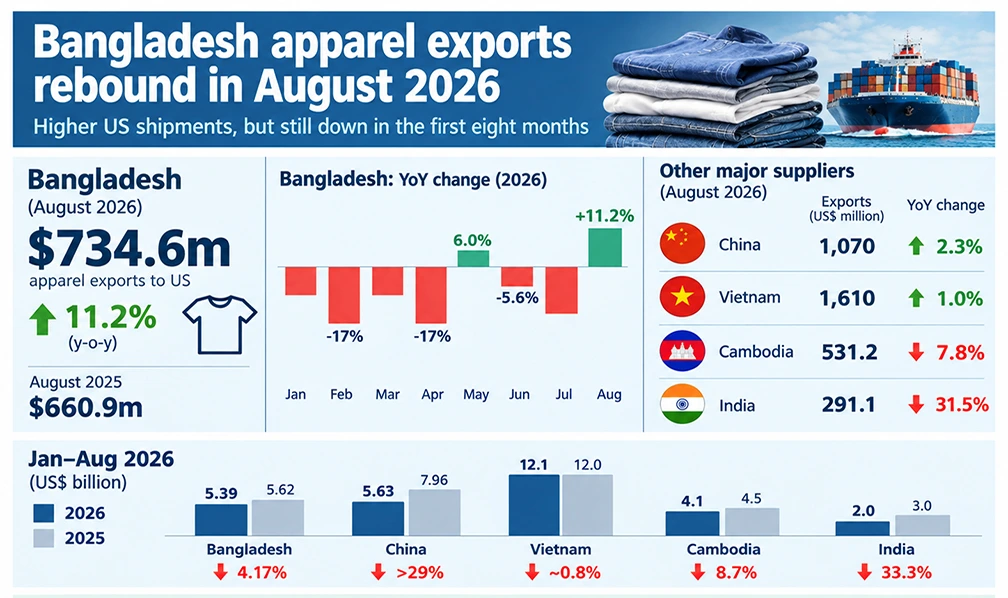
Bangladesh’s apparel exports to the United States, its largest market, surged 18.64 per cent in the first nine months of 2025, outperforming most major competitors.
The growth exceeded the global average of 1.74 per cent, though Vietnam retained its position as the top US apparel exporter.
Exporters caution that the full impact of US tariffs imposed in August may only be reflected in the coming months.
According to US official figures, exports increased both in value and volume during the July–September period of the current calendar year.
Readymade garment exports from Bangladesh during January–September fetched $6.42 billion, marking the 18.64 per cent growth, according to data released on December 11by OTEXA, an affiliate of the US Department of Commerce.
In the same period of 2024, Bangladesh earned $5.41 billion.
During the reporting period, the growth rate also surpassed the global average of 1.74 per cent, placing Bangladesh ahead of most major competitors except Cambodia, while Vietnam maintained its position as the top exporter, pushing China behind.
However, exporters said that OTEXA publishes data with a two-month lag, meaning the September figures reflected shipments made in July.
Reciprocal tariffs imposed by the US came into effect on 7 August. It may take another two months to see the real impact of these tariffs, during which a downturn in exports could occur.
During January–September, Bangladesh shipped 2.07 billion square metres of garments, about 19 per cent higher than the 1.73 billion square metres exported in the corresponding period of 2024.
America’s overall apparel imports during January–July 2025 stood at $60.34 billion, up from $59.31 billion in the same period last year.
Vietnam became the leading apparel exporter to the US during the first nine months of 2025, shipping RMG items worth $12.74 billion, representing approximately 13.69 per cent growth.
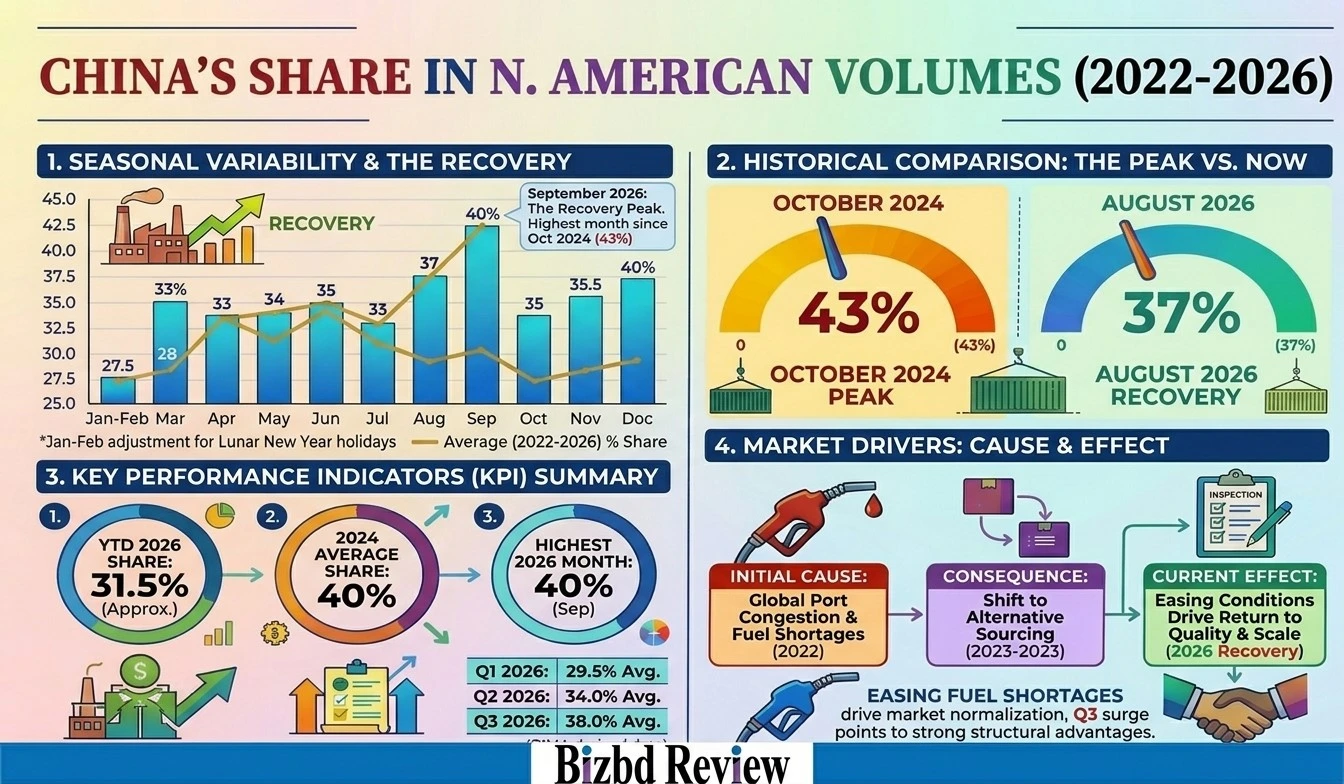
China dropped to second place, exporting US$8.78 billion worth of apparel, a 29.89 per cent year-on-year decline, reflecting the impact of renewed tariff barriers and ongoing geopolitical tensions.
Fazlee Shamim Ehsan, Executive President of the Bangladesh Knitwear Manufacturers and Exporters Association (BKMEA), said that OTEXA publishes data with a two-month delay, meaning September figures reflected shipments from early July onwards.
To assess the impact of US tariffs, it will take another two months when data for shipments from August onwards becomes available.
Ehsan said that there is still growth in the US market, and it may not fall significantly or could continue to grow, provided there is a stable political situation and a national election that restores buyers’ confidence.
He said that with an improving local situation and a stable government, Bangladesh is likely to secure a larger share of work orders shifted from China.
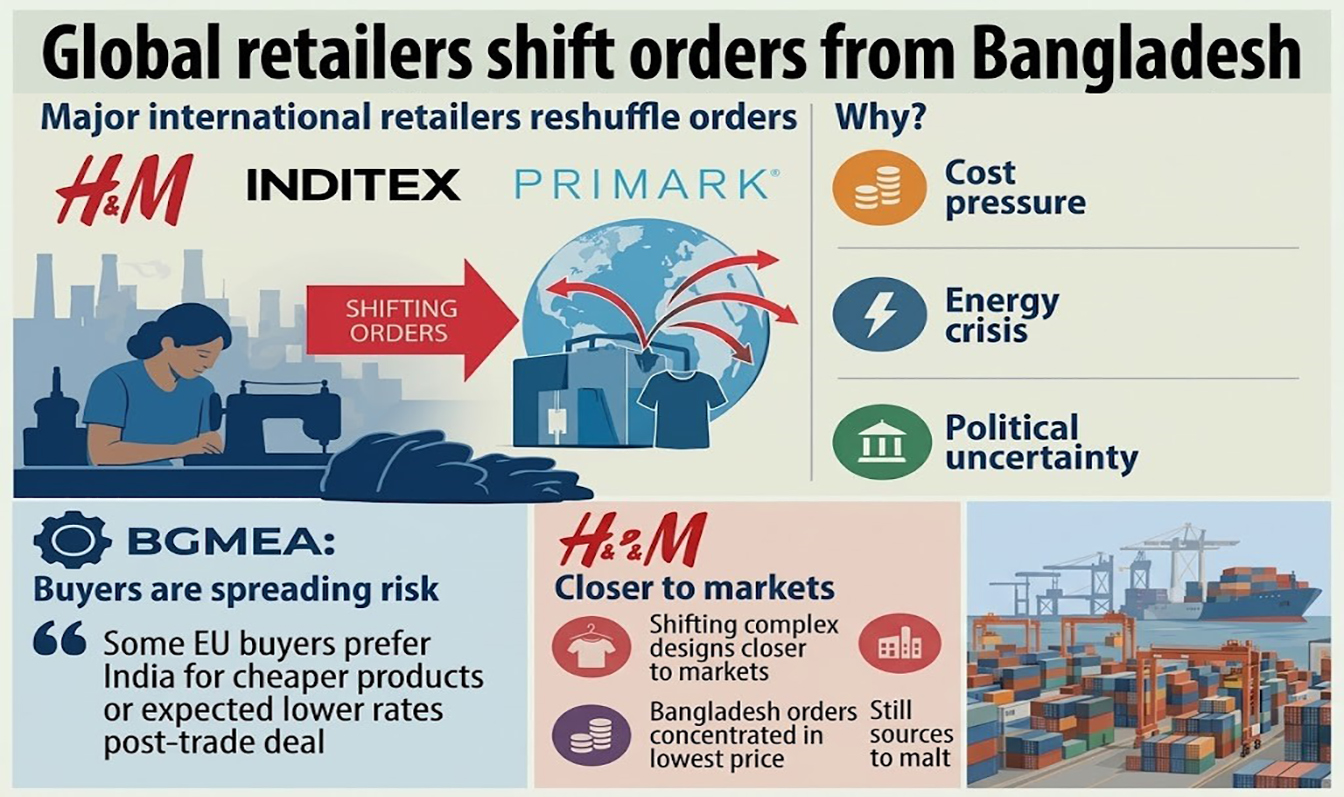
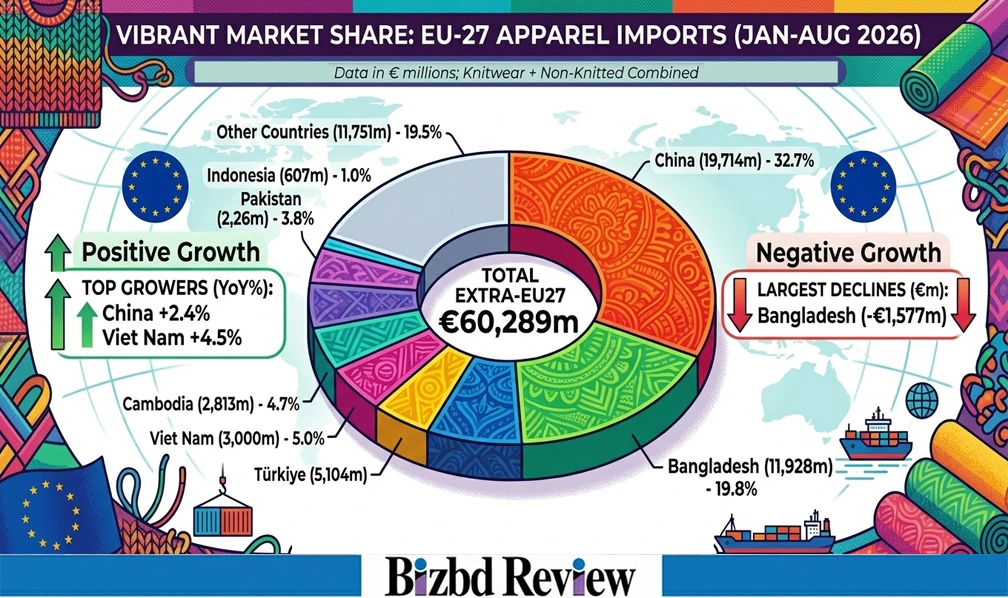
The BKMEA leader, however, noted that Bangladesh is facing challenges in the EU market, where the economy is under strain, while major competitors like China have been focusing on that market due to high US tariffs on their goods.
Exporters noted that although Chinese orders have shifted away from the US due to tariffs, China is aggressively increasing its share of the EU market by offering much lower prices to EU buyers to offset the decline in US market share.
Meanwhile, India’s apparel exports rose by 12.81 per cent to $4.10 billion during January–September 2025.
Indonesia recorded a 13.49 per cent increase in apparel shipments to $3.59 billion, continuing its steady growth as a supplier to the US market.
Cambodia witnessed a 28.47 per cent rise in exports, reaching $3.57 billion during the period under consideration.
Pakistan also recorded growth of 14 per cent, reaching $1.80 billion from the US market.