3:20 pm, Monday, 13 April 2026

Bangladesh faces eighth straight month of export contraction in March

Bangladesh’s merchandise export earnings contracted for an eighth consecutive month in March, registering a steep year-on-year decline amid weakening global demand and mounting external pressures on key sectors.

Data released on April 2 by the Export Promotion Bureau (EPB) showed that export receipts for March 2026 stood at $3.48 billion, down 18.07 per cent from $4.28 billion in the same month a year earlier.

The downturn also weighed on cumulative performance, with total exports during the July-March period of the financial year 2025-26 falling to $35.38 billion, marking a 4.85 per cent decline from $37.19 billion in the corresponding period of the previous fiscal year.

Garment sector under pressure
The ready-made garment (RMG) sector, Bangladesh’s principal export driver, remained under strain, reflecting subdued demand across major destinations including the United States, Germany, the United Kingdom, Italy and France, alongside emerging markets such as India, Japan and Australia.

In March alone, RMG exports dropped 19.35 per cent to $2.78 billion from $3.44 billion a year earlier.

Over the nine-month period, the sector generated $28.57 billion, albeit with a 5.51 per cent year-on-year decline.

Within the segment, knitwear exports fell 6.42 per cent to $15.11 billion, while woven garments declined 4.48 per cent to US$13.46 billion.

Prolonged negative trend
Exports have remained in negative territory since August 2025, when earnings fell 2.93 per cent year-on-year.

The decline deepened in subsequent months, recording contractions of 4.61 per cent in September, 7.43 per cent in October, 5.58 per cent in November, 14.25 per cent in December, 0.50 per cent in January, and 12.03 per cent in February.

Industry insiders noted that while early fiscal performance indicated resilience, the sustained downturn since August underscores structural challenges in the export sector amid volatile global demand.

External shocks and market dynamics
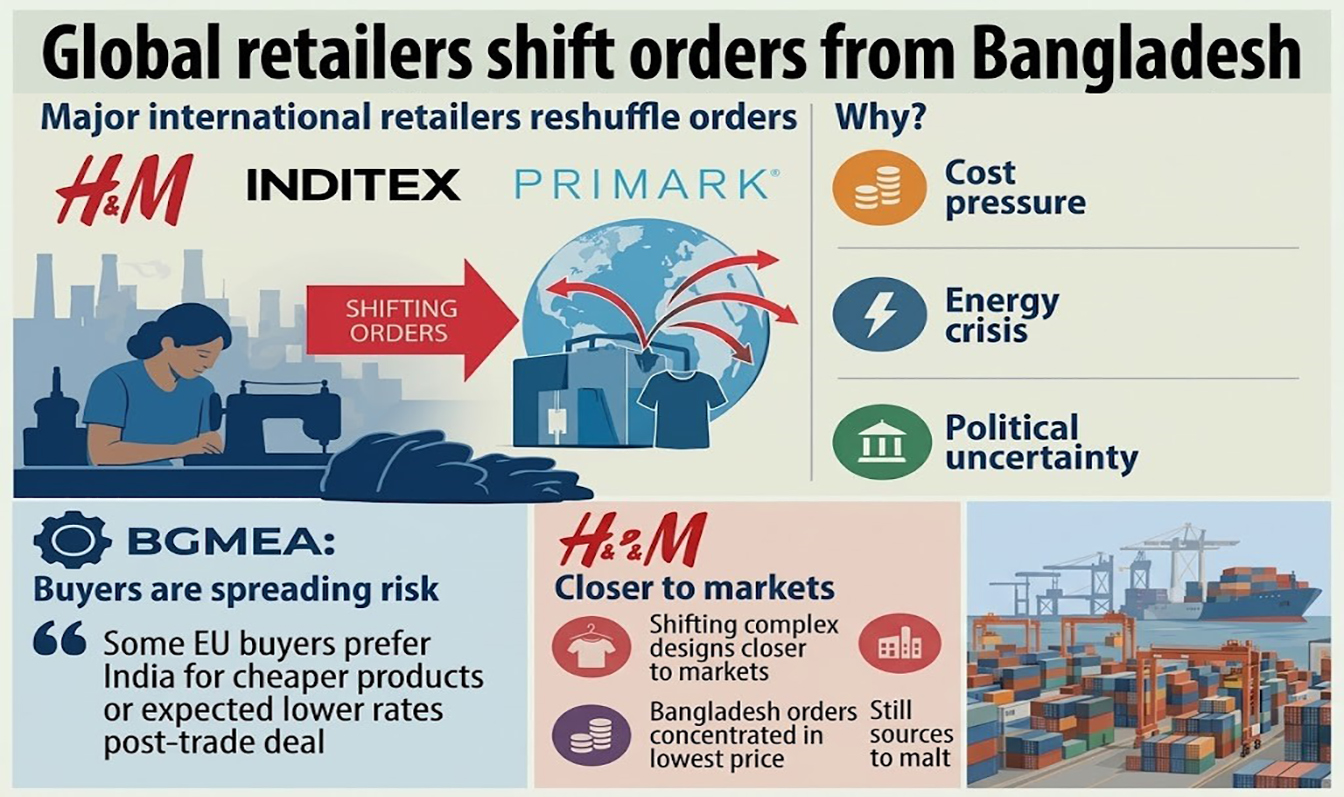
Exporters attributed the persistent slump to a combination of weakening global demand, heightened competition, rising production costs and shifting trade dynamics.

They also pointed to reciprocal tariffs imposed by the United States and China’s increased penetration in markets where Bangladesh traditionally holds a competitive edge.

The EPB highlighted broader geopolitical factors influencing trade flows, including tensions in the Middle East involving the United States, Israel and Iran, as well as the prolonged Russia-Ukraine war.

These developments have contributed to energy market volatility, inflationary pressures and reduced consumer purchasing power across key export destinations such as the European Union, the United States and Southeast Asia.

Such conditions have led to slower order placements, alongside postponements and cancellations, the agency said.

Industry concerns grow
Mahmud Hasan Khan, president of the Bangladesh Garment Manufacturers and Exporters Association (BGMEA), attributed part of the March decline to extended Eid holidays, which disrupted production and shipments.

He warned, however, that ongoing conflicts in the Middle East were further dampening buyer confidence and order volumes.

Echoing these concerns, Mohammad Hatem, president of the Bangladesh Knitwear Manufacturers and Exporters Association (BKMEA), said the industry had yet to recover from the fallout of the Russia-Ukraine war, while emerging tensions involving Iran and the United States could further erode global demand.

He cautioned that export performance may deteriorate further in the coming months, noting that declining sales in the US market, partly linked to tariff measures, have reduced new work orders.

Mixed performance across sectors
Despite the overall downturn, a few sectors posted modest gains.

Leather and leather goods exports rose 3.15 per cent to $878.82 million, while frozen and live fish exports increased 3.71 per cent to $356.03 million.

Pharmaceutical exports also recorded a 3.14 per cent rise to $170.67 million.

However, other sectors remained under pressure.

Agricultural exports declined 9.21 per cent to $732.70 million, jute and jute goods fell 1.30 per cent to $618.17 million, and home textile exports edged down slightly to $672.62 million.

Outlook uncertain
Bangladesh’s export sector, which earned $48.28 billion in the previous fiscal year, driven largely by US$39.34 billion in garment shipments, now faces an increasingly uncertain outlook.

Analysts say the persistence of global economic headwinds, geopolitical instability and shifting trade patterns will continue to test the resilience of the country’s export-oriented industries in the months ahead.
Bangladesh faces eighth straight month of export contraction in March

Update Time : 07:22:40 am, Saturday, 4 April 2026

Bangladesh’s merchandise export earnings contracted for an eighth consecutive month in March, registering a steep year-on-year decline amid weakening global demand and mounting external pressures on key sectors.

Data released on April 2 by the Export Promotion Bureau (EPB) showed that export receipts for March 2026 stood at $3.48 billion, down 18.07 per cent from $4.28 billion in the same month a year earlier.

The downturn also weighed on cumulative performance, with total exports during the July-March period of the financial year 2025-26 falling to $35.38 billion, marking a 4.85 per cent decline from $37.19 billion in the corresponding period of the previous fiscal year.

Garment sector under pressure
The ready-made garment (RMG) sector, Bangladesh’s principal export driver, remained under strain, reflecting subdued demand across major destinations including the United States, Germany, the United Kingdom, Italy and France, alongside emerging markets such as India, Japan and Australia.

In March alone, RMG exports dropped 19.35 per cent to $2.78 billion from $3.44 billion a year earlier.

Over the nine-month period, the sector generated $28.57 billion, albeit with a 5.51 per cent year-on-year decline.

Within the segment, knitwear exports fell 6.42 per cent to $15.11 billion, while woven garments declined 4.48 per cent to US$13.46 billion.

Prolonged negative trend
Exports have remained in negative territory since August 2025, when earnings fell 2.93 per cent year-on-year.

The decline deepened in subsequent months, recording contractions of 4.61 per cent in September, 7.43 per cent in October, 5.58 per cent in November, 14.25 per cent in December, 0.50 per cent in January, and 12.03 per cent in February.

Industry insiders noted that while early fiscal performance indicated resilience, the sustained downturn since August underscores structural challenges in the export sector amid volatile global demand.

External shocks and market dynamics
Exporters attributed the persistent slump to a combination of weakening global demand, heightened competition, rising production costs and shifting trade dynamics.

They also pointed to reciprocal tariffs imposed by the United States and China’s increased penetration in markets where Bangladesh traditionally holds a competitive edge.

The EPB highlighted broader geopolitical factors influencing trade flows, including tensions in the Middle East involving the United States, Israel and Iran, as well as the prolonged Russia-Ukraine war.

These developments have contributed to energy market volatility, inflationary pressures and reduced consumer purchasing power across key export destinations such as the European Union, the United States and Southeast Asia.

Such conditions have led to slower order placements, alongside postponements and cancellations, the agency said.

Industry concerns grow
Mahmud Hasan Khan, president of the Bangladesh Garment Manufacturers and Exporters Association (BGMEA), attributed part of the March decline to extended Eid holidays, which disrupted production and shipments.

He warned, however, that ongoing conflicts in the Middle East were further dampening buyer confidence and order volumes.

Echoing these concerns, Mohammad Hatem, president of the Bangladesh Knitwear Manufacturers and Exporters Association (BKMEA), said the industry had yet to recover from the fallout of the Russia-Ukraine war, while emerging tensions involving Iran and the United States could further erode global demand.

He cautioned that export performance may deteriorate further in the coming months, noting that declining sales in the US market, partly linked to tariff measures, have reduced new work orders.

Mixed performance across sectors
Despite the overall downturn, a few sectors posted modest gains.

Leather and leather goods exports rose 3.15 per cent to $878.82 million, while frozen and live fish exports increased 3.71 per cent to $356.03 million.

Pharmaceutical exports also recorded a 3.14 per cent rise to $170.67 million.

However, other sectors remained under pressure.

Agricultural exports declined 9.21 per cent to $732.70 million, jute and jute goods fell 1.30 per cent to $618.17 million, and home textile exports edged down slightly to $672.62 million.

Outlook uncertain
Bangladesh’s export sector, which earned $48.28 billion in the previous fiscal year, driven largely by US$39.34 billion in garment shipments, now faces an increasingly uncertain outlook.

Analysts say the persistence of global economic headwinds, geopolitical instability and shifting trade patterns will continue to test the resilience of the country’s export-oriented industries in the months ahead.