Bizbd Report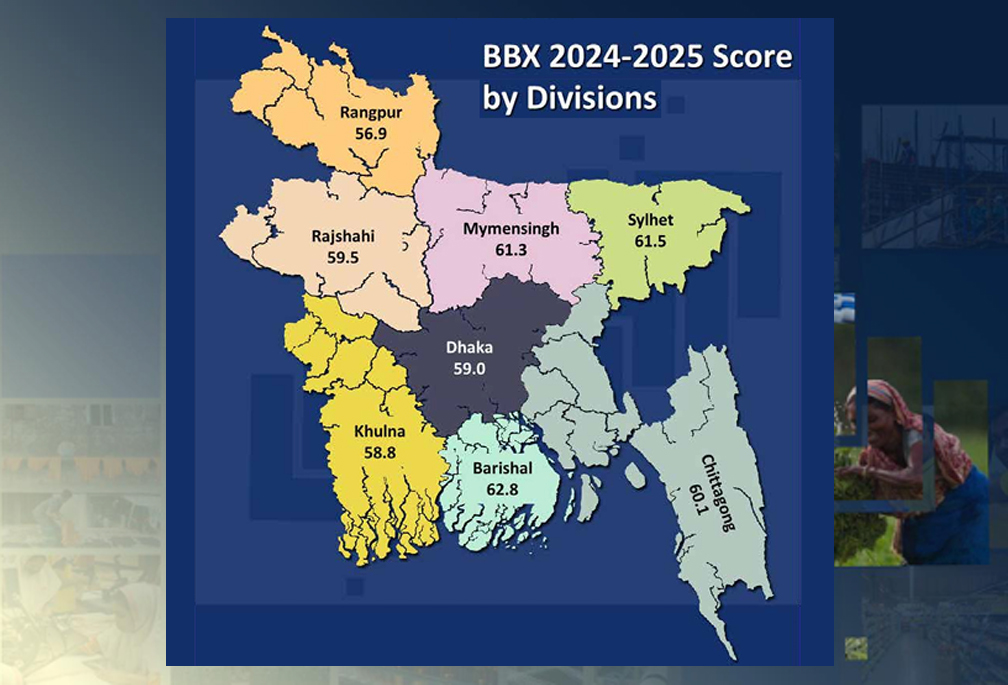
Bangladesh’s business environment remains fragile and largely stagnant, according to the Bangladesh Business Climate Index (BBX) 2024–25, even as the overall index score inched up to 59.69, from 58.75 in 2023–24.
The BBX 2024–25, a comprehensive and home-grown measure developed jointly by the Policy Exchange Bangladesh (PEB) and the Metropolitan Chamber of Commerce and Industry (MCCI), was published on October 16, offering a detailed snapshot of the operational realities for businesses across the nation.
According to the BBX scoring framework, an overall score of 41–60 denotes an environment where several bottlenecks remain for businesses, and significant efforts are required to improve operational conditions.
BBX identified access to finance as the most critical challenge, alongside regulatory weaknesses, infrastructure bottlenecks, and trade inefficiencies that constrain business operations.
Sustainability and labour-related pressures, including compliance costs and skill shortages, further burden firms, particularly small and medium enterprises, it said.
The report said that the prevailing business environment in Bangladesh was heavily influenced by domestic political changes, global policy uncertainty, and widespread social unrest.
It noted that structural bottlenecks, persistent macroeconomic pressures, and uneven reform implementation across sectors and regions continued to constrain economic activity and investor confidence.
While some sectors had benefited from incremental improvements in regulatory and financial access, the report said, the overall business climate remained fragile, with growth and efficiency gains concentrated in select areas.
MCCI held the repot launch event at its Gulshan office, with commerce adviser Sk Bashir Uddin as chief guest and Australian Trade and Investment Commissioner to Bangladesh Ben Carson as guest of honour.
MCCI president Kamran T Rahman opened the event with welcome remarks, and Policy Exchange Bangladesh Chairman M Masrur Reaz gave the keynote presentation.
Panelists included Bangladesh Chamber of Industries (BCI) president Anwar-ul Alam Chowdhury, Japan External Trade Organization (JETRO) country representative Kazuiki Kataoka, and Berger Paints Bangladesh Limited managing director Rupali Chowdhury.
According to the report, the overall performance of the BBX 2024–25 showed uneven progress, with some improvements alongside persistent constraints.
It said that technology-intensive sectors such as electronics, pharmaceuticals, and leather had generally adopted reforms and technology faster, enhancing their competitiveness.
In contrast, industries including construction, textiles, and agriculture continued to face operational challenges due to infrastructure deficiencies, labour shortages, and regulatory complexities.
The report observed that all eight divisions of Bangladesh required significant attention to strengthen the business environment.
It stated that five divisions fell within the second lowest category, where multiple bottlenecks continued to limit growth, while the remaining three divisions required major policy and regulatory simplification.
Dhaka and Chattogram, the country’s main growth centres, were also placed in the second lowest tier, showing that even the most economically active regions were not performing strongly across the BBX pillars.
The report said that the political changes of August 2024 had influenced the business environment, particularly in last-mile service delivery.
It noted improvements in access to land and technology, largely attributed to the reduction of predatory behaviour by politically linked intermediaries, which had previously undermined operational efficiency.
It concluded that targeted political and administrative interventions could directly affect business performance, especially in sectors long hampered by informal practices.
According to the report, incremental reforms had led to measurable improvements in several BBX pillars.
It stated that access to finance, paying taxes, and dispute resolution had all shown gains, although progress remained uneven.
Access to finance, historically the weakest pillar, had posted the largest single improvement, rising 43 per cent from 28.11 to 40.07.
BBX said this demonstrated that strategically prioritised reforms could produce tangible results, though access to finance remained far below the level required for a fully conducive business environment.
The report said that business infrastructure continued to be the highest-performing pillar, scoring 68.82, despite a slight deterioration.

It added that environmental regulations and standards, scoring 50.18, along with access to finance, remained the lowest-performing pillars, reflecting ongoing challenges in compliance, financing, and sustainability.
The report identified access to finance as the most critical concern, affecting nine out of eleven surveyed sectors.
It noted that structural barriers included heavy reliance on bank loans, high collateral requirements, bureaucratic delays, and uneven availability of non-bank financing.
These challenges were most pronounced in less formalised sectors, including wholesale, agriculture, and transport, as well as capital-intensive industries such as textiles, construction, and readymade garments.
It said that the tax system imposed a high compliance burden, with complex regulations and unpredictable changes increasing operational costs.
Informal payments were widespread, with around 57 per cent of respondents admitting to making such payments related to taxes.
The report found that, for large firms, the average cost of tax registration rose to approximately Tk36,000.
It noted that high input costs and macroeconomic pressures, including inflation and interest rates of up to 14 per cent for long-term credit, further constrained investment and domestic demand.
According to the report, 36 per cent of businesses viewed inflation as the single largest risk, followed by high interest rates, cited by 21 per cent of respondents.
The report said that regulatory and governance challenges persisted. Informal practices, particularly in land, utilities, and tax processing, increased costs, created inequities, and weakened investor confidence.
It said that policy implementation gaps, inconsistent monitoring, and limited outreach reduced the effectiveness of reforms.
Complexity in starting a business remained a challenge despite digitalisation efforts, as fragmented agency coordination, multiple approvals, and sector-specific licensing slowed incorporation.
The report noted that 42 per cent of respondents experienced moderate difficulty, while 26.8 per cent reported substantial difficulty in obtaining general licences or permits.
It added that the availability of regulatory information had deteriorated following the political changes of 2024, contributing to operational uncertainty.
Judicial delays, case backlogs, and limited technology adoption were also cited as hindrances to timely dispute resolution.
The report observed that infrastructure deficiencies remained a major bottleneck. Frequent power outages, unreliable transport, and logistics challenges, coupled with informal payments, reduced operational efficiency.
It noted that in Dhaka, 16 per cent of respondents reported substantial difficulty in accessing utilities, indicating strain even in the most developed division.
Trade facilitation continued to be hampered by inefficient customs procedures, inconsistent valuation, and uneven regional implementation.
The report added that the impending graduation from Least Developed Country (LDC) status had created trade and policy uncertainty, with around 40 per cent of businesses expressing concern over potential changes in preferential trade access, tariffs, and competitiveness.