Bizbd Report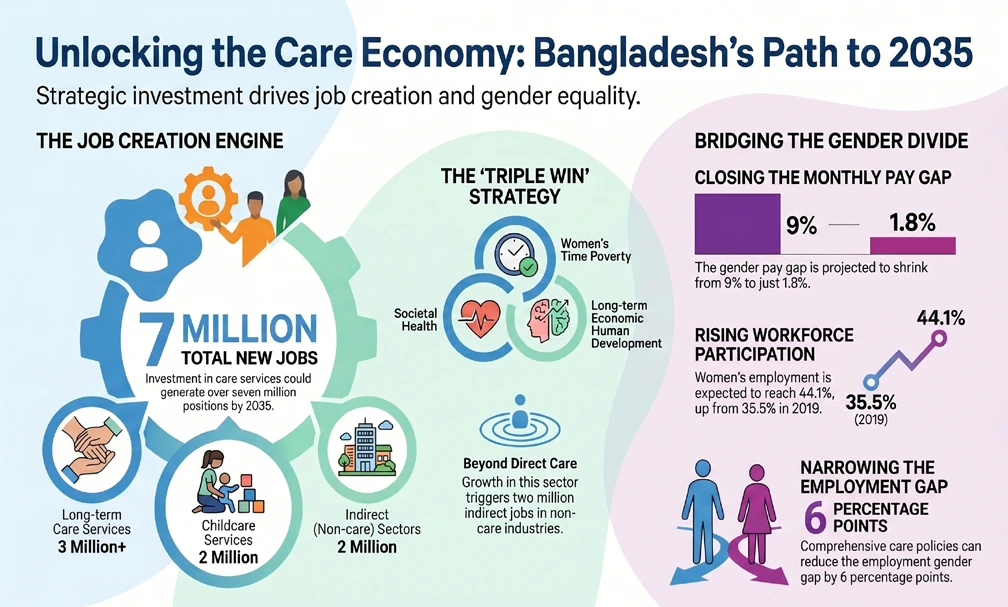
Investment in Bangladesh’s care economy could generate over 7 million jobs by 2035, while narrowing gender gaps in employment and pay, speakers said at a national conclave in Dhaka on April 23.
Of the projected employment, over 2 million jobs would be created directly in childcare, more than 3 million in long-term care services, and around 2 million indirectly in non-care sectors.
The findings were shared by Anne Drong, national project coordinator at the International Labour Organization (ILO), while delivering a keynote paper titled ‘Investing in Care: Unlocking Bangladesh’s Economic and Social Potential’ at the National Care Conclave 2026.
The conclave was jointly organised by the ILO, UN Women and the Asian Development Bank (ADB), in coordination with the Ministry of Women and Children Affairs, Ministry of Labour and Employment, and Ministry of Social Welfare.
The forum aimed to identify pathways for developing Bangladesh’s care economy through a comprehensive policy framework, including institutional provisions for care entitlements, quality standards for services, and the creation of decent work opportunities both domestically and overseas.
Drong noted that investment in a comprehensive care policy package could reduce the gender gap in employment by 6 percentage points and raise women’s employment rate to 44.1 per cent by 2035, up from 35.5 per cent in 2019.
She ssaid that the gender pay gap in monthly earnings could narrow significantly—from 9 per cent in 2019 to 1.8 per cent by 2035.
To build an effective care system, she recommended reforms to modernise policy frameworks and service delivery mechanisms, alongside skills development, formal certification for care workers, and stronger regulation and quality monitoring.
Gitanjali Singh, country representative of UN Women Bangladesh, highlighted the structural challenges underpinning gender inequality.
‘The undervaluing and gendered division of care work–both unpaid and paid–is one of the biggest drivers of gender inequality,’ she said.
She described investment in care systems as a ‘triple win’ for women, society and the economy, noting that reducing women’s time poverty would enable greater participation in the labour market while delivering long-term gains in human development, health and poverty reduction.
Speaking at a session, Women and Children Affairs Minister Abu Zafar Md Zahid Hossain said empowering women is essential for macroeconomic stability. ‘By redefining care as a shared responsibility rather than a burden borne solely by women, we are unlocking the full potential of our workforce for national prosperity,’ he said.
State Minister for Social Welfare Farzana Sharmin stressed the need to formally recognise the care economy as a cornerstone of development.
She said prioritising care would help establish it as a dignified and professional sector that drives economic growth and empowers women nationwide.
ILO Bangladesh Country Director Max Tunon underscored the importance of elevating care to a public policy priority.
‘By transforming care from an invisible, private responsibility into a public policy priority, the government is unlocking a vital engine for economic prosperity and gender equality,’ he said, reaffirming support for expanding access to quality childcare and long-term care services.
Nasheeba Selim, principal social development officer (gender) at the ADB, said a continuum of care policies is essential to ensure equal participation of women and men in the labour force while balancing care responsibilities.
She noted that childcare and long-term care remain central to most households and are critical for ensuring early childhood development and income security.
Addressing another panel, Social Welfare Secretary Mohammad Abu Yusuf identified several challenges facing the sector, including social stigma surrounding caregiving professions, high service costs, long travel distances, a mismatch between demand and supply, and the absence of an effective regulatory authority.
He said that while Bangladesh has numerous relevant laws, weak implementation remains a persistent obstacle.