Bizbd Report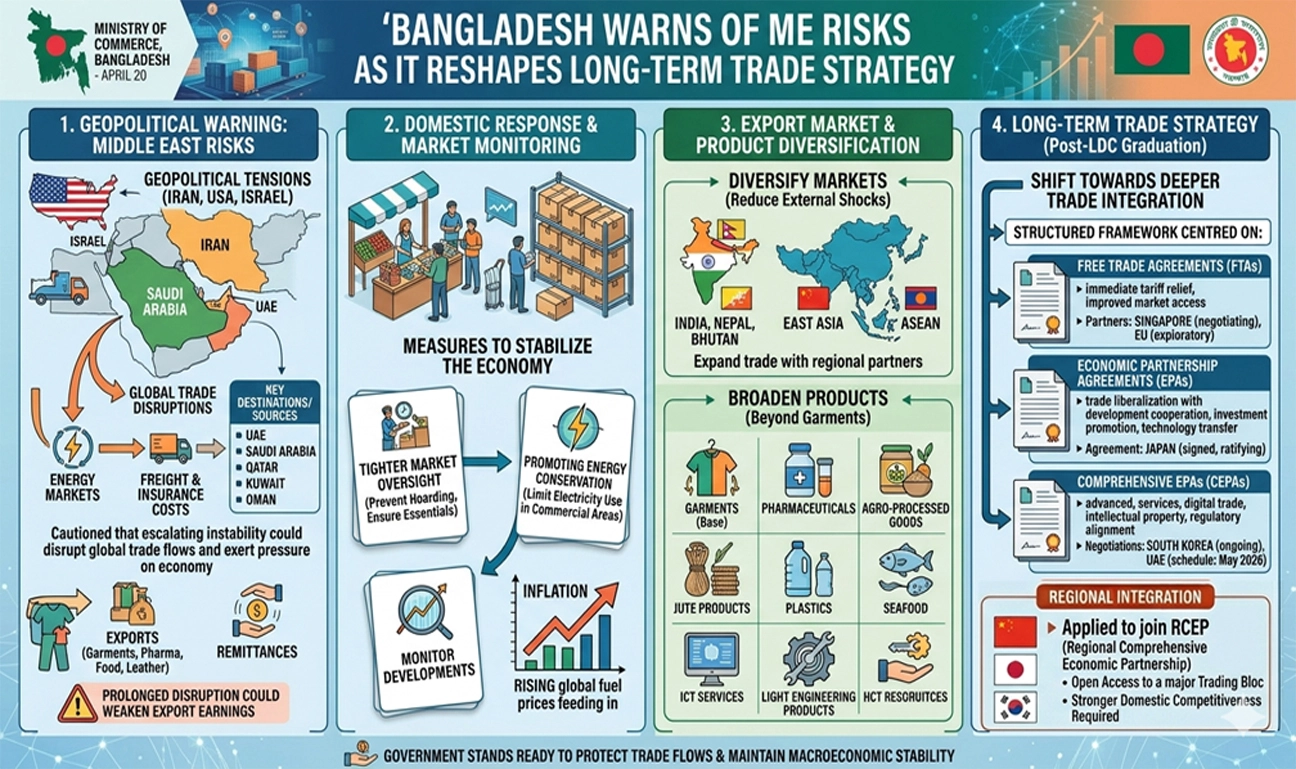
Bangladesh has cautioned that escalating instability in the Middle East could disrupt global trade flows and exert pressure on its economy, even as the government advances a multi-layered strategy to sustain export growth beyond least developed country (LDC) status.
Commerce Minister Khandker Abdul Muktadir told the Jatiya Sangsad on April 20 that geopolitical tensions involving Iran, the United States and Israel were already creating uncertainty in energy markets and global supply chains, with implications for Bangladesh’s trade, inflation and remittance inflows.
Responding to lawmakers during a parliamentary session, the minister said the Middle East remained a critical market for Bangladesh’s exports—including garments, pharmaceuticals, frozen food and leather goods—and a major source of remittances.
Key destinations include the United Arab Emirates, Saudi Arabia, Qatar, Kuwait and Oman.
He warned that any prolonged disruption could weaken export earnings while pushing up import costs, shipping charges and insurance premiums.
Rising global fuel prices, he noted, were already feeding into domestic inflationary pressures.
The government is closely monitoring developments and has introduced measures to stabilise the domestic economy, including tighter market oversight to prevent hoarding and ensure the supply of essential goods.
Authorities are also promoting energy conservation by limiting unnecessary electricity use in commercial areas and public events.
At the same time, Dhaka is seeking to reduce its exposure to external shocks by diversifying export markets and products. Efforts are under way to expand trade with regional partners such as India, Nepal and Bhutan, as well as countries in East Asia and the Association of Southeast Asian Nations.
Exports are also being broadened beyond garments to include pharmaceuticals, agro-processed goods, jute products, plastics, seafood, ICT services and light engineering products.
Shift towards deeper trade integration
Alongside short-term measures, the government is pursuing a structured trade framework centred on Free Trade Agreements (FTAs), Economic Partnership Agreements (EPAs) and Comprehensive Economic Partnership Agreements (CEPAs) to prepare for LDC graduation.
Muktadir said FTAs would provide immediate tariff relief and improved market access, with negotiations ongoing with partners such as Singapore and exploratory engagement with the European Union.
EPAs, he explained, would combine trade liberalisation with development cooperation, including investment promotion, technology transfer and capacity building. Bangladesh has already signed its first such agreement with Japan, with ratification under way.
More advanced CEPAs are being negotiated to cover services, digital trade, intellectual property and regulatory alignment.
Talks with South Korea have progressed through several rounds, while negotiations with the UAE are scheduled to begin in May 2026.
The minister also confirmed that Bangladesh has applied to join the Regional Comprehensive Economic Partnership, which includes major economies such as China, Japan and South Korea.
Membership, he said, would open access to one of the world’s largest trading blocs but would require stronger domestic competitiveness.
Balancing risks and reforms
The combined approach—leveraging FTAs for market access, EPAs for development support and CEPAs for deeper integration—is intended to offset the gradual loss of preferential trade benefits following LDC graduation.
Muktadir said the strategy would help Bangladesh sustain export momentum, diversify its economic base and strengthen resilience against external shocks, including those arising from geopolitical tensions in the Middle East.
He assured parliament that the government stood ready to take further measures to protect trade flows and maintain macroeconomic stability as global uncertainties persist.