3:52 pm, Friday, 24 April 2026

Bangladesh apparel sector seeks steady fuel supply as costs surge

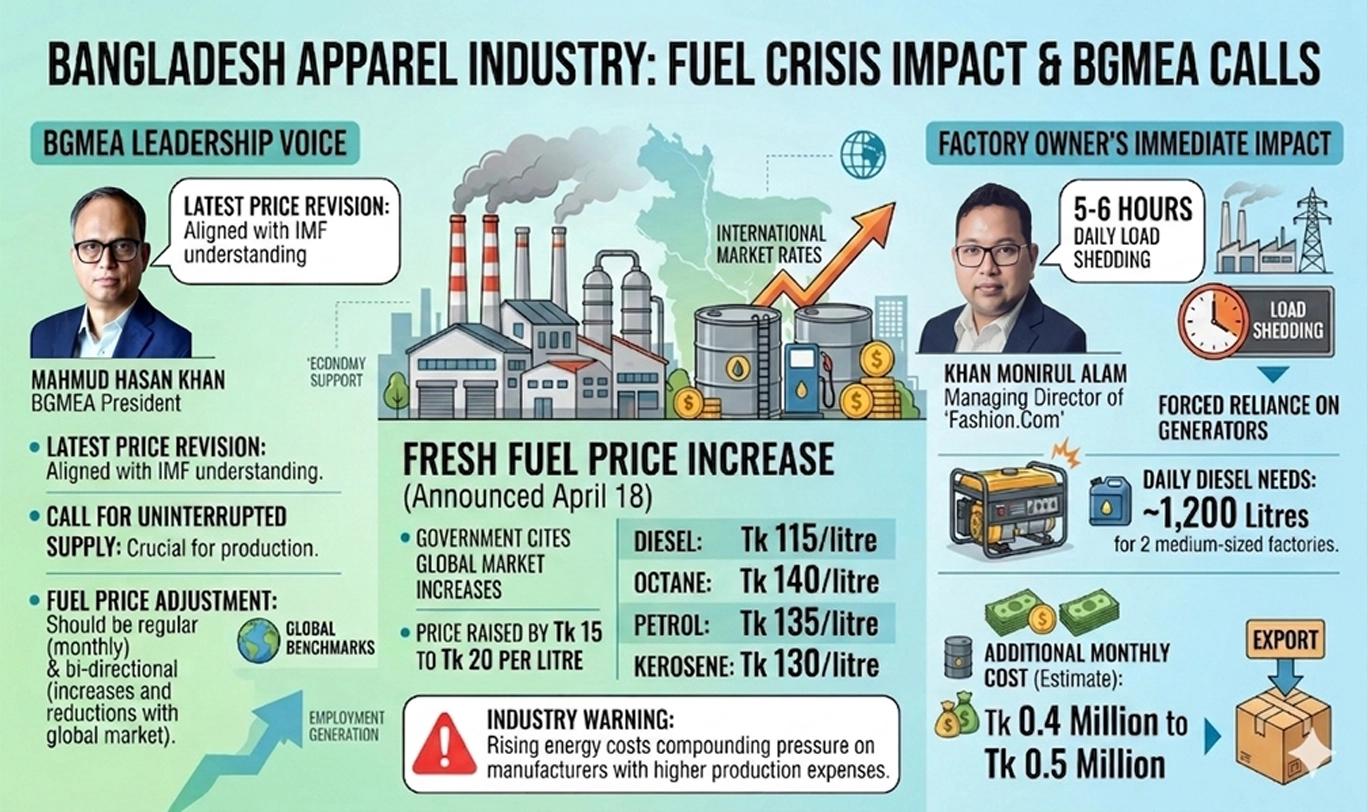
Leaders of Bangladesh’s export-oriented apparel industry have called for uninterrupted fuel supply following a fresh increase in retail prices, warning that rising energy costs are compounding pressure on manufacturers already grappling with higher production expenses.

Industry representatives said the adjustment, announced on April 18, must be accompanied by reliable access to fuel, particularly for factories dependent on diesel-powered generators amid persistent electricity shortages.

Bangladesh Garment Manufacturers and Exporters Association (BGMEA) president Mahmud Hasan Khan said the latest price revision appeared to be aligned with an understanding with the International Monetary Fund.

He argued that fuel prices should be adjusted regularly, preferably on a monthly basis, in line with global benchmarks.

‘Adjustment should not only mean increases but also reductions when international prices decline,’ BGMEA president said, adding that uninterrupted supply remains critical as higher fuel costs will inevitably raise production expenses.

The government raised fuel oil prices by Tk 15 to Tk 20 per litre, citing increases in global market rates. Under the revised structure, diesel now costs Tk 115 per litre, octane Tk 140, petrol Tk 135 and kerosene Tk 130.

Factory owners say the impact is immediate and significant. Khan Monirul Alam, managing director of Fashion.Com, said his Ashulia-based facility experiences between five and six hours of load shedding daily, forcing reliance on generators.

To keep two medium-sized factories running during outages, he requires around 1,200 litres of diesel each day.

Following the price hike, he estimates an additional monthly cost of Tk 0.4 million to Tk 0.5 million.

Generators, intended as backup systems, are also under strain, he noted. ‘They have limited capacity, and prolonged use leads to overheating, raising safety concerns,’ he said.

Frequent power cuts further disrupt production, even though generators take only around 30 seconds to start.

Most factories now depend on such backup systems, reflecting the scale of the energy challenge.

Echoing similar concerns, Bangladesh Knitwear Manufacturers and Exporters Association (BKMEA) president Mohammad Hatem said higher production costs were unavoidable but stressed that supply shortages posed the more immediate threat.

‘There is no denying costs will rise, but the main problem is that we are not getting fuel,’ he said, urging authorities to ensure consistent availability.

Hatem also pointed to previous gas price increases that were not matched by adequate supply.

Economists broadly supported the decision to adjust prices, while cautioning about its wider impact. Centre for Policy Dialogue distinguished fellow Mustafizur Rahman said the move reflects higher procurement costs amid global uncertainty.

He noted that sectors such as transport and manufacturing, along with consumers, would be most affected.

Mustafiz urged strict market monitoring to prevent disproportionate increases in transport fares and called for stronger social safety net measures to support low- and fixed-income groups still under strain from the Covid-19 pandemic and the war in Ukraine.

Meanwhile, Bangladesh Institute of Bank Management director general Md Ezazul Islam warned that the latest hike could add to inflationary pressures, which are already elevated.

He said while subsidies could ease the burden, they would strain public finances.

Describing the adjustment as a necessary step, he also recommended a regular review mechanism, allowing prices to move in tandem with international trends—including reductions when global rates fall.

Bangladesh apparel sector seeks steady fuel supply as costs surge

Update Time : 10:56:23 am, Wednesday, 22 April 2026

Leaders of Bangladesh’s export-oriented apparel industry have called for uninterrupted fuel supply following a fresh increase in retail prices, warning that rising energy costs are compounding pressure on manufacturers already grappling with higher production expenses.

Industry representatives said the adjustment, announced on April 18, must be accompanied by reliable access to fuel, particularly for factories dependent on diesel-powered generators amid persistent electricity shortages.

Bangladesh Garment Manufacturers and Exporters Association (BGMEA) president Mahmud Hasan Khan said the latest price revision appeared to be aligned with an understanding with the International Monetary Fund.

He argued that fuel prices should be adjusted regularly, preferably on a monthly basis, in line with global benchmarks.

‘Adjustment should not only mean increases but also reductions when international prices decline,’ BGMEA president said, adding that uninterrupted supply remains critical as higher fuel costs will inevitably raise production expenses.

The government raised fuel oil prices by Tk 15 to Tk 20 per litre, citing increases in global market rates. Under the revised structure, diesel now costs Tk 115 per litre, octane Tk 140, petrol Tk 135 and kerosene Tk 130.

Factory owners say the impact is immediate and significant. Khan Monirul Alam, managing director of Fashion.Com, said his Ashulia-based facility experiences between five and six hours of load shedding daily, forcing reliance on generators.

To keep two medium-sized factories running during outages, he requires around 1,200 litres of diesel each day.

Following the price hike, he estimates an additional monthly cost of Tk 0.4 million to Tk 0.5 million.

Generators, intended as backup systems, are also under strain, he noted. ‘They have limited capacity, and prolonged use leads to overheating, raising safety concerns,’ he said.

Frequent power cuts further disrupt production, even though generators take only around 30 seconds to start.

Most factories now depend on such backup systems, reflecting the scale of the energy challenge.

Echoing similar concerns, Bangladesh Knitwear Manufacturers and Exporters Association (BKMEA) president Mohammad Hatem said higher production costs were unavoidable but stressed that supply shortages posed the more immediate threat.

‘There is no denying costs will rise, but the main problem is that we are not getting fuel,’ he said, urging authorities to ensure consistent availability.

Hatem also pointed to previous gas price increases that were not matched by adequate supply.

Economists broadly supported the decision to adjust prices, while cautioning about its wider impact. Centre for Policy Dialogue distinguished fellow Mustafizur Rahman said the move reflects higher procurement costs amid global uncertainty.

He noted that sectors such as transport and manufacturing, along with consumers, would be most affected.

Mustafiz urged strict market monitoring to prevent disproportionate increases in transport fares and called for stronger social safety net measures to support low- and fixed-income groups still under strain from the Covid-19 pandemic and the war in Ukraine.

Meanwhile, Bangladesh Institute of Bank Management director general Md Ezazul Islam warned that the latest hike could add to inflationary pressures, which are already elevated.

He said while subsidies could ease the burden, they would strain public finances.

Describing the adjustment as a necessary step, he also recommended a regular review mechanism, allowing prices to move in tandem with international trends—including reductions when global rates fall.