Bizbd Report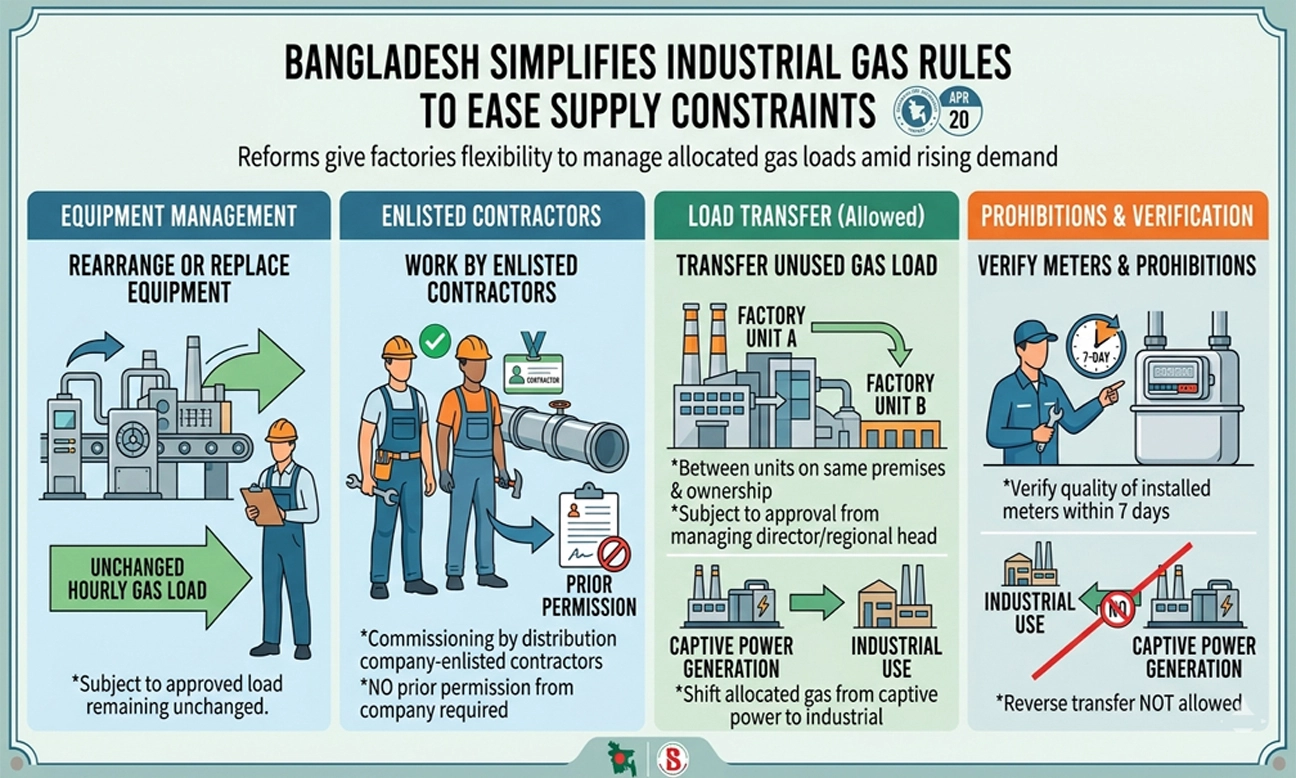
Bangladesh has introduced a series of reforms to simplify its industrial gas distribution system, allowing factories greater flexibility in managing allocated gas loads amid rising demand for energy.
The Power, Energy and Mineral Resources Division issued a circular on April 20 outlining revised guidelines aimed at making gas services more efficient and customer-friendly, while addressing longstanding operational bottlenecks faced by industrial users.
Under the new rules, industrial units will be allowed to rearrange or replace gas equipment as long as their approved hourly gas load remains unchanged.
The commissioning of such work must be carried out by contractors enlisted with the relevant gas distribution companies, although prior permission from those companies will no longer be required.
The circular also permits the transfer of unused gas load between units located within the same premises and under the same ownership, subject to approval from the managing director or regional head of the respective gas distribution company.
In addition, factories will be able to shift gas load allocated under captive power generation to industrial use within the same premises and ownership structure.
However, the reverse transfer—from industrial use to captive power—will not be allowed.
To ensure accountability, gas distribution and marketing companies have been instructed to verify the quality of installed meters within seven days.
Industry leaders have broadly welcomed the move. The Bangladesh Textile Mills Association (BTMA), representing primary textile producers, described the reforms as ‘positive and timely’.
The association said the measures would help boost productivity, lower operational costs and improve energy management, particularly for energy-intensive sectors such as textiles and garments, which remain central to the country’s export economy.
The reforms come as Bangladesh faces mounting pressure on its gas supply, with policymakers seeking to balance industrial growth with limited domestic energy resources.