6:17 pm, Saturday, 8 November 2025

Govt seeks three-year deferral of LDC graduation

  • Bizbd Report
  • Update Time : 06:46:07 pm, Tuesday, 16 September 2025
  • 283

Bangladesh government is pursuing a three-year deferral of the country’s graduation from the United Nations’ Least Developed Country (LDC) status, following pressure from the business community.

The country is scheduled to graduate from the LDC category in November 2026.

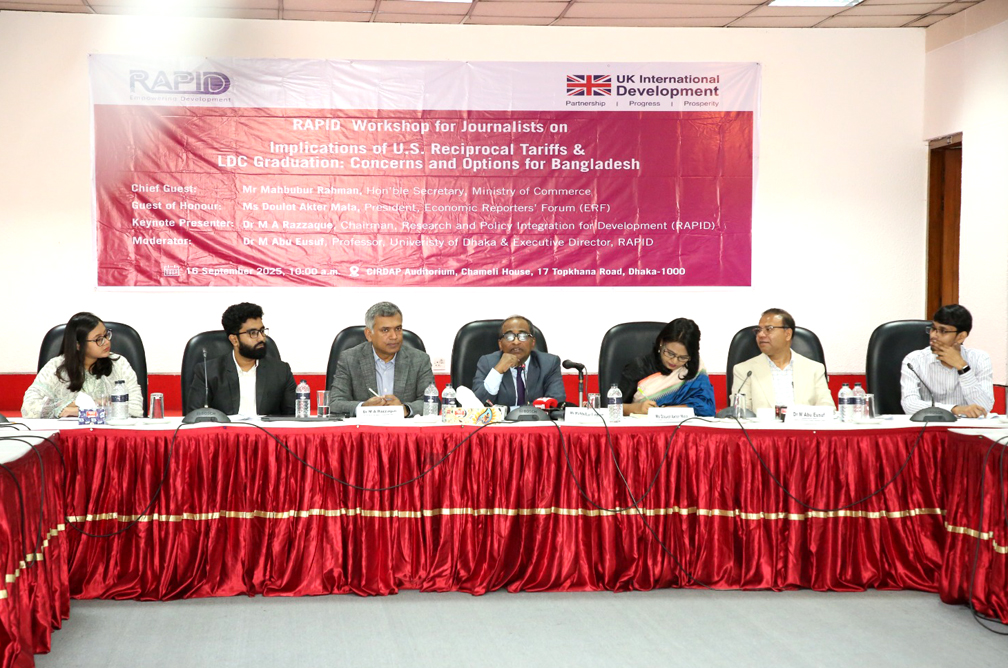
Speaking at an event on Tuesday, organised by the Research and Policy Integration for Development (RAPID) at the CIRDAP auditorium in Dhaka, Commerce Ministry Secretary Mahbubur Rahman said the government is actively seeking an extension of the LDC transition period.

‘In this regard, we are consulting with experts and will make every possible effort,’ he said, adding that while prospects are not highly encouraging, there is no reason to be entirely disheartened.

The workshop, titled ‘RAPID Workshop for Journalists on Implications of US Reciprocal Tariffs & LDC Graduation: Concerns and Options for Bangladesh’, also addressed trade and export strategies.

Commerce secretary said that delaying the graduation would require a resolution to be passed at the United Nations General Assembly.

‘However, some of Bangladesh’s key development partners, including Japan, Turkey, India and the United States, do not favour the extension,’ he said, acknowledging that this makes securing approval challenging.

He said that the government is engaging with development partners to obtain technical assistance instead.

The commerce secretary also emphasised the need to expand Bangladesh’s export basket to strengthen its negotiation capacity.

‘We are working to enhance our negotiating capacity by forming a negotiation pool with private specialists,’ he said.

Highlighting the limitations of existing trade agreements, he said that although China had provided zero-duty access to almost all Bangladeshi products, the country had been unable to increase its exports to China, pointing to the significant trade deficit with the East Asian nation.

Commerce secretary also cautioned that negotiating deals based on a single product, such as readymade garments, was not advisable, and stressed the importance of building capacity and investing in new industries to address post-LDC challenges.

On tariffs, Mahbub said that Bangladesh had initiated FTA negotiations with the United States under the TICFA and the 2013 investment treaty.

He said that the USTR was negotiating with 154 countries and noted that a USTR delegation led by Brendan Lynch had arrived in Bangladesh on Sunday, demonstrating the country’s importance to them.

Commerce seretary emphasised the need for investment in key sectors to address post-LDC and tariff-related challenges and observed that exporters might lose some incentives after graduation.

Regarding financial stability, Mahbub said that efforts were underway to strengthen foreign currency reserves and the exchange rate, both of which were crucial for attracting investment.

He added that he did not consider the LDC graduation to be as alarming as it might appear.

During the event, RAPID Chairman M A Razzaque presented a research report on the potential impact of US reciprocal tariffs on Bangladesh’s exports.

According to the report, Bangladesh’s global trade could decline by 0.77 per cent due to the tariffs.

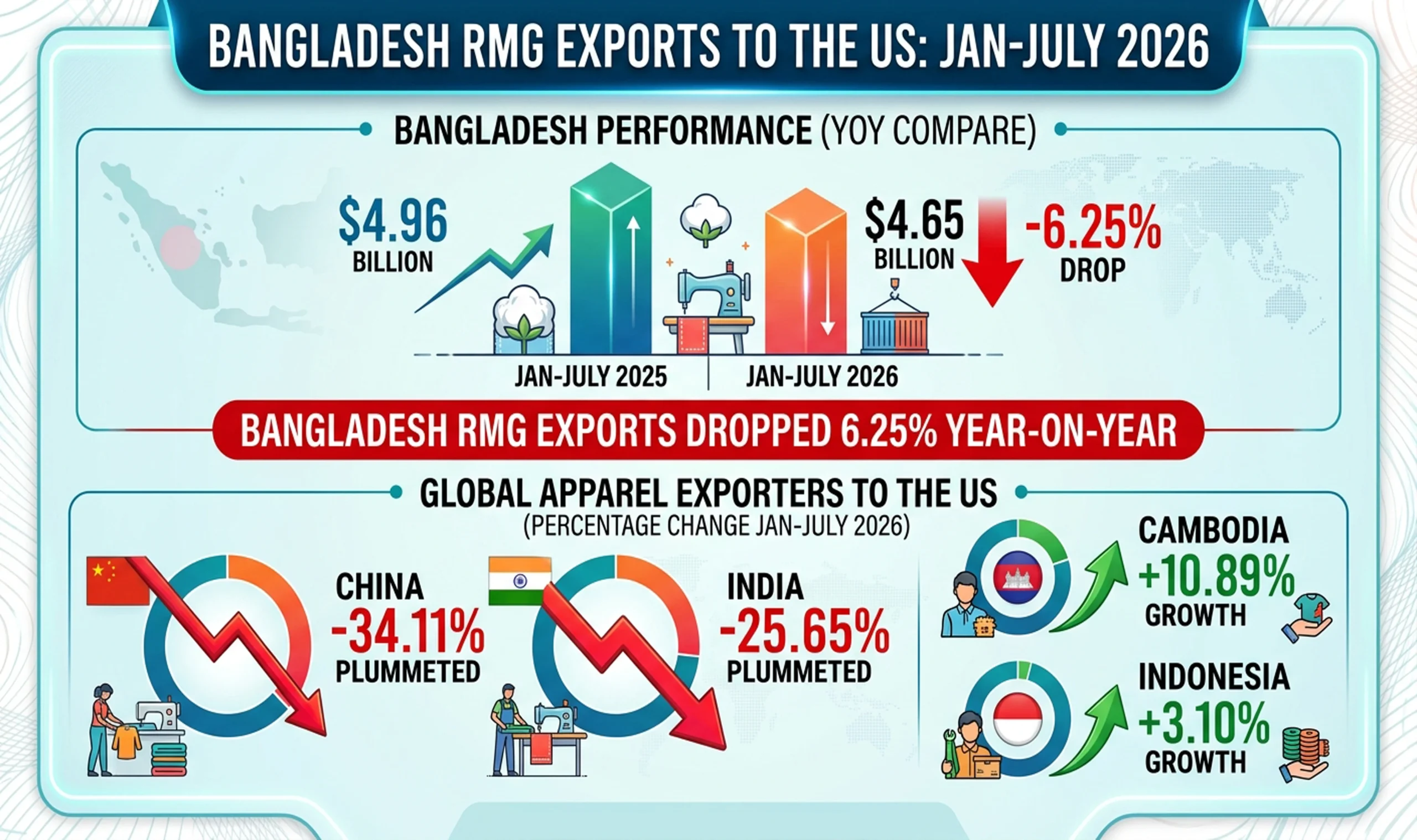
It projected that reciprocal tariffs could reduce Bangladesh’s exports to the US by up to 14 per cent, equivalent to $1.25 billion, including $1.08 billion in the readymade garment sector, over the next year.

The report also highlighted similar export declines in other countries, with China’s exports to the US falling by 58 per cent, India’s by 48 per cent, Vietnam’s by 28 per cent, and Indonesia’s by 27 per cent.

It warned that if India secures a trade deal reducing its reciprocal tariff by 20 per cent, Bangladesh’s export decline could deepen to 17.46 per cent, while India’s would reduce to 18.33 per cent.

Following LDC graduation, the report mentioned, Bangladesh is likely to face tariff increases in major export markets.

It also described the deferment process under the Committee for Development Policy (CDP) as complex, requiring formal application, CDP review, recommendations to ECOSOC, ECOSOC review, and a final consensus decision by the UN General Assembly.

Limited time and disunity among G77 members make deferment almost impossible, the report concluded.

Doulat Akter Mala, president of the Economic Reporters Forum, and Mohammed Abu Eusuf, executive director of RAPID, also spoke at the event.
Govt seeks three-year deferral of LDC graduation

Update Time : 06:46:07 pm, Tuesday, 16 September 2025

Bangladesh government is pursuing a three-year deferral of the country’s graduation from the United Nations’ Least Developed Country (LDC) status, following pressure from the business community.

The country is scheduled to graduate from the LDC category in November 2026.

Speaking at an event on Tuesday, organised by the Research and Policy Integration for Development (RAPID) at the CIRDAP auditorium in Dhaka, Commerce Ministry Secretary Mahbubur Rahman said the government is actively seeking an extension of the LDC transition period.

‘In this regard, we are consulting with experts and will make every possible effort,’ he said, adding that while prospects are not highly encouraging, there is no reason to be entirely disheartened.

The workshop, titled ‘RAPID Workshop for Journalists on Implications of US Reciprocal Tariffs & LDC Graduation: Concerns and Options for Bangladesh’, also addressed trade and export strategies.

Commerce secretary said that delaying the graduation would require a resolution to be passed at the United Nations General Assembly.

‘However, some of Bangladesh’s key development partners, including Japan, Turkey, India and the United States, do not favour the extension,’ he said, acknowledging that this makes securing approval challenging.

He said that the government is engaging with development partners to obtain technical assistance instead.

The commerce secretary also emphasised the need to expand Bangladesh’s export basket to strengthen its negotiation capacity.

‘We are working to enhance our negotiating capacity by forming a negotiation pool with private specialists,’ he said.

Highlighting the limitations of existing trade agreements, he said that although China had provided zero-duty access to almost all Bangladeshi products, the country had been unable to increase its exports to China, pointing to the significant trade deficit with the East Asian nation.

Commerce secretary also cautioned that negotiating deals based on a single product, such as readymade garments, was not advisable, and stressed the importance of building capacity and investing in new industries to address post-LDC challenges.

On tariffs, Mahbub said that Bangladesh had initiated FTA negotiations with the United States under the TICFA and the 2013 investment treaty.

He said that the USTR was negotiating with 154 countries and noted that a USTR delegation led by Brendan Lynch had arrived in Bangladesh on Sunday, demonstrating the country’s importance to them.

Commerce seretary emphasised the need for investment in key sectors to address post-LDC and tariff-related challenges and observed that exporters might lose some incentives after graduation.

Regarding financial stability, Mahbub said that efforts were underway to strengthen foreign currency reserves and the exchange rate, both of which were crucial for attracting investment.

He added that he did not consider the LDC graduation to be as alarming as it might appear.

During the event, RAPID Chairman M A Razzaque presented a research report on the potential impact of US reciprocal tariffs on Bangladesh’s exports.

According to the report, Bangladesh’s global trade could decline by 0.77 per cent due to the tariffs.

It projected that reciprocal tariffs could reduce Bangladesh’s exports to the US by up to 14 per cent, equivalent to $1.25 billion, including $1.08 billion in the readymade garment sector, over the next year.

The report also highlighted similar export declines in other countries, with China’s exports to the US falling by 58 per cent, India’s by 48 per cent, Vietnam’s by 28 per cent, and Indonesia’s by 27 per cent.

It warned that if India secures a trade deal reducing its reciprocal tariff by 20 per cent, Bangladesh’s export decline could deepen to 17.46 per cent, while India’s would reduce to 18.33 per cent.

Following LDC graduation, the report mentioned, Bangladesh is likely to face tariff increases in major export markets.

It also described the deferment process under the Committee for Development Policy (CDP) as complex, requiring formal application, CDP review, recommendations to ECOSOC, ECOSOC review, and a final consensus decision by the UN General Assembly.

Limited time and disunity among G77 members make deferment almost impossible, the report concluded.

Doulat Akter Mala, president of the Economic Reporters Forum, and Mohammed Abu Eusuf, executive director of RAPID, also spoke at the event.