10:07 am, Monday, 14 September 2026

Fresh wage review for private industrial workers

The Minimum Wage Board will hold further discussions with relevant stakeholders to reconsider the proposed minimum wages for workers in private industrial establishments, excluding agricultural and domestic workers, following strong objections from rights groups and major trade unions.

The decision was taken at a meeting of the Wage Board on September 6, according to sources present at the meeting.

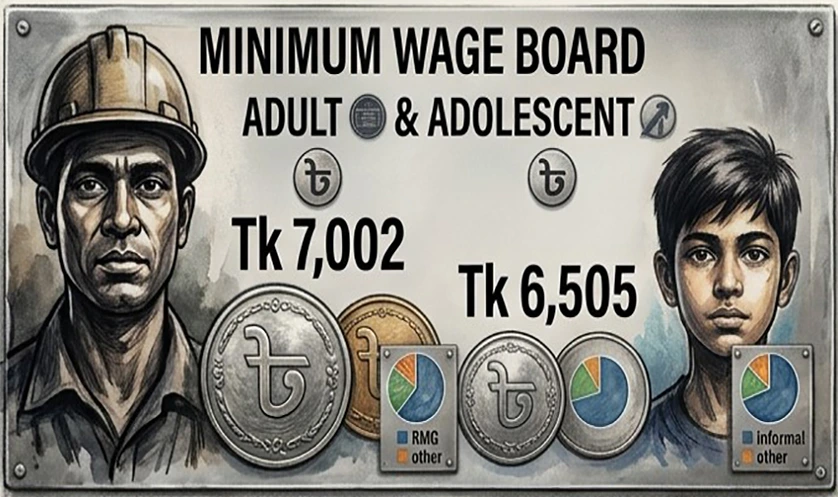
The board had earlier recommended, through a gazette notification issued on August 3, a minimum monthly wage of Tk 7,002 for adult unskilled workers and Tk 6,505 for adolescent workers employed in private industrial establishments, many of which operate in the informal sector.

It had invited recommendations and objections from members of the public and industry stakeholders within 14 days of the gazette’s publication.

Several labour rights organisations, including the Jatiya Shramik Federation, Sammilito Shramik Federation and Samajtantrik Shramik Front, submitted strong objections to the proposed rates.

They called for the draft proposal to be withdrawn immediately and urged the board to hold formal hearings based on field-level expenditure data to reassess the wages.

Razekuzzaman Ratan, president of the Samajtantrik Shramik Front, described the proposed wages as unacceptable and called for the rates to be fixed afresh.

In his objection letter, he argued that daily wage rates of Tk 700 to Tk 850, which had been fixed for divisional cities in 2025, should be taken into consideration.

Citing high inflation and rising living costs, Ratan rejected the proposed daily wage equivalent of Tk 235 and called for the rates to be reassessed through consultation with and feedback from labour representatives.

The rights groups also argued that maintaining separate wage tiers for adult unskilled and young workers directly contradicted Section 141 of the Bangladesh Labour Act, 2006.

They said wage determination should move beyond employers’ ability to pay and instead follow a living-wage model based on actual living costs, market prices, inflation, national income, worker productivity and family needs.

They further argued that wages for young workers should be determined strictly on the basis of output and working hours, rather than age, to prevent age from being used to deny workers fair pay.

The groups also demanded a baseline minimum wage that would ensure workers were not forced to live below the national poverty line.

Syed Sultan Uddin Ahmed, executive director of the Bangladesh Institute of Labour Studies and a former chairman of the Labour Reform Commission, said they had proposed at Sunday’s meeting that the Wage Board formulate a new wage proposal by taking into account key indicators, including relevant legal provisions, inflation, the cost of living and the recently announced pay scale for public officials.

He said that, given the large number of sectors involved and the difficulty of ensuring representation from owners and workers from every sector, neutral representatives from both sides should be included on the board to help address the issue.

The meeting had decided to hold further consultations with relevant stakeholders as part of the process of reassessing the proposed wages, he added.
Fresh wage review for private industrial workers

Update Time : 11:22:40 pm, Monday, 7 September 2026

The Minimum Wage Board will hold further discussions with relevant stakeholders to reconsider the proposed minimum wages for workers in private industrial establishments, excluding agricultural and domestic workers, following strong objections from rights groups and major trade unions.

The decision was taken at a meeting of the Wage Board on September 6, according to sources present at the meeting.

The board had earlier recommended, through a gazette notification issued on August 3, a minimum monthly wage of Tk 7,002 for adult unskilled workers and Tk 6,505 for adolescent workers employed in private industrial establishments, many of which operate in the informal sector.

It had invited recommendations and objections from members of the public and industry stakeholders within 14 days of the gazette’s publication.

Several labour rights organisations, including the Jatiya Shramik Federation, Sammilito Shramik Federation and Samajtantrik Shramik Front, submitted strong objections to the proposed rates.

They called for the draft proposal to be withdrawn immediately and urged the board to hold formal hearings based on field-level expenditure data to reassess the wages.

Razekuzzaman Ratan, president of the Samajtantrik Shramik Front, described the proposed wages as unacceptable and called for the rates to be fixed afresh.

In his objection letter, he argued that daily wage rates of Tk 700 to Tk 850, which had been fixed for divisional cities in 2025, should be taken into consideration.

Citing high inflation and rising living costs, Ratan rejected the proposed daily wage equivalent of Tk 235 and called for the rates to be reassessed through consultation with and feedback from labour representatives.

The rights groups also argued that maintaining separate wage tiers for adult unskilled and young workers directly contradicted Section 141 of the Bangladesh Labour Act, 2006.

They said wage determination should move beyond employers’ ability to pay and instead follow a living-wage model based on actual living costs, market prices, inflation, national income, worker productivity and family needs.

They further argued that wages for young workers should be determined strictly on the basis of output and working hours, rather than age, to prevent age from being used to deny workers fair pay.

The groups also demanded a baseline minimum wage that would ensure workers were not forced to live below the national poverty line.

Syed Sultan Uddin Ahmed, executive director of the Bangladesh Institute of Labour Studies and a former chairman of the Labour Reform Commission, said they had proposed at Sunday’s meeting that the Wage Board formulate a new wage proposal by taking into account key indicators, including relevant legal provisions, inflation, the cost of living and the recently announced pay scale for public officials.

He said that, given the large number of sectors involved and the difficulty of ensuring representation from owners and workers from every sector, neutral representatives from both sides should be included on the board to help address the issue.

The meeting had decided to hold further consultations with relevant stakeholders as part of the process of reassessing the proposed wages, he added.