2:32 pm, Tuesday, 27 October 2026

Fashion brands urged to share Bangladesh’s clean energy transition costs

Global fashion brands must share the cost of Bangladesh’s transition to clean energy, with industry stakeholders calling for fair purchasing practices, accessible financing and stronger worker protections to ensure decarbonisation does not threaten jobs and livelihoods.

Fifteen fashion brands could help Bangladesh avoid 1.26 million tonnes of carbon dioxide emissions annually by 2040, equivalent to 8.59 million tonnes cumulatively, according to a study by the Stand.earth Research Group.

The findings highlight the potential contribution of international buyers to reducing emissions in Bangladesh’s garment industry, the world’s second-largest apparel exporter. However, the financial support currently provided by fashion brands remains limited.

The 2025 Fossil Free Fashion Scorecard found that only six of 42 major fashion brands offered suppliers financing for decarbonisation, while just one provided support without increasing suppliers’ debt burden.

Around 90 per cent of the fashion sector’s energy still comes from fossil gas burned on-site, underscoring the scale of the challenge in shifting towards cleaner energy sources.

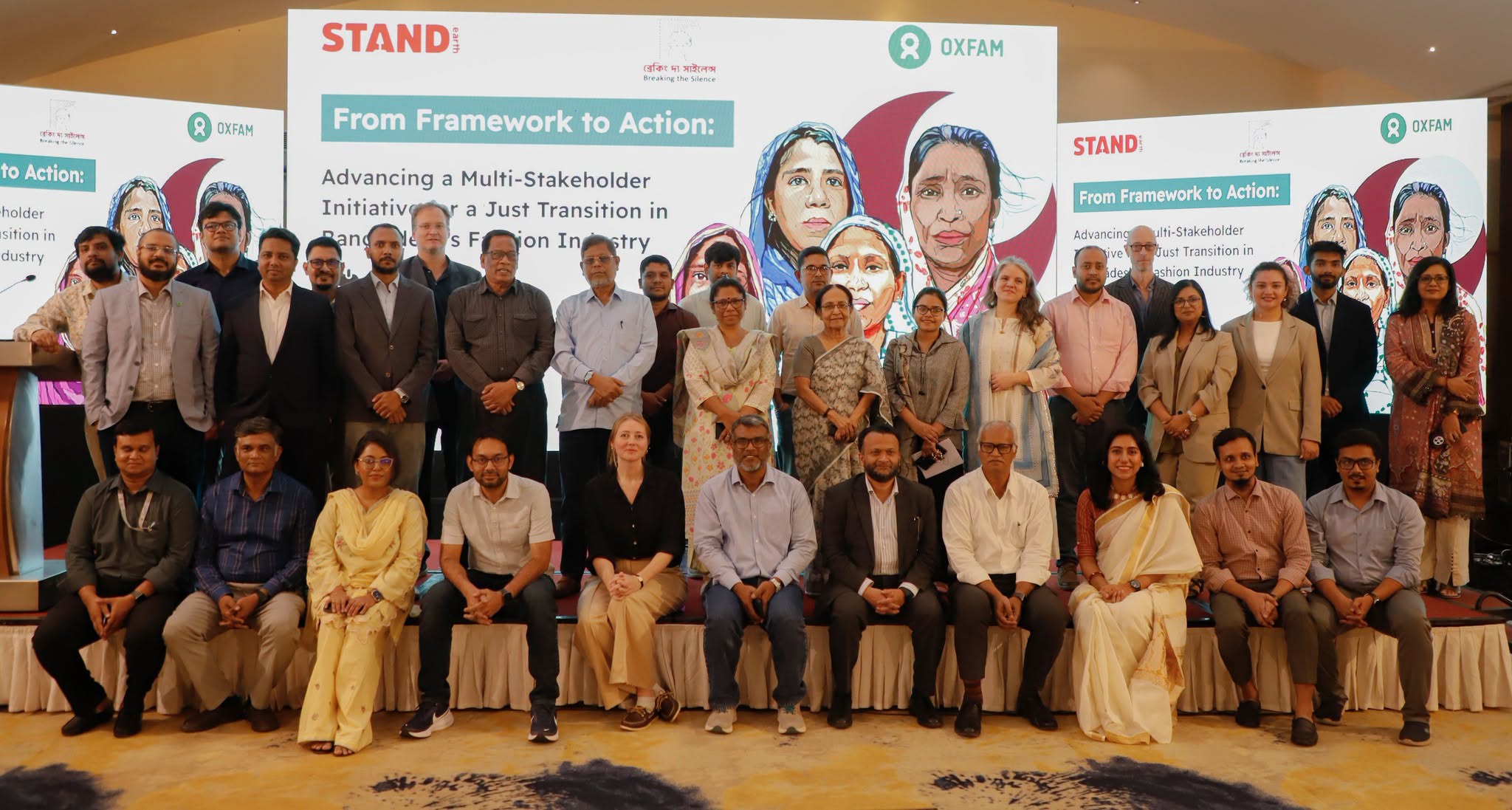
The issues were raised at a national multi-stakeholder dialogue in Dhaka on Monday titled ‘From Framework to Action: Advancing a Multi-Stakeholder Initiative for a Just Transition in Bangladesh’s Fashion Industry’.

Stand.earth, Oxfam in Bangladesh and Breaking the Silence jointly organised the event, which brought together policymakers, fashion brands, manufacturers, trade unions, the International Labour Organization, GIZ and Cornell University’s Global Labour Institute.

Participants stressed that investments in renewable energy and electrification must be accompanied by fairer sourcing practices, affordable financing, skills development and safeguards for workers, particularly women, who face growing climate-related risks.

Speaking as chief guest, Kazi Rafiqul Islam, a member of parliament and the Parliamentary Standing Committee on the Ministry of Planning, said the energy transition was not merely a technological shift but an economic, social and humanitarian transformation.

He said the move towards environmentally friendly production must not come at the expense of workers’ employment, fair wages, workplace safety or social security.

Razequzzaman Ratan, president of the Socialist Labour Front, questioned how the costs and benefits of the transition were being distributed, arguing that the burden was falling on the industry and workers while it remained unclear who was benefiting.

Rachel Kitchin, senior campaign manager at Stand.earth, called on fashion brands to contribute their fair share of the costs of decarbonisation and energy efficiency through collective, shared or grant-based financing.

She also advocated industry-wide financing mechanisms, including nationally or globally administered funds, to mobilise resources for climate action.

Rumana Rashid, director of the Bangladesh Garment Manufacturers and Exporters Association, said workers must receive training and opportunities to develop new skills as factories adopted cleaner energy, more efficient machinery and new production systems.

She also stressed the need for safer workplaces and meaningful worker participation in decisions affecting their jobs and working conditions.

Atwar Rahman, interim head of the Project Management Unit at Oxfam in Bangladesh, said climate justice and economic justice must advance together to ensure that vulnerable communities did not bear the costs of climate action.

Roksana Sultana, executive director of Breaking the Silence, said factory owners could not finance the transition alone and called for coordinated support from governments, international brands, development partners and financial institutions.

Bangladesh, the world’s second-largest apparel exporter and the ninth most climate-vulnerable country, has around four million garment workers who face increasing exposure to extreme heat and flooding.

Participants urged fashion brands to join the Clean Fashion Investment Pact and translate their corporate commitments into practical action.

Their proposals included pooled and grant-based financing, incorporating decarbonisation costs into prices paid by international buyers, enforceable protections against workplace heat and greater representation of women workers in decisions related to the transition.

They emphasised that a shift to cleaner production must ensure that the financial burden does not fall disproportionately on manufacturers and workers while global brands continue to benefit from the industry’s supply chains.
Fashion brands urged to share Bangladesh’s clean energy transition costs

Update Time : 10:55:33 pm, Monday, 26 October 2026

Global fashion brands must share the cost of Bangladesh’s transition to clean energy, with industry stakeholders calling for fair purchasing practices, accessible financing and stronger worker protections to ensure decarbonisation does not threaten jobs and livelihoods.

Fifteen fashion brands could help Bangladesh avoid 1.26 million tonnes of carbon dioxide emissions annually by 2040, equivalent to 8.59 million tonnes cumulatively, according to a study by the Stand.earth Research Group.

The findings highlight the potential contribution of international buyers to reducing emissions in Bangladesh’s garment industry, the world’s second-largest apparel exporter. However, the financial support currently provided by fashion brands remains limited.

The 2025 Fossil Free Fashion Scorecard found that only six of 42 major fashion brands offered suppliers financing for decarbonisation, while just one provided support without increasing suppliers’ debt burden.

Around 90 per cent of the fashion sector’s energy still comes from fossil gas burned on-site, underscoring the scale of the challenge in shifting towards cleaner energy sources.

The issues were raised at a national multi-stakeholder dialogue in Dhaka on Monday titled ‘From Framework to Action: Advancing a Multi-Stakeholder Initiative for a Just Transition in Bangladesh’s Fashion Industry’.

Stand.earth, Oxfam in Bangladesh and Breaking the Silence jointly organised the event, which brought together policymakers, fashion brands, manufacturers, trade unions, the International Labour Organization, GIZ and Cornell University’s Global Labour Institute.

Participants stressed that investments in renewable energy and electrification must be accompanied by fairer sourcing practices, affordable financing, skills development and safeguards for workers, particularly women, who face growing climate-related risks.

Speaking as chief guest, Kazi Rafiqul Islam, a member of parliament and the Parliamentary Standing Committee on the Ministry of Planning, said the energy transition was not merely a technological shift but an economic, social and humanitarian transformation.

He said the move towards environmentally friendly production must not come at the expense of workers’ employment, fair wages, workplace safety or social security.

Razequzzaman Ratan, president of the Socialist Labour Front, questioned how the costs and benefits of the transition were being distributed, arguing that the burden was falling on the industry and workers while it remained unclear who was benefiting.

Rachel Kitchin, senior campaign manager at Stand.earth, called on fashion brands to contribute their fair share of the costs of decarbonisation and energy efficiency through collective, shared or grant-based financing.

She also advocated industry-wide financing mechanisms, including nationally or globally administered funds, to mobilise resources for climate action.

Rumana Rashid, director of the Bangladesh Garment Manufacturers and Exporters Association, said workers must receive training and opportunities to develop new skills as factories adopted cleaner energy, more efficient machinery and new production systems.

She also stressed the need for safer workplaces and meaningful worker participation in decisions affecting their jobs and working conditions.

Atwar Rahman, interim head of the Project Management Unit at Oxfam in Bangladesh, said climate justice and economic justice must advance together to ensure that vulnerable communities did not bear the costs of climate action.

Roksana Sultana, executive director of Breaking the Silence, said factory owners could not finance the transition alone and called for coordinated support from governments, international brands, development partners and financial institutions.

Bangladesh, the world’s second-largest apparel exporter and the ninth most climate-vulnerable country, has around four million garment workers who face increasing exposure to extreme heat and flooding.

Participants urged fashion brands to join the Clean Fashion Investment Pact and translate their corporate commitments into practical action.

Their proposals included pooled and grant-based financing, incorporating decarbonisation costs into prices paid by international buyers, enforceable protections against workplace heat and greater representation of women workers in decisions related to the transition.

They emphasised that a shift to cleaner production must ensure that the financial burden does not fall disproportionately on manufacturers and workers while global brands continue to benefit from the industry’s supply chains.