4:38 am, Friday, 2 October 2026

Bangladesh’s RMG industry caught in global sourcing realignment

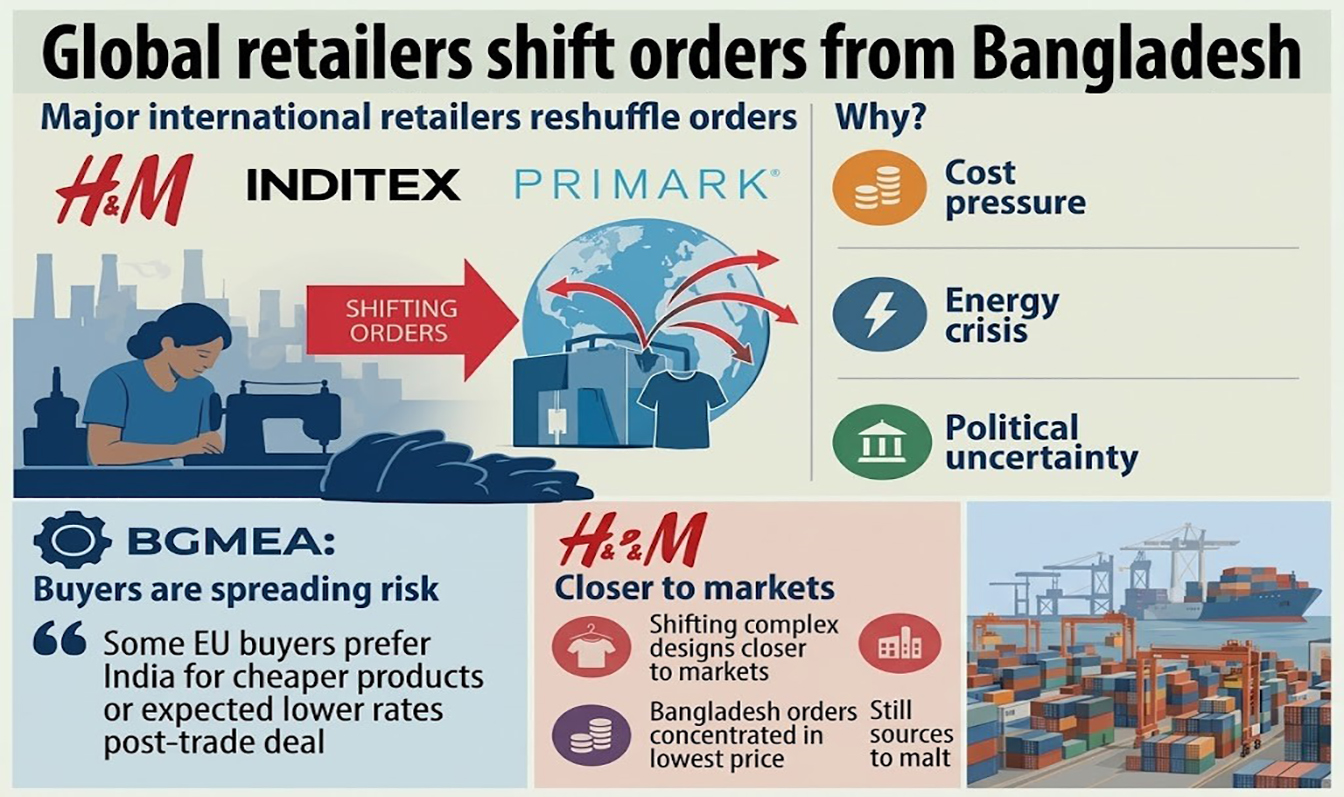
International fashion retailers are gradually shifting garment orders away from Bangladesh as they restructure global supply chains to reduce operational, geopolitical and energy-related risks, creating fresh challenges for the country’s readymade garment industry.

Industry insiders said uncertainty over Bangladesh’s graduation from least developed country status and the possible erosion of duty-free market access, trade advantages enjoyed by competing suppliers, previous political turmoil, rising production costs and energy shortages were among the factors influencing buyers’ sourcing decisions.

Several garment manufacturers said major European retailers, including H&M, Inditex and Primark, were gradually shifting orders from Bangladesh to other sourcing destinations, particularly India, where products were becoming cheaper and buyers expected further cost advantages from a proposed India-European Union trade agreement.

Bangladesh Garment Manufacturers and Exporters Association president Mahmud Hasan Khan acknowledged that international buyers were adjusting their procurement models to spread risks across sourcing destinations.

‘Buyers constantly balance their need for quality apparel against cost efficiency, meaning they will rarely depend on a single country for their entire inventory,’ he said, adding that determining sourcing strategies was an ongoing task for both brands and suppliers.

Although Mahmud Hasan Khan declined to disclose specific order volumes or identify brands shifting orders elsewhere, he said the BGMEA had launched proactive campaigns to attract new global buyers while persuading existing partners to increase their procurement volumes.

An exporter supplying garments to the European market said major buyers, particularly H&M, Inditex and Primark, were gradually shifting orders to other destinations, preferably India, as they could obtain products at lower prices or expected further cost advantages once the proposed India-EU trade agreement came into effect.

He said a buying house working for Primark had recently taken steps to establish two new offices in India, indicating growing interest in the country as a sourcing destination.

A recent Clean Clothes Campaign report also highlighted how leading fast-fashion companies were restructuring the types of garments they sourced from different regions, with implications for Bangladesh’s position in global apparel supply chains.

The report found that Swedish retailer H&M was pursuing a proximity-sourcing strategy, moving production of complex T-shirt designs closer to consumer markets while concentrating basic, entry-level styles in Bangladesh.

The shift had resulted in a sharp decline in H&M’s order volumes for Bangladeshi cotton T-shirts, with local orders increasingly concentrated in the lowest price bracket, according to the report.

It also identified a notable reversal in procurement prices between H&M and Inditex, the parent company of Zara. In 2021, H&M paid an average T-shirt procurement price 16 per cent higher than Inditex, but by 2025 Inditex was paying roughly 6 per cent more than H&M.

The report said the pricing trend underscored Bangladesh’s vulnerability as a sourcing hub primarily for the cheapest and most basic garment products.

As international fashion brands prioritise geographical proximity and energy stability to strengthen supply-chain resilience, Bangladeshi manufacturers face the dual challenge of defending their market share in low-cost basic items while developing capacity to produce higher-value and more complex apparel.

Responding to questions, H&M Group media relations officer Pernille Skanvig Schønau declined to disclose specific figures, including production volumes or Bangladesh’s share of the company’s total order book, citing commercial sensitivity.

She said the company continuously evolved its supply-chain approach, drawing on its extensive industry experience while keeping products and customers at the centre of its operations.

H&M was continuing to build a resilient, flexible and agile supply chain capable of adapting to changing circumstances and customer needs, while maintaining a balanced portfolio of suppliers and geographical distribution, she said.

‘As part of this, we are consolidating our supply chain to fewer, more strategic partners, across all our sourcing markets. This enables us to deliver consistent product quality and strong sustainability performance, which also translates into stronger business opportunities for our suppliers through stable orders and greater predictability beyond individual seasons,’ she said.

Schønau also reaffirmed Bangladesh’s importance as a sourcing market for H&M, noting that the retailer had maintained a presence in the country for four decades and that long-term partnerships with local manufacturers remained central to its global operations.

However, H&M’s latest publicly available supplier list showed that 189 production units or factories in Bangladesh were producing garments for the retailer, down from approximately 235 factories in its 2020 supplier list.

Industry insiders estimated that H&M sourced apparel worth $3 billion to $3.5 billion from Bangladesh annually, making the country one of its largest production hubs.

The developments highlight the growing pressure on Bangladesh’s garment industry to retain existing sourcing relationships while competing on cost, supply-chain resilience and product capabilities as international retailers reassess their global procurement strategies.
Bangladesh’s RMG industry caught in global sourcing realignment

Update Time : 12:18:04 am, Friday, 2 October 2026

International fashion retailers are gradually shifting garment orders away from Bangladesh as they restructure global supply chains to reduce operational, geopolitical and energy-related risks, creating fresh challenges for the country’s readymade garment industry.

Industry insiders said uncertainty over Bangladesh’s graduation from least developed country status and the possible erosion of duty-free market access, trade advantages enjoyed by competing suppliers, previous political turmoil, rising production costs and energy shortages were among the factors influencing buyers’ sourcing decisions.

Several garment manufacturers said major European retailers, including H&M, Inditex and Primark, were gradually shifting orders from Bangladesh to other sourcing destinations, particularly India, where products were becoming cheaper and buyers expected further cost advantages from a proposed India-European Union trade agreement.

Bangladesh Garment Manufacturers and Exporters Association president Mahmud Hasan Khan acknowledged that international buyers were adjusting their procurement models to spread risks across sourcing destinations.

‘Buyers constantly balance their need for quality apparel against cost efficiency, meaning they will rarely depend on a single country for their entire inventory,’ he said, adding that determining sourcing strategies was an ongoing task for both brands and suppliers.

Although Mahmud Hasan Khan declined to disclose specific order volumes or identify brands shifting orders elsewhere, he said the BGMEA had launched proactive campaigns to attract new global buyers while persuading existing partners to increase their procurement volumes.

An exporter supplying garments to the European market said major buyers, particularly H&M, Inditex and Primark, were gradually shifting orders to other destinations, preferably India, as they could obtain products at lower prices or expected further cost advantages once the proposed India-EU trade agreement came into effect.

He said a buying house working for Primark had recently taken steps to establish two new offices in India, indicating growing interest in the country as a sourcing destination.

A recent Clean Clothes Campaign report also highlighted how leading fast-fashion companies were restructuring the types of garments they sourced from different regions, with implications for Bangladesh’s position in global apparel supply chains.

The report found that Swedish retailer H&M was pursuing a proximity-sourcing strategy, moving production of complex T-shirt designs closer to consumer markets while concentrating basic, entry-level styles in Bangladesh.

The shift had resulted in a sharp decline in H&M’s order volumes for Bangladeshi cotton T-shirts, with local orders increasingly concentrated in the lowest price bracket, according to the report.

It also identified a notable reversal in procurement prices between H&M and Inditex, the parent company of Zara. In 2021, H&M paid an average T-shirt procurement price 16 per cent higher than Inditex, but by 2025 Inditex was paying roughly 6 per cent more than H&M.

The report said the pricing trend underscored Bangladesh’s vulnerability as a sourcing hub primarily for the cheapest and most basic garment products.

As international fashion brands prioritise geographical proximity and energy stability to strengthen supply-chain resilience, Bangladeshi manufacturers face the dual challenge of defending their market share in low-cost basic items while developing capacity to produce higher-value and more complex apparel.

Responding to questions, H&M Group media relations officer Pernille Skanvig Schønau declined to disclose specific figures, including production volumes or Bangladesh’s share of the company’s total order book, citing commercial sensitivity.

She said the company continuously evolved its supply-chain approach, drawing on its extensive industry experience while keeping products and customers at the centre of its operations.

H&M was continuing to build a resilient, flexible and agile supply chain capable of adapting to changing circumstances and customer needs, while maintaining a balanced portfolio of suppliers and geographical distribution, she said.

‘As part of this, we are consolidating our supply chain to fewer, more strategic partners, across all our sourcing markets. This enables us to deliver consistent product quality and strong sustainability performance, which also translates into stronger business opportunities for our suppliers through stable orders and greater predictability beyond individual seasons,’ she said.

Schønau also reaffirmed Bangladesh’s importance as a sourcing market for H&M, noting that the retailer had maintained a presence in the country for four decades and that long-term partnerships with local manufacturers remained central to its global operations.

However, H&M’s latest publicly available supplier list showed that 189 production units or factories in Bangladesh were producing garments for the retailer, down from approximately 235 factories in its 2020 supplier list.

Industry insiders estimated that H&M sourced apparel worth $3 billion to $3.5 billion from Bangladesh annually, making the country one of its largest production hubs.

The developments highlight the growing pressure on Bangladesh’s garment industry to retain existing sourcing relationships while competing on cost, supply-chain resilience and product capabilities as international retailers reassess their global procurement strategies.