4:26 am, Saturday, 17 October 2026

Bangladesh leads EU apparel import decline as China, Vietnam gain

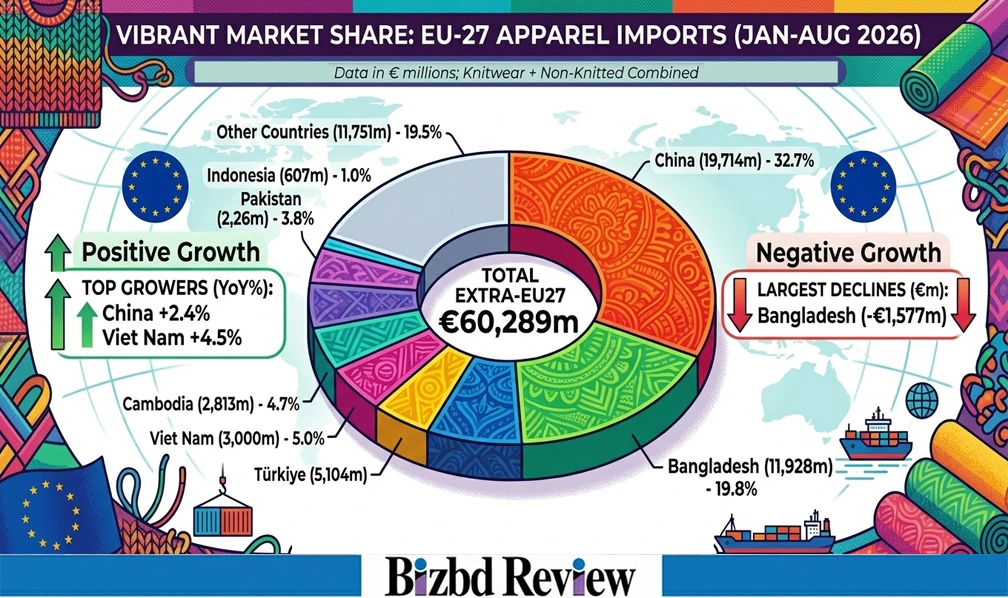
Bangladesh’s apparel shipments to the European Union fell 11.7 per cent year-on-year to €11.93 billion in January-August 2026, accounting for about two-thirds of the overall decline in the bloc’s apparel imports from outside the EU, while China and Vietnam increased their exports, according to Eurostat data.

The 27 nation bloc imported apparel worth €60.29 billion from non-EU countries during the first eight months of the year, down 3.8 per cent from €62.69 billion in the same period of 2025.

Bangladesh’s exports declined by €1.58 billion, from €13.51 billion, as the country’s share of the market fell from 21.5 per cent to 19.8 per cent.

The data, released on October 16, show that the decline in Bangladesh’s shipments was concentrated in the first five months of 2026, while exports stabilised from June, with year-on-year growth returning in July and August.

China remained the EU’s largest apparel supplier, with exports rising 2.4 per cent to €19.71 billion. Vietnam recorded the fastest growth among the eight major suppliers covered in the analysis, with shipments increasing 4.5 per cent to €3 billion.

The other major suppliers — Turkey, India, Cambodia, Pakistan and Indonesia — all recorded declines in export values during the period.

Bangladesh’s performance was weaker in both major apparel categories: knitted or crocheted garments and non-knitted garments, which mainly comprise woven products.

Exports of knitted apparel, Bangladesh’s largest product segment in the EU market, fell 12.1 per cent to €7.07 billion from €8.05 billion a year earlier.

Shipments of non-knitted apparel declined 11 per cent to €4.86 billion from €5.46 billion.

Knitwear accounted for about 59 per cent of Bangladesh’s total apparel shipments to the EU during the period.

Its value fell by almost €1 billion, the largest decline recorded for any country and product category in the dataset.

The fall in export value was substantially greater than the decline in shipment volumes. Bangladesh’s apparel shipments by weight dropped by about 4.6 per cent, from approximately 908,000 tonnes to 867,000 tonnes, while their total value fell 11.7 per cent.

The implied average price per kilogram declined by about 8 per cent for both knitted and non-knitted garments.

For knitwear, it fell from approximately €1.36 to €1.25 a kilogram, while the average for non-knitted apparel dropped from €1.73 to €1.60.

The figures suggest that lower prices or a shift towards cheaper products accounted for a substantial part of the decline, alongside reduced shipment volumes.

The monthly figures indicate a marked change in Bangladesh’s export performance as the year progressed.

Combined shipments of knitted and non-knitted apparel to the EU were down 25 per cent year-on-year in January, 13 per cent in February, 19 per cent in March, 19 per cent in April and 17 per cent in May.

The combined value of shipments during January-May was approximately €7.3 billion, compared with €9 billion in the same period of 2025, representing a decline of about 19 per cent.

The trend changed in June, when combined exports edged up 1 per cent year-on-year to €1.37 billion. Shipments rose 4 per cent to €1.74 billion in July and 1 per cent to €1.50 billion in August.

Combined exports during June-August were approximately €4.6 billion, about 2 per cent higher than a year earlier. The improvement meant that the overall eight-month shortfall was driven by the weak performance in the first five months.

The three months of improvement, however, are not sufficient to establish whether Bangladesh’s recovery in the EU market will continue.

China and Vietnam were the only two countries among the eight major suppliers to record growth in overall apparel exports to the EU during January-August.

China’s shipments increased by €458 million to €19.71 billion, lifting its share of extra-EU apparel imports from 30.7 per cent to 32.7 per cent.

Its knitwear exports rose 2.7 per cent to €10.3 billion, while non-knitted apparel exports increased 2 per cent to €9.5 billion.

Vietnam’s exports rose by €128 million to €3 billion. Its knitwear export value increased 6.1 per cent despite a 13 per cent fall in volume, as the average price per kilogram rose from approximately €2.14 to €2.61. The figures suggest a shift towards higher-value garments. Its non-knitted apparel exports grew 3.1 per cent, supported by a 4.6 per cent increase in volume.

Turkey, the EU’s third-largest supplier, recorded an 11 per cent decline in apparel export value to €5.10 billion. Its knitwear exports fell 11.9 per cent and non-knitted shipments dropped 9.8 per cent.

The data indicate that lower volumes, rather than a significant fall in average prices, accounted for much of the decline.

India’s exports fell 10.8 per cent to €3.08 billion, with knitwear shipments down 13.1 per cent and non-knitted apparel down 8.7 per cent.

Cambodia recorded a comparatively smaller overall decline of 4.5 per cent to €2.81 billion. Its knitwear exports fell 9.5 per cent, partly offset by a 2.1 per cent increase in non-knitted apparel.

Pakistan’s exports dropped 9.6 per cent to €2.30 billion. Its knitwear export value fell 13.5 per cent despite a 7.7 per cent increase in volume, as the average price per kilogram declined from approximately €1.12 to €0.90. Non-knitted apparel exports fell 6 per cent.

Indonesia, the smallest supplier among the eight countries, saw exports decline 11 per cent to €607 million, with shipments falling in both product categories.

The combined exports of the eight suppliers fell 4.8 per cent to €48.54 billion. Their decline of €2.45 billion was slightly greater than the €2.40 billion fall in total EU apparel imports from all non-EU countries, as imports from other suppliers collectively recorded a small net increase.

The figures also show that knitted apparel was under greater pressure than non-knitted products. Imports of knitwear from the eight suppliers fell 5.8 per cent, compared with a 3.6 per cent decline in non-knitted apparel.

The divergent performances suggest that the EU market’s contraction was accompanied by changes in supplier competitiveness and product pricing.

Bangladesh and Pakistan experienced sharper declines in export values than in volumes, whereas Turkey and India recorded substantial volume reductions alongside comparatively stable prices.
Bangladesh leads EU apparel import decline as China, Vietnam gain

Update Time : 09:27:44 pm, Friday, 16 October 2026

Bangladesh’s apparel shipments to the European Union fell 11.7 per cent year-on-year to €11.93 billion in January-August 2026, accounting for about two-thirds of the overall decline in the bloc’s apparel imports from outside the EU, while China and Vietnam increased their exports, according to Eurostat data.

The 27 nation bloc imported apparel worth €60.29 billion from non-EU countries during the first eight months of the year, down 3.8 per cent from €62.69 billion in the same period of 2025.

Bangladesh’s exports declined by €1.58 billion, from €13.51 billion, as the country’s share of the market fell from 21.5 per cent to 19.8 per cent.

The data, released on October 16, show that the decline in Bangladesh’s shipments was concentrated in the first five months of 2026, while exports stabilised from June, with year-on-year growth returning in July and August.

China remained the EU’s largest apparel supplier, with exports rising 2.4 per cent to €19.71 billion. Vietnam recorded the fastest growth among the eight major suppliers covered in the analysis, with shipments increasing 4.5 per cent to €3 billion.

The other major suppliers — Turkey, India, Cambodia, Pakistan and Indonesia — all recorded declines in export values during the period.

Bangladesh’s performance was weaker in both major apparel categories: knitted or crocheted garments and non-knitted garments, which mainly comprise woven products.

Exports of knitted apparel, Bangladesh’s largest product segment in the EU market, fell 12.1 per cent to €7.07 billion from €8.05 billion a year earlier.

Shipments of non-knitted apparel declined 11 per cent to €4.86 billion from €5.46 billion.

Knitwear accounted for about 59 per cent of Bangladesh’s total apparel shipments to the EU during the period.

Its value fell by almost €1 billion, the largest decline recorded for any country and product category in the dataset.

The fall in export value was substantially greater than the decline in shipment volumes. Bangladesh’s apparel shipments by weight dropped by about 4.6 per cent, from approximately 908,000 tonnes to 867,000 tonnes, while their total value fell 11.7 per cent.

The implied average price per kilogram declined by about 8 per cent for both knitted and non-knitted garments.

For knitwear, it fell from approximately €1.36 to €1.25 a kilogram, while the average for non-knitted apparel dropped from €1.73 to €1.60.

The figures suggest that lower prices or a shift towards cheaper products accounted for a substantial part of the decline, alongside reduced shipment volumes.

The monthly figures indicate a marked change in Bangladesh’s export performance as the year progressed.

Combined shipments of knitted and non-knitted apparel to the EU were down 25 per cent year-on-year in January, 13 per cent in February, 19 per cent in March, 19 per cent in April and 17 per cent in May.

The combined value of shipments during January-May was approximately €7.3 billion, compared with €9 billion in the same period of 2025, representing a decline of about 19 per cent.

The trend changed in June, when combined exports edged up 1 per cent year-on-year to €1.37 billion. Shipments rose 4 per cent to €1.74 billion in July and 1 per cent to €1.50 billion in August.

Combined exports during June-August were approximately €4.6 billion, about 2 per cent higher than a year earlier. The improvement meant that the overall eight-month shortfall was driven by the weak performance in the first five months.

The three months of improvement, however, are not sufficient to establish whether Bangladesh’s recovery in the EU market will continue.

China and Vietnam were the only two countries among the eight major suppliers to record growth in overall apparel exports to the EU during January-August.

China’s shipments increased by €458 million to €19.71 billion, lifting its share of extra-EU apparel imports from 30.7 per cent to 32.7 per cent.

Its knitwear exports rose 2.7 per cent to €10.3 billion, while non-knitted apparel exports increased 2 per cent to €9.5 billion.

Vietnam’s exports rose by €128 million to €3 billion. Its knitwear export value increased 6.1 per cent despite a 13 per cent fall in volume, as the average price per kilogram rose from approximately €2.14 to €2.61. The figures suggest a shift towards higher-value garments. Its non-knitted apparel exports grew 3.1 per cent, supported by a 4.6 per cent increase in volume.

Turkey, the EU’s third-largest supplier, recorded an 11 per cent decline in apparel export value to €5.10 billion. Its knitwear exports fell 11.9 per cent and non-knitted shipments dropped 9.8 per cent.

The data indicate that lower volumes, rather than a significant fall in average prices, accounted for much of the decline.

India’s exports fell 10.8 per cent to €3.08 billion, with knitwear shipments down 13.1 per cent and non-knitted apparel down 8.7 per cent.

Cambodia recorded a comparatively smaller overall decline of 4.5 per cent to €2.81 billion. Its knitwear exports fell 9.5 per cent, partly offset by a 2.1 per cent increase in non-knitted apparel.

Pakistan’s exports dropped 9.6 per cent to €2.30 billion. Its knitwear export value fell 13.5 per cent despite a 7.7 per cent increase in volume, as the average price per kilogram declined from approximately €1.12 to €0.90. Non-knitted apparel exports fell 6 per cent.

Indonesia, the smallest supplier among the eight countries, saw exports decline 11 per cent to €607 million, with shipments falling in both product categories.

The combined exports of the eight suppliers fell 4.8 per cent to €48.54 billion. Their decline of €2.45 billion was slightly greater than the €2.40 billion fall in total EU apparel imports from all non-EU countries, as imports from other suppliers collectively recorded a small net increase.

The figures also show that knitted apparel was under greater pressure than non-knitted products. Imports of knitwear from the eight suppliers fell 5.8 per cent, compared with a 3.6 per cent decline in non-knitted apparel.

The divergent performances suggest that the EU market’s contraction was accompanied by changes in supplier competitiveness and product pricing.

Bangladesh and Pakistan experienced sharper declines in export values than in volumes, whereas Turkey and India recorded substantial volume reductions alongside comparatively stable prices.