Bizbd Report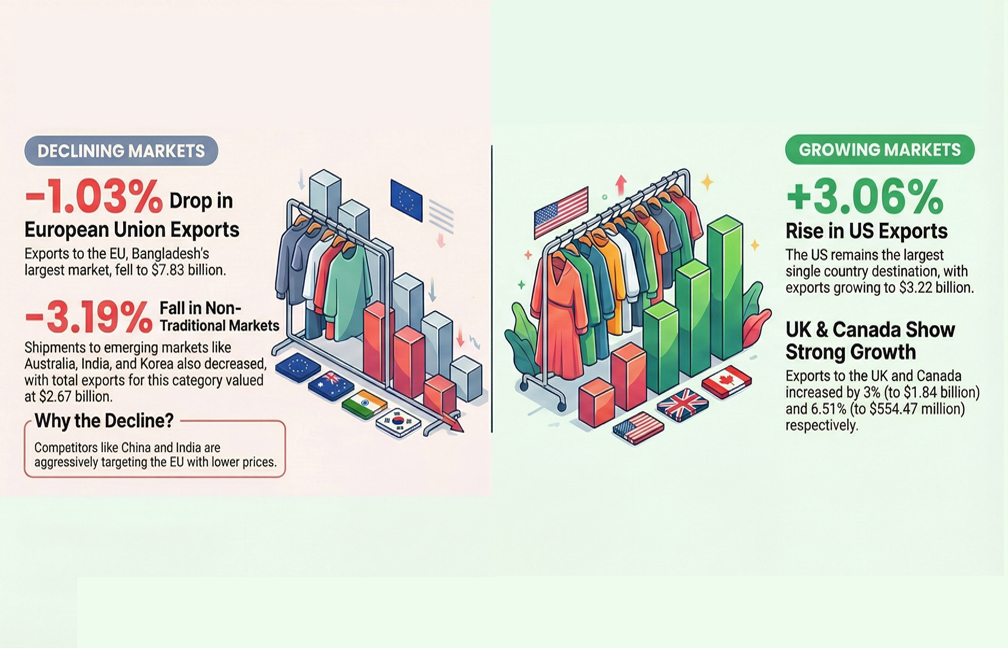
Bangladesh’s readymade garment (RMG) exports to the European Union (EU) and non-traditional markets such as Australia, India, and Korea recorded negative growth during the first five months of the current financial year 2025-26, official data showed.
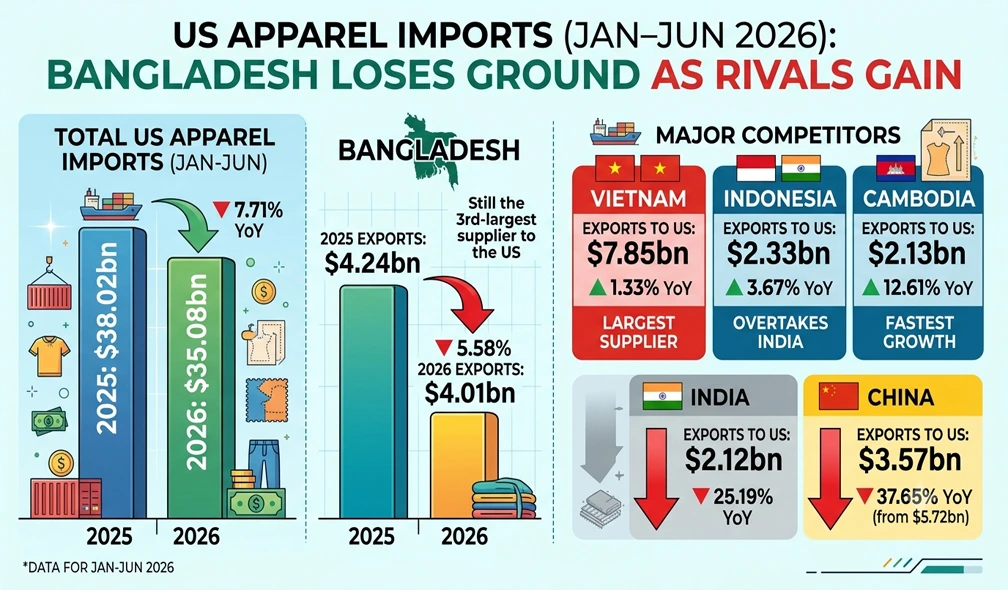
Exports to the country’s largest single destination, the United States, however, registered growth despite new American tariff regimes.
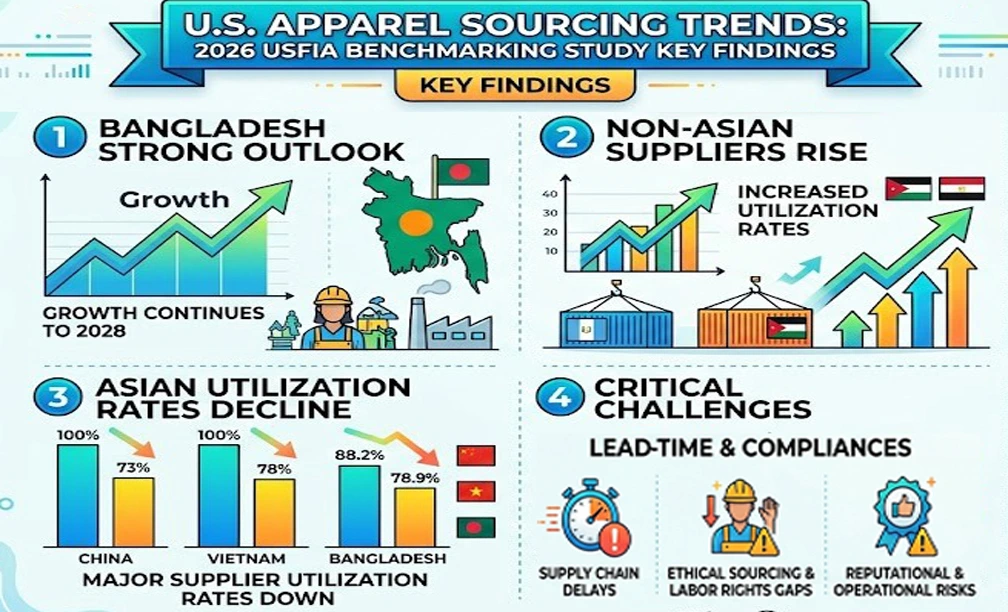
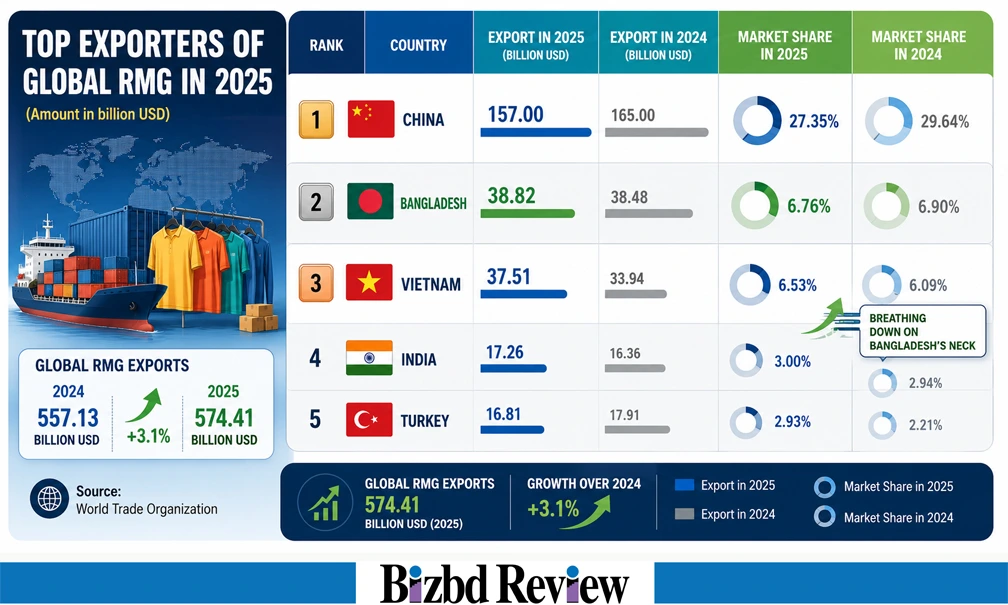
Industry insiders attributed the decline in western markets largely to the US tariff, which also forced Bangladesh’s major competitors, particularly China and India, to shift focus beyond the American market.
These countries are now offering aggressively low prices to capture market share in Europe and other non-traditional destinations, they said.
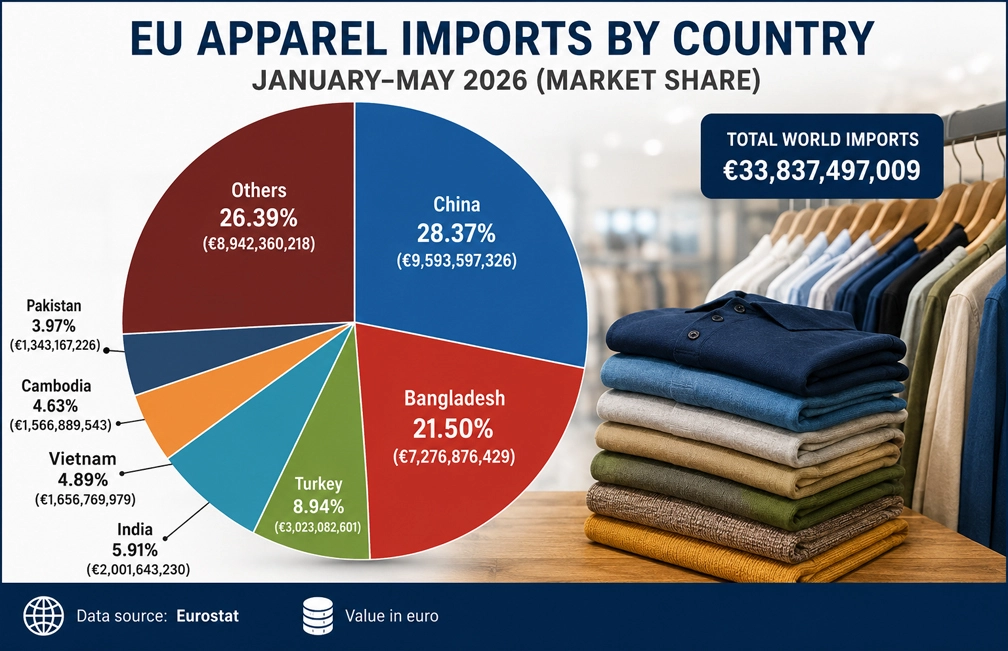
Data from the Export Promotion Bureau (EPB) show that exports to the EU fell by 1.03 per cent to $7.83 billion during the July–November period of fiscal 2025-26, down from $7.91 billion in the same period last year.
The EU accounted for 48.57 per cent of Bangladesh’s total RMG shipments, valued at $16.13 billion during the first five months of the fiscal year.
Among the major EU markets, Denmark, France, Germany, and Italy recorded declines ranging from 3.56 per cent to approximately 9 per cent.
Garment exports to non-traditional markets also fell by 3.19 per cent year-on-year to $2.67 billion, compared with $2.75 billion during July–November 2024-25.
These markets, defined as destinations beyond the traditional ones of the EU, US, Canada, and UK, include Australia, Japan, India, Brazil, Chile, China, Russia, Korea, Mexico, and Turkey.
Exports to Australia, India, Korea, Mexico, New Zealand, Russia, and Turkey dropped by between 8.18 per cent and 24.55 per cent, while Japan recorded a modest growth of 0.98 per cent over the same period last fiscal year.
Industry insiders attributed the marginal rise to weak consumer demand in both advanced and emerging markets, driven by high living costs, sluggish global growth, and ongoing geopolitical tensions.
Faruque Hasan, former president of the Bangladesh Garment Manufacturers and Exporters Association (BGMEA) and managing director of Giant Group, said global demand in the EU and other emerging markets had declined in recent months, leading to a fall in imports.
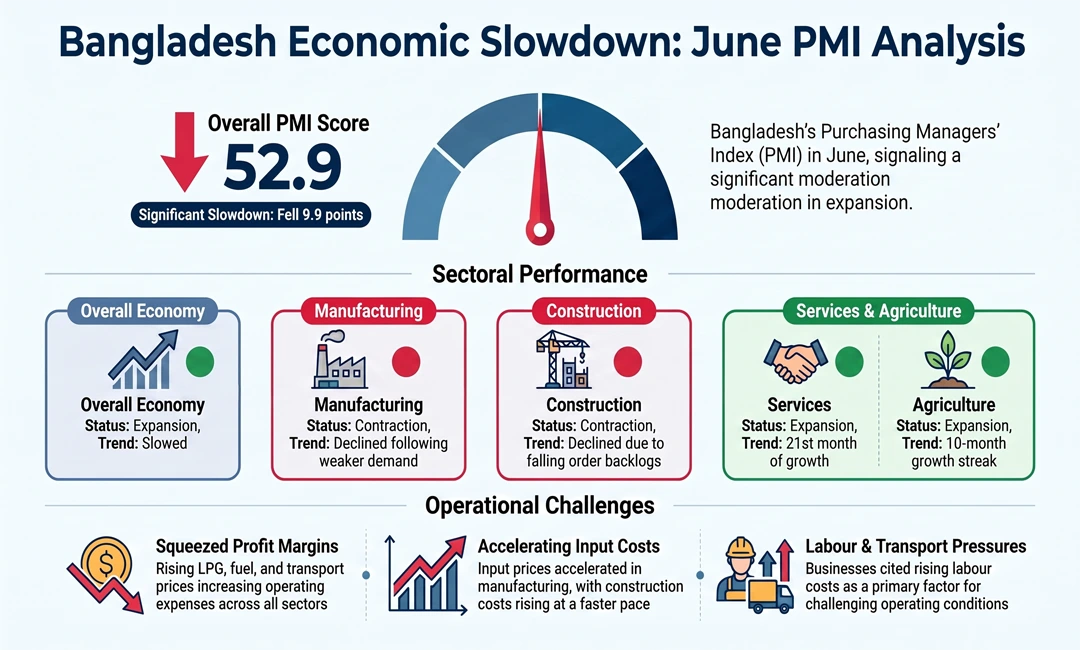
He said that China and India, facing the impact of high US tariffs, were aggressively targeting EU markets with low prices, while Bangladesh’s competitiveness was being eroded by high production costs and elevated bank interest rates.
Faruque predicted that garment export growth could slow further in the coming months, including in the US market.
Fazlul Hoque, former president of the Bangladesh Knitwear Manufacturers and Exporters Association (BKMEA), said the muted performance reflected a broader slowdown in the global apparel market.
He said that economic uncertainty and disruptions, including the effect of new US tariffs, had dampened demand.
Despite these challenges, exports to the US–the country’s largest single destination–rose by 3.06 per cent to $3.22 billion.
Shipments to Canada and the UK also increased, by 6.51 per cent and 3 per cent respectively, earning $554.47 million and $1.84 billion during the July–November period of fiscal 2025-26.