6:21 pm, Saturday, 8 November 2025
ECONOMIC REFORM SUMMIT

Bangladesh must rethink economy to create jobs, say experts

Experts and business leaders have warned that Bangladesh’s existing economic model has reached its limits and must be replaced with one capable of delivering broad-based growth, employment, and inclusive prosperity.

They urged policymakers to move beyond short-term recovery measures and implement structural reforms that can attract investment, expand savings, and build a robust capital market to support long-term financing.

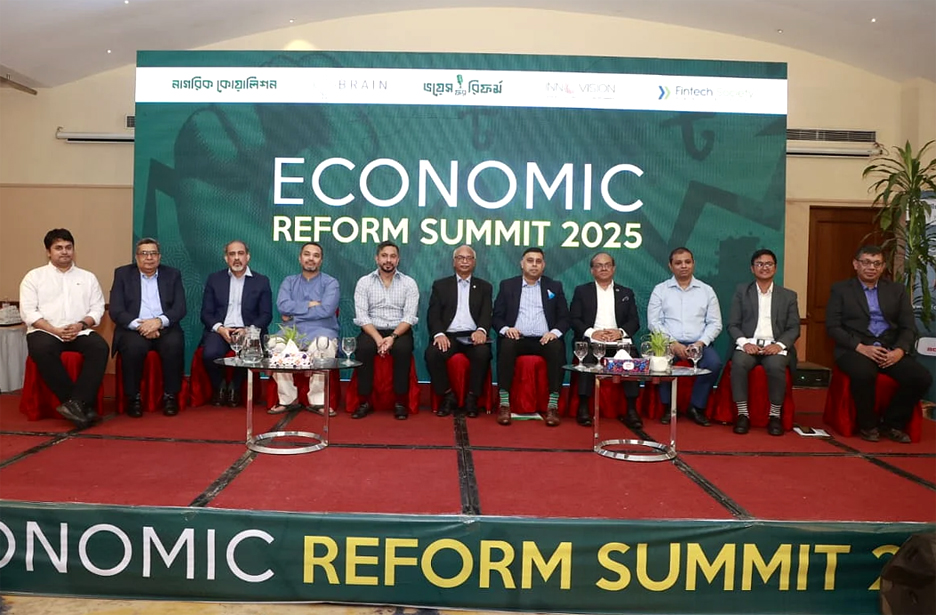
The remarks came during the opening session of the two-day Economic Reform Summit 2025 at the Lakeshore Hotel in Dhaka on Monday.

The event was jointly organised by Voice for Reform, BRAIN, Innovision Consulting, Fintech Society, and Citizen Coalition.

Bangladesh Nationalist Party standing committee member Amir Khasru Mahmud Chowdhury, the summit’s chief guest, said the old economic model had primarily benefited a small segment of society while excluding the majority.

‘We must develop a new model that creates opportunities for all and provides jobs for millions of young people,’ he said, urging the government to reduce bureaucratic control and digitise public services to curb corruption.

Khasru also called on business associations to take a more proactive role in driving reforms.

Dhaka University professor Rashed Al Mahmud Titumir said the current model fails to generate sufficient employment and must be replaced with one that connects rural economies with youth and women through micro, cottage, and small industries.

‘We need to advance with a green, knowledge-based, and circular economic strategy,’ he said.

Policy Exchange Bangladesh chairman Masrur Reaz highlighted the absence of a long-term national investment strategy, leaving both domestic and foreign investors without clear guidance.

Tax expert Snehasish Barua called for policy consistency, transparency in transactions, and the promotion of a cashless economy, emphasising the need for realistic targets with coherent and coordinated implementation.

BUILD chairperson Abul Kasem Khan warned that Bangladesh’s investment environment remains less competitive than Vietnam, which attracts $14–16 billion in foreign direct investment (FDI) annually.

To achieve a $500 billion economy, Bangladesh must attract at least $15–20 billion in FDI each year for the next decade. He added that reforms are undermined by weak implementation and that bureaucracy must become investment-friendly.

Nakibur Rahman, spokesperson for Bangladesh Jamaat-e-Islami in the USA, pointed out that the cost of capital in Bangladesh is 3–5 per cent higher than in competing nations, with corruption further raising the cost of doing business.

‘We must replace outdated laws that enable corruption,’ he said.

Export Promotion Bureau vice-chairman Mohammad Hasan Arif noted that Bangladesh struggles to negotiate with foreign investors due to weak institutional capacity.

‘Without energy security, investment will not come,’ he said, calling for closer coordination between business leaders, policymakers, and bureaucrats.

Mohammad Rashed, additional director of Bangladesh Bank’s Payment System Department, highlighted the central bank’s interoperable payment system launched in 2020, which connects banks, mobile financial services, and payment providers.

He said the system would soon integrate leading microfinance institutions and introduce a ‘Bangla QR Code’ for one-click digital transactions.

‘Once 10 crore accounts adopt this unified QR system, it will transform Bangladesh’s digital payments landscape,’ he said.

TallyPay CEO Shahadat Khan added that over one million small merchants now use their platform to manage daily accounts and accept QR-based payments after receiving a payment service provider licence from the central bank.
ECONOMIC REFORM SUMMIT

Bangladesh must rethink economy to create jobs, say experts

Update Time : 10:00:00 pm, Monday, 27 October 2025

Experts and business leaders have warned that Bangladesh’s existing economic model has reached its limits and must be replaced with one capable of delivering broad-based growth, employment, and inclusive prosperity.

They urged policymakers to move beyond short-term recovery measures and implement structural reforms that can attract investment, expand savings, and build a robust capital market to support long-term financing.

The remarks came during the opening session of the two-day Economic Reform Summit 2025 at the Lakeshore Hotel in Dhaka on Monday.

The event was jointly organised by Voice for Reform, BRAIN, Innovision Consulting, Fintech Society, and Citizen Coalition.

Bangladesh Nationalist Party standing committee member Amir Khasru Mahmud Chowdhury, the summit’s chief guest, said the old economic model had primarily benefited a small segment of society while excluding the majority.

‘We must develop a new model that creates opportunities for all and provides jobs for millions of young people,’ he said, urging the government to reduce bureaucratic control and digitise public services to curb corruption.

Khasru also called on business associations to take a more proactive role in driving reforms.

Dhaka University professor Rashed Al Mahmud Titumir said the current model fails to generate sufficient employment and must be replaced with one that connects rural economies with youth and women through micro, cottage, and small industries.

‘We need to advance with a green, knowledge-based, and circular economic strategy,’ he said.

Policy Exchange Bangladesh chairman Masrur Reaz highlighted the absence of a long-term national investment strategy, leaving both domestic and foreign investors without clear guidance.

Tax expert Snehasish Barua called for policy consistency, transparency in transactions, and the promotion of a cashless economy, emphasising the need for realistic targets with coherent and coordinated implementation.

BUILD chairperson Abul Kasem Khan warned that Bangladesh’s investment environment remains less competitive than Vietnam, which attracts $14–16 billion in foreign direct investment (FDI) annually.

To achieve a $500 billion economy, Bangladesh must attract at least $15–20 billion in FDI each year for the next decade. He added that reforms are undermined by weak implementation and that bureaucracy must become investment-friendly.

Nakibur Rahman, spokesperson for Bangladesh Jamaat-e-Islami in the USA, pointed out that the cost of capital in Bangladesh is 3–5 per cent higher than in competing nations, with corruption further raising the cost of doing business.

‘We must replace outdated laws that enable corruption,’ he said.

Export Promotion Bureau vice-chairman Mohammad Hasan Arif noted that Bangladesh struggles to negotiate with foreign investors due to weak institutional capacity.

‘Without energy security, investment will not come,’ he said, calling for closer coordination between business leaders, policymakers, and bureaucrats.

Mohammad Rashed, additional director of Bangladesh Bank’s Payment System Department, highlighted the central bank’s interoperable payment system launched in 2020, which connects banks, mobile financial services, and payment providers.

He said the system would soon integrate leading microfinance institutions and introduce a ‘Bangla QR Code’ for one-click digital transactions.

‘Once 10 crore accounts adopt this unified QR system, it will transform Bangladesh’s digital payments landscape,’ he said.

TallyPay CEO Shahadat Khan added that over one million small merchants now use their platform to manage daily accounts and accept QR-based payments after receiving a payment service provider licence from the central bank.