9:06 am, Tuesday, 19 May 2026

Global headwinds squeeze Bangladesh’s RMG exports

Bangladesh’s readymade garment (RMG) exports have come under sustained pressure in recent months, as weakening global demand, escalating trade tensions and ongoing geopolitical conflicts weigh on shipments to key markets, according to official data and industry sources.

Data from the Export Promotion Bureau (EPB) show that exports to major destinations in the European Union (EU) and several emerging markets recorded negative growth during the first eight months of the financial year 2025-26.

Key EU markets—including Germany, France, Italy, Denmark, Spain, the Netherlands and Poland, each worth over a billion dollars annually–posted declines ranging from 8.0 per cent to over 12 per cent.

Only a few markets managed modest growth, with the Netherlands expanding by 0.24 per cent, Spain by 3.03 per cent and Poland by 7.03 per cent.

Overall, exports to the 27-member EU bloc fell by 5.49 per cent year-on-year during the July-February period.

Bangladesh earned $12.68 billion from garment shipments to the EU, down from $13.42 billion in the same period of the previous fiscal year.

A breakdown of product categories shows knitwear exports declining by 6.86 per cent to $7.54 billion, compared with $8.10 billion a year earlier.

Woven garment exports also dropped by 3.42 per cent to $5.13 billion from $5.31 billion.

Non-traditional markets, which have been a focus of Bangladesh’s diversification strategy, also registered a downturn.

Exports to destinations such as Japan, Australia, India, South Korea, Mexico, Russia and Turkey fell between 5.38 per cent and 24.38 per cent.

Total earnings from these markets stood at $4.24 billion, down from $4.52 billion, marking a 6.34 per cent decline.

Industry insiders attribute the slowdown to a combination of high inflation, subdued consumer spending and persistent geopolitical instability.

Ongoing conflicts, including the Russia–Ukraine war and tensions involving the United States, Israel and Iran, have disrupted global trade flows and dampened retail demand.

Mohammad Hatem, president of the Bangladesh Knitwear Manufacturers and Exporters Association (BKMEA), said the downturn reflects a broader contraction in the global apparel market.

He noted that uncertainty stemming from new US tariff measures and geopolitical disruptions has weakened buyer confidence and reduced order volumes.

Hatem said that while a stable domestic political environment could support recovery, negative growth may persist through the end of the current fiscal year.

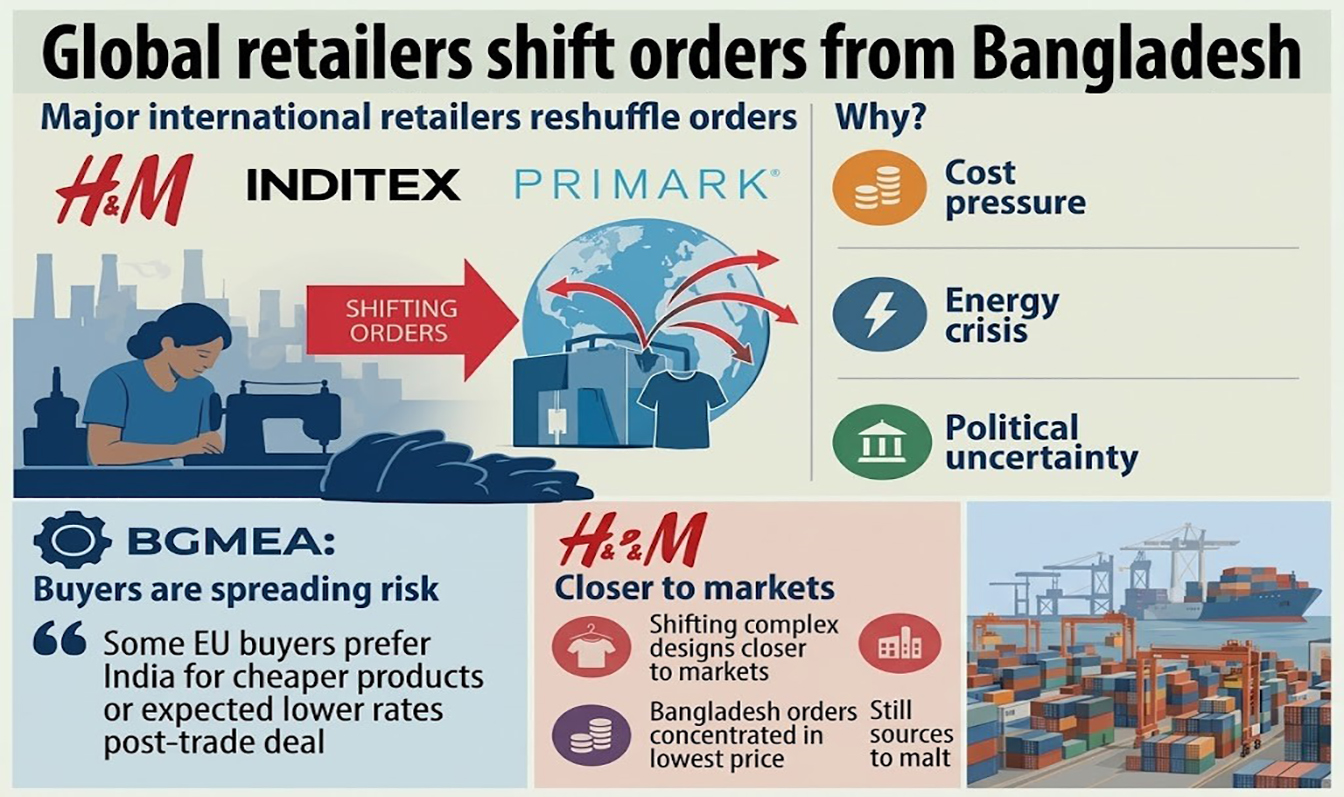
Echoing similar concerns, Inamul Haq Khan, vice-president of the Bangladesh Garment Manufacturers and Exporters Association (BGMEA), said rising living costs in key markets have forced consumers to prioritise essential spending over apparel purchases, prompting buyers to scale back orders.

He observed that while countries such as Vietnam and Cambodia have shown relative resilience, Bangladesh and India have been more exposed to demand shocks.

Inamul said that the depreciation of the local currency against the US dollar could offer some competitive advantage, although it reflects broader economic pressures.

Despite the overall decline, a few traditional markets showed marginal growth. Exports to Canada rose by 3.08 per cent to $871.58 million, while shipments to the United Kingdom increased by 1.22 per cent to $2.96 billion.

In the United States, Bangladesh’s largest single apparel market, exports remained largely flat, edging up by less than 1.0 per cent to $5.02 billion during the period.

In aggregate, Bangladesh’s total RMG exports fell by 3.73 per cent year-on-year to $25.79 billion in the first eight months of FY2025–26, compared with $26.79 billion in the corresponding period of the previous fiscal year, underscoring the mounting challenges facing the country’s key export sector.
Global headwinds squeeze Bangladesh’s RMG exports

Update Time : 08:34:50 pm, Tuesday, 17 March 2026

Bangladesh’s readymade garment (RMG) exports have come under sustained pressure in recent months, as weakening global demand, escalating trade tensions and ongoing geopolitical conflicts weigh on shipments to key markets, according to official data and industry sources.

Data from the Export Promotion Bureau (EPB) show that exports to major destinations in the European Union (EU) and several emerging markets recorded negative growth during the first eight months of the financial year 2025-26.

Key EU markets—including Germany, France, Italy, Denmark, Spain, the Netherlands and Poland, each worth over a billion dollars annually–posted declines ranging from 8.0 per cent to over 12 per cent.

Only a few markets managed modest growth, with the Netherlands expanding by 0.24 per cent, Spain by 3.03 per cent and Poland by 7.03 per cent.

Overall, exports to the 27-member EU bloc fell by 5.49 per cent year-on-year during the July-February period.

Bangladesh earned $12.68 billion from garment shipments to the EU, down from $13.42 billion in the same period of the previous fiscal year.

A breakdown of product categories shows knitwear exports declining by 6.86 per cent to $7.54 billion, compared with $8.10 billion a year earlier.

Woven garment exports also dropped by 3.42 per cent to $5.13 billion from $5.31 billion.

Non-traditional markets, which have been a focus of Bangladesh’s diversification strategy, also registered a downturn.

Exports to destinations such as Japan, Australia, India, South Korea, Mexico, Russia and Turkey fell between 5.38 per cent and 24.38 per cent.

Total earnings from these markets stood at $4.24 billion, down from $4.52 billion, marking a 6.34 per cent decline.

Industry insiders attribute the slowdown to a combination of high inflation, subdued consumer spending and persistent geopolitical instability.

Ongoing conflicts, including the Russia–Ukraine war and tensions involving the United States, Israel and Iran, have disrupted global trade flows and dampened retail demand.

Mohammad Hatem, president of the Bangladesh Knitwear Manufacturers and Exporters Association (BKMEA), said the downturn reflects a broader contraction in the global apparel market.

He noted that uncertainty stemming from new US tariff measures and geopolitical disruptions has weakened buyer confidence and reduced order volumes.

Hatem said that while a stable domestic political environment could support recovery, negative growth may persist through the end of the current fiscal year.

Echoing similar concerns, Inamul Haq Khan, vice-president of the Bangladesh Garment Manufacturers and Exporters Association (BGMEA), said rising living costs in key markets have forced consumers to prioritise essential spending over apparel purchases, prompting buyers to scale back orders.

He observed that while countries such as Vietnam and Cambodia have shown relative resilience, Bangladesh and India have been more exposed to demand shocks.

Inamul said that the depreciation of the local currency against the US dollar could offer some competitive advantage, although it reflects broader economic pressures.

Despite the overall decline, a few traditional markets showed marginal growth. Exports to Canada rose by 3.08 per cent to $871.58 million, while shipments to the United Kingdom increased by 1.22 per cent to $2.96 billion.

In the United States, Bangladesh’s largest single apparel market, exports remained largely flat, edging up by less than 1.0 per cent to $5.02 billion during the period.

In aggregate, Bangladesh’s total RMG exports fell by 3.73 per cent year-on-year to $25.79 billion in the first eight months of FY2025–26, compared with $26.79 billion in the corresponding period of the previous fiscal year, underscoring the mounting challenges facing the country’s key export sector.