6:02 pm, Wednesday, 6 May 2026
ILO REPORT

Bangladesh job market faces dual challenge of expansion, skill disruption

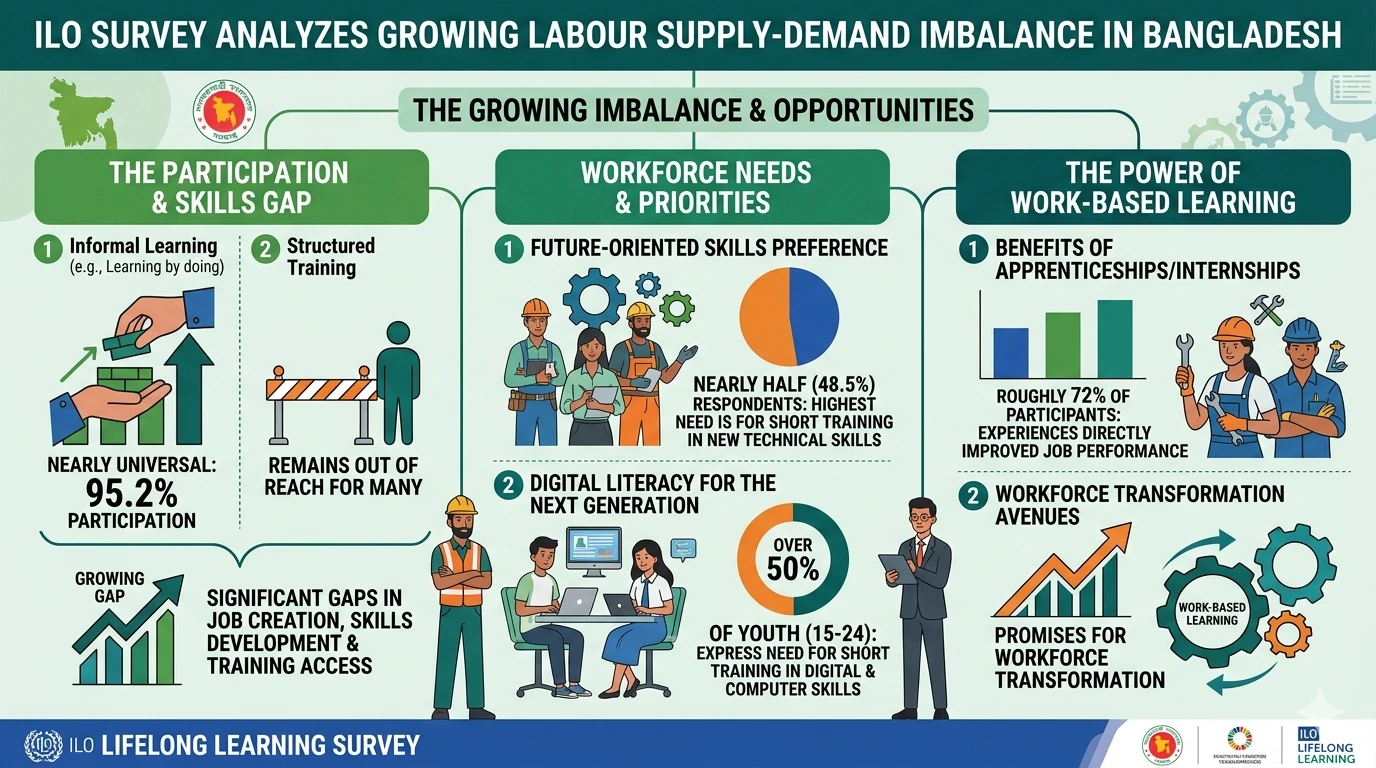
Bangladesh’s job creation is failing to keep pace with a rapidly expanding workforce, while nearly half of workers are calling for short-term technical training and more than half of young people report an urgent need for digital skills, according to the latest report by the International Labour Organization.

The findings also showed that although 95.2 per cent of workers in Bangladesh rely on informal learning, the absence of formal recognition left the vast majority of skills uncertified and undervalued.

The ILO on May 5 launched its flagship publication, ‘The World of Work Report: Lifelong Learning and Skills for the Future,’ which painted a detailed picture of Bangladesh’s evolving labour market.

It highlighted a growing imbalance between labour supply and demand, with new data pointing to significant gaps in job creation, skills development and access to training.

While the country’s workforce continued to expand rapidly, investment in technical, digital and work-based learning remained limited, raising concerns over long-term employability and economic resilience.

The report identified several priority areas that Bangladesh must address to future-proof its workforce amid structural shifts driven by digitalisation and the global transition towards greener economies.

It noted that although lifelong learning was widely recognised as essential, access to such opportunities remained highly unequal and restricted, particularly for vulnerable groups.

A detailed analysis of survey data revealed a substantial unmet demand for training.

Informal learning, primarily through hands-on experience, dominated the skills landscape, with participation reaching 95.2 per cent.

In contrast, only 12 per cent of the working-age population engaged in formal or non-formal education and training in 2025.

The report highlighted stark inequalities in access to training based on education levels.

Among adults with secondary education, 25.7 per cent participated in learning activities, compared with just 3.7 per cent of those without secondary education, it said.

Occupational differences are equally pronounced, with participation rates highest among professionals at 36.9 per cent and technicians at 33.5 per cent, but falling sharply to only 3.5 per cent among workers in elementary occupations, the report said.

According to the report, formal sector workers were more than three times as likely to engage in structured learning, with participation at 37.2 per cent, compared with just 10.8 per cent among informal workers.

The survey findings also pointed to a clear demand for practical and future-oriented skills.

It mentioned that nearly 48.5 per cent of respondents identified short-term technical training as their most pressing need, reflecting a preference for targeted, job-relevant learning.

Digital literacy has emerged as a critical priority, particularly among younger workers, with more than half of those aged 15 to 24 expressing a need for training in digital and computer skills, it said.

ILo report said that at present, non-formal training in Bangladesh was largely occupation-specific, accounting for 57 per cent of such programmes, followed by digital skills at 19.2 per cent and personal development at 15.5 per cent.

However, the report stressed that focusing solely on technical competencies is insufficient.

It said that employers were increasingly seeking ‘rounded’ skill profiles that combined technical expertise with cognitive abilities and socio-emotional skills such as communication, teamwork and leadership.

The report said that work-based learning was a highly effective yet underutilised pathway for skills development, noting that around 72 per cent of respondents who had participated in apprenticeships or internships reported improved job performance as a direct result.

Despite this, it added that participation remained extremely low, with 93 per cent of respondents stating that they had not engaged in any work-based training over the past three years.

It further underscored the importance of recognising informal learning, given its near-universal prevalence, warning that without systems to validate skills acquired through experience, many workers, particularly those in the informal economy, remained excluded from better employment opportunities due to a lack of certification.

Drawing on worker surveys, online vacancy analysis, institutional data and a review of 174 studies, the report warned that insufficient investment in inclusive learning systems could widen inequalities both within and between countries.

It argued that aligning skills development with labour market demand was essential to ensure that economic transformation benefits all segments of society.

‘Lifelong learning is the bridge between today’s jobs and tomorrow’s opportunities. It is not only about employability and productivity, but also about supporting decent work, driving true innovation and building resilient societies,’ said ILO director general Gilbert F Houngbo.

The ILO findings also reflected global trends observed in Bangladesh, including increasing demand from employers for a combination of technical and soft skills.

ILO country director for Bangladesh Max Tuñón said that the report’s findings revealed several global trends that were also observed in Bangladesh, including employers’ demand for workers with a combination of technical and soft skills.

‘For that, we need to address the institutional fragmentation and work more closely with the private sector, to deliver quality training that meets the needs of a rapidly changing labour market,’ he said.

By addressing these gaps and aligning skills development systems with evolving labour market needs, the report recommended that Bangladesh could harness its demographic momentum to generate sustainable, decent employment while enhancing productivity and competitiveness across the economy.
ILO REPORT

Bangladesh job market faces dual challenge of expansion, skill disruption

Update Time : 08:06:27 pm, Tuesday, 5 May 2026

Bangladesh’s job creation is failing to keep pace with a rapidly expanding workforce, while nearly half of workers are calling for short-term technical training and more than half of young people report an urgent need for digital skills, according to the latest report by the International Labour Organization.

The findings also showed that although 95.2 per cent of workers in Bangladesh rely on informal learning, the absence of formal recognition left the vast majority of skills uncertified and undervalued.

The ILO on May 5 launched its flagship publication, ‘The World of Work Report: Lifelong Learning and Skills for the Future,’ which painted a detailed picture of Bangladesh’s evolving labour market.

It highlighted a growing imbalance between labour supply and demand, with new data pointing to significant gaps in job creation, skills development and access to training.

While the country’s workforce continued to expand rapidly, investment in technical, digital and work-based learning remained limited, raising concerns over long-term employability and economic resilience.

The report identified several priority areas that Bangladesh must address to future-proof its workforce amid structural shifts driven by digitalisation and the global transition towards greener economies.

It noted that although lifelong learning was widely recognised as essential, access to such opportunities remained highly unequal and restricted, particularly for vulnerable groups.

A detailed analysis of survey data revealed a substantial unmet demand for training.

Informal learning, primarily through hands-on experience, dominated the skills landscape, with participation reaching 95.2 per cent.

In contrast, only 12 per cent of the working-age population engaged in formal or non-formal education and training in 2025.

The report highlighted stark inequalities in access to training based on education levels.

Among adults with secondary education, 25.7 per cent participated in learning activities, compared with just 3.7 per cent of those without secondary education, it said.

Occupational differences are equally pronounced, with participation rates highest among professionals at 36.9 per cent and technicians at 33.5 per cent, but falling sharply to only 3.5 per cent among workers in elementary occupations, the report said.

According to the report, formal sector workers were more than three times as likely to engage in structured learning, with participation at 37.2 per cent, compared with just 10.8 per cent among informal workers.

The survey findings also pointed to a clear demand for practical and future-oriented skills.

It mentioned that nearly 48.5 per cent of respondents identified short-term technical training as their most pressing need, reflecting a preference for targeted, job-relevant learning.

Digital literacy has emerged as a critical priority, particularly among younger workers, with more than half of those aged 15 to 24 expressing a need for training in digital and computer skills, it said.

ILo report said that at present, non-formal training in Bangladesh was largely occupation-specific, accounting for 57 per cent of such programmes, followed by digital skills at 19.2 per cent and personal development at 15.5 per cent.

However, the report stressed that focusing solely on technical competencies is insufficient.

It said that employers were increasingly seeking ‘rounded’ skill profiles that combined technical expertise with cognitive abilities and socio-emotional skills such as communication, teamwork and leadership.

The report said that work-based learning was a highly effective yet underutilised pathway for skills development, noting that around 72 per cent of respondents who had participated in apprenticeships or internships reported improved job performance as a direct result.

Despite this, it added that participation remained extremely low, with 93 per cent of respondents stating that they had not engaged in any work-based training over the past three years.

It further underscored the importance of recognising informal learning, given its near-universal prevalence, warning that without systems to validate skills acquired through experience, many workers, particularly those in the informal economy, remained excluded from better employment opportunities due to a lack of certification.

Drawing on worker surveys, online vacancy analysis, institutional data and a review of 174 studies, the report warned that insufficient investment in inclusive learning systems could widen inequalities both within and between countries.

It argued that aligning skills development with labour market demand was essential to ensure that economic transformation benefits all segments of society.

‘Lifelong learning is the bridge between today’s jobs and tomorrow’s opportunities. It is not only about employability and productivity, but also about supporting decent work, driving true innovation and building resilient societies,’ said ILO director general Gilbert F Houngbo.

The ILO findings also reflected global trends observed in Bangladesh, including increasing demand from employers for a combination of technical and soft skills.

ILO country director for Bangladesh Max Tuñón said that the report’s findings revealed several global trends that were also observed in Bangladesh, including employers’ demand for workers with a combination of technical and soft skills.

‘For that, we need to address the institutional fragmentation and work more closely with the private sector, to deliver quality training that meets the needs of a rapidly changing labour market,’ he said.

By addressing these gaps and aligning skills development systems with evolving labour market needs, the report recommended that Bangladesh could harness its demographic momentum to generate sustainable, decent employment while enhancing productivity and competitiveness across the economy.