Bizbd Report
Bangladesh has set out its most ambitious climate plan yet under Nationally Determined Contribution (NDC) 3.0, but its success faces steep challenges.
The country is grappling with stalled carbon market negotiations, weak institutional capacity, rising urban pollution, and a vast financing gap of more than $316 billion.
According to a recent study, while the strategy aims to cut emissions by 27 per cent by 2030 through renewable energy, industrial decarbonisation and improved land use, the government admits that without stronger international support and domestic reforms such as a carbon tax, the targets risk slipping out of reach.
A detailed briefing by the Dhaka-based think-tank Change Initiative, issued on September 13, described carbon finance as a largely untapped source of revenue that could help Bangladesh bridge a daunting financing gap.
The organisation estimated that the country would require more than $316 billion by 2030 to meet its new targets, with $46.38 billion needed for unconditional measures and a further $270.13 billion dependent on international finance.
It said, however, that Bangladesh had so far received only 1.25 per cent of the $270 billion in foreign climate finance required under its earlier NDC 2.0, raising doubts over whether richer countries would meet their obligations.
The report warned that ambition would falter without timely international support, stressing that for OECD nations, delivering on climate finance was not charity but rather a test of credibility, equity and justice.
It highlighted that Bangladesh had already achieved about nine per cent of its unconditional emissions reduction target under NDC 2.0, thereby outperforming expectations.
The shortfall in conditional reductions, analysts argued, was not due to domestic inaction but rather the absence of the promised international funds and technology transfers.
NDC 3.0 was reported to seek a fivefold increase in ambition, proposing an unconditional cut of 39.58 million tonnes of carbon dioxide equivalent and a conditional cut of 116.35 million tonnes, which together would reduce emissions by 26.9 per cent against the projected business-as-usual scenario of 432.58 million tonnes by 2030.

The Change Initiative study, led by M Zakir Hossain Khan, cautioned that without addressing governance gaps, Bangladesh risked falling short of its targets.
It identified weak coordination among ministries, fragmented monitoring systems and unreliable baseline data as significant barriers to implementation.
Khan maintained that conditional finance was not merely a budget line for conditional mitigation targets but a question of carbon justice.
He added that meeting the commitments of developed countries in mobilising grant-based climate finance was the bare minimum owed to vulnerable people and the planet’s ecosystems.
Professor Ijaz Hossain, an energy expert and member of the NDC 3.0 formulation team, echoed this view, stressing that the environmental degradation of Dhaka had already made it one of the least liveable cities in the world.
He observed that it was time to take decisive action not only to meet global commitments such as the NDC, but also to safeguard the health and well-being of future generations, emphasising that a just transition must be built on renewable energy.
The analysis said that alongside carbon trading, Bangladesh was also considering the introduction of a carbon tax.
Although no such levy existed at present, NDC 3.0 outlined a model that could generate significant domestic revenue.
According to the plan, a five per cent tax on fossil fuel imports, including coal, oil and gas, could raise around BDT 2,060 crore annually, while a ten per cent tax could double that amount.
It further noted that 20 per cent of the revenue would be redistributed to low-income households to cushion them from higher energy prices, making the measure both fiscally and socially progressive.
Advocates were of the view that such a tax would not only raise funds but also incentivise industries and consumers to shift towards cleaner energy alternatives.
The analysis acknowledged that despite these opportunities, the financing challenge remained formidable.
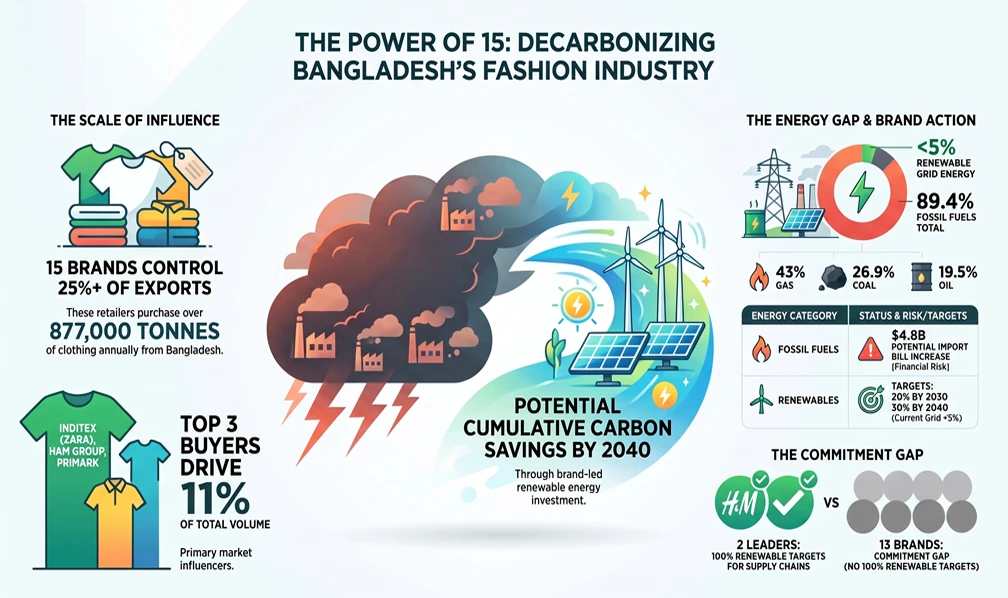
It pointed out that Bangladesh’s energy and power sector alone accounted for nearly a quarter of emissions, which were projected to rise from 95.14 to 108.87 million tonnes by 2030 under a business-as-usual scenario.
NDC 3.0 was said to propose installing 24,106 megawatts of renewable energy capacity under conditional financing, alongside efficiency improvements in gas use and a gradual phase-down of coal.
Analysts argued that with sufficient climate finance, emissions reductions in this sector could be quintupled, but the upfront costs were considerable.
The Change Initiative was reported to have estimated that the conditional energy sector transition alone would require $12 billion in annualised capital expenditure, with a net cost of $8.5 billion per year after fuel savings were considered.

The analysis observed that the industrial sector, particularly steel, cement and fertiliser production, also contributed significantly to emissions but had been largely overlooked in NDC 2.0.
Under the new plan, conditional measures such as transitioning to electric arc furnaces in steelmaking and adopting clinker substitutes in cement could reduce emissions by more than three million tonnes.
The Agriculture, Forestry and Other Land Use (AFOLU) sector was said to hold further potential, with agroforestry, livestock feed improvements and mangrove restoration expected to yield meaningful reductions, especially if blue carbon credits were monetised.
Urban systems and transport were described as critical blind spots. Dhaka’s rising reliance on air conditioning was projected to sharply increase electricity demand, yet simple measures such as standardising room temperatures at 26°C rather than 22°C could save over 4,000 megawatts of power.
Expanding urban green spaces was estimated to cut cooling demand by up to 15 per cent, while large-scale adoption of electric vehicles would reduce emissions from the transport sector, which currently accounted for nearly nine per cent of energy-related emissions.
Experts maintained that these often-neglected sectors were central to achieving a just and sustainable transition.
Waste management was identified as another challenge.
Bangladesh’s inadequate systems were said to have led to rising methane emissions, but improved composting and recycling could both cut emissions and generate energy while enriching soil quality.
Analysts pointed out that enforcement of existing waste-management laws remained weak, undermining progress in this area.
The report concluded that Bangladesh’s NDC 3.0 was far more ambitious than its predecessors and more closely aligned with the Paris Agreement’s 1.5°C goal.
However, it cautioned that the country’s ability to deliver on this ambition would depend heavily on whether international partners honoured their climate finance pledges and whether domestic reforms such as a carbon tax and strengthened governance systems could be swiftly enacted.
Analysts warned that without urgent action, the credibility gap in global climate justice would only widen.
The analysis ultimately underscored that for Bangladesh the stakes were existential. With rising seas threatening its coastal regions, climate-induced migration straining urban centres, and pollution choking its cities, the country’s path to a low-carbon, climate-resilient future would determine not only its international standing but also the survival and dignity of millions of its citizens.