Bizbd Report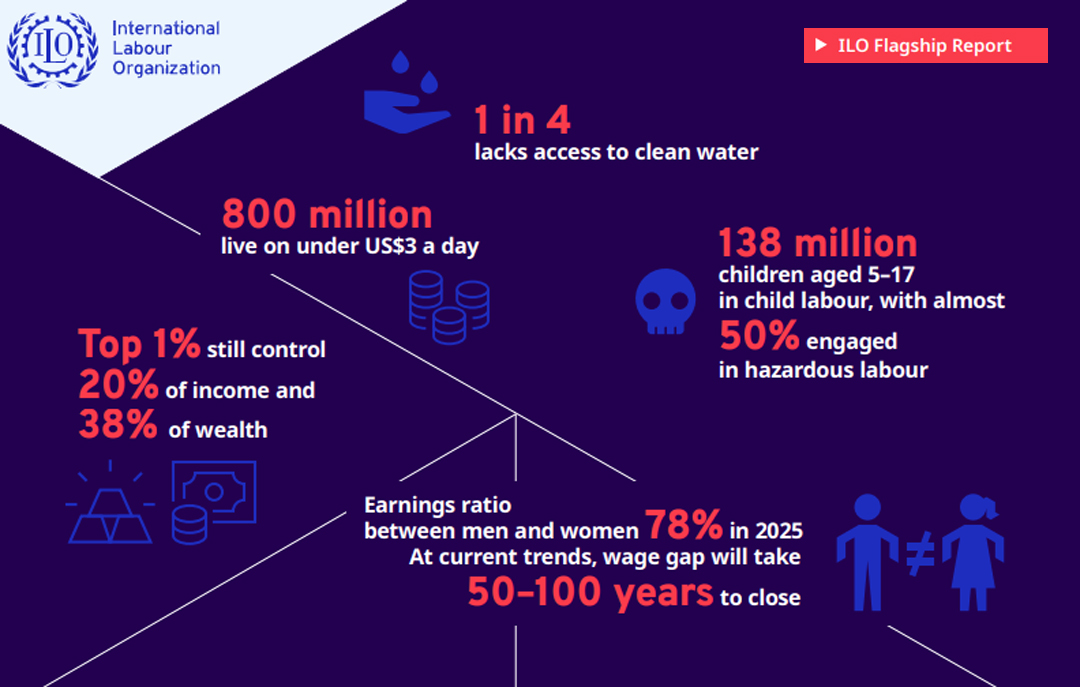
Extreme disparities in wealth and income continue worldwide, with the richest one per cent controlling 20 per cent of global income and 38 per cent of total wealth, according to a new report by the International Labour Organization.
The report titled The State of Social Justice: A Work in Progress, published on Tuesday at the UN General Assembly in New York, stated that the richest group controls nearly 2.5 times the total income and more than 20 times the wealth of the bottom 50 per cent of the population.
The study published ahead of the World Social Summit in Doha in November to mark 30 years since the 1995 Copenhagen Summit on Social Development, found that although the world is wealthier, healthier, and better educated than in 1995, the benefits have not been shared evenly and progress in reducing inequality has stalled.
It showed that deep-seated social and economic inequalities continued to challenge global progress on social justice, despite measurable advances in education, productivity, and social protection over the past three decades.
The report highlighted that persistent disparities leave millions worldwide without fair treatment or equal opportunity, and revealed that one quarter of the global population still lacks access to clean water, underscoring basic deficits despite unprecedented global wealth.
The ILO report showed that gender inequality remains pronounced, noting that in 2025 women earn only 78 cents for every dollar earned by men.
It said that, at current trends, closing the global gender pay gap could take 50 to 100 years, with low- and lower-middle-income countries potentially requiring almost a century to achieve parity.
The report showed that roughly 800 million people live on under $3 per day, struggling to meet minimum caloric requirements, which contributes to high working poverty rates.
Child labour continues to affect millions, with 138 million children aged 5 to 17 in 2024 engaged in labour, nearly half of them in hazardous work, depriving them of education and childhood, it said.
At the same time, the ILO report underscored significant progress since 1995, particularly following the World Summit for Social Development.
It mentioned that global education has improved, with school completion rates rising by 10 percentage points for primary education, 17 points for lower secondary, and 22 points for upper secondary.
The report said that economic productivity has surged, with annual output per worker increasing 78 per cent globally since 1995 and by 215 per cent in upper-middle-income countries.
Labour productivity inequality between countries has declined by 40 per cent since 1995, largely driven by middle-income nations narrowing the gap with high-income countries, the report said.
It revealed that child labour rates for ages 5–14 have fallen from 20.6 per cent in 1995 to 7.8 per cent in 2024, reducing the absolute number of children in labour from 250 million to 106 million.
Social protection coverage has expanded, with over 50 per cent of the global population now covered by at least one scheme, though nearly half remain excluded.
Work-related mortality has also improved, declining by more than 10 per cent since 2000.
The report also said that extreme poverty has fallen sharply, from 39 per cent of the global population in 1995 to 10 per cent in 2023, while working poverty among employed persons decreased from 27.9 per cent in 2000 to 6.9 per cent in 2024.
‘The world has made undeniable progress in social protection, education, and productivity. But millions remain excluded from opportunity and dignity at work,’ ILO director-general Gilbert F Houngbo said.
He said that the social justice was not only a moral imperative – it was essential for economic security, social cohesion, and peace.
The report warned that without deliberate policy interventions, global inequalities could deepen further amid ongoing environmental, digital, and demographic transitions.
It called for urgent action to ensure equitable access to opportunities, reduce income and gender disparities, and manage transitions inclusively.
The findings will feed into discussions at the upcoming World Social Summit in Doha in November and guide the ILO-led Global Coalition for Social Justice, which brings together governments, employers, workers, and other partners to promote fairer, more inclusive societies worldwide.