Bizbd Report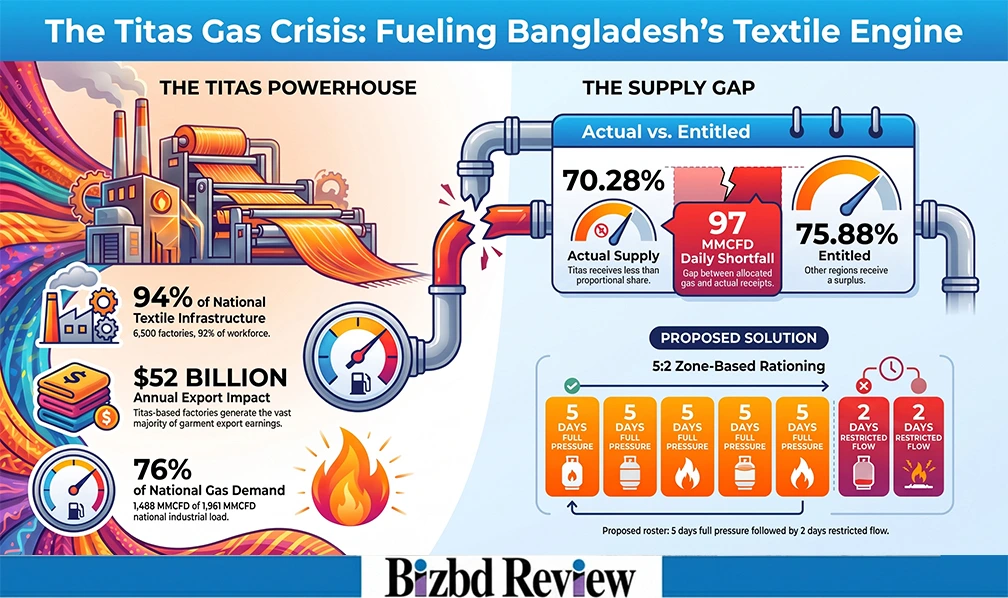
Bangladesh’s four leading textile and apparel trade bodies have jointly appealed to the Gas Transmission Company Limited (GTCL) to urgently rebalance the national gas supply and introduce a zone-based rationing system, warning that continued shortages in the Titas Gas region are severely disrupting production at export-oriented factories.
In a joint letter sent on September 16 to the managing director of GTCL, the Bangladesh Garment Manufacturers and Exporters Association (BGMEA), the Bangladesh Knitwear Manufacturers and Exporters Association (BKMEA), the Bangladesh Textile Mills Association (BTMA), and the Bangladesh Terry Towel and Linen Manufacturers and Exporters Association (BTTLMEA) presented detailed data on regional supply disparities affecting the sector.
The trade bodies noted that the Titas Gas area contains the overwhelming majority of the country’s textile infrastructure, housing around 6,500 factories, or 94.05 per cent of the national total, employing 12 million workers (91.99 per cent) and generating nearly $52 billion in annual export earnings.
According to official figures cited in the letter, the total approved industrial and captive gas load across all distribution companies in Bangladesh stands at 1,961 million cubic feet per day (MMCFD).
Of this, the Titas Gas region alone accounts for 1,488 MMCFD, or 75.88 per cent of the national approved load, while the remaining five gas distribution companies together hold 473 MMCFD, or 24.12 per cent.
However, an analysis of average supply data between September 5 and 9 showed that Titas received considerably less than its approved share.
While GTCL allocated a daily average of 980.20 MMCFD to the region, actual receipts averaged only 883.20 MMCFD, leaving a shortfall of 97 MMCFD against the allocation.
Of the total actual daily supply of 1,256.80 MMCFD distributed nationwide during that period, Titas received just 70.28 per cent (883.20 MMCFD), compared with its proportional entitlement of 75.88 per cent (953.57 MMCFD).
By contrast, the other five distribution companies received 373.60 MMCFD, some 70.37 MMCFD above their proportional share of 303.23 MMCFD.
To prevent further damage to national production and export shipments, the trade bodies put forward a three-point demand to GTCL.
First, they called for an immediate review and reallocation of surplus, reassignable gas from other distribution regions to the Titas Gas area, while preserving the minimum operational and technical requirements of those regions.
Second, they urged priority measures to ensure both adequate gas volume and the operational pressure required for efficient factory operations in the Titas zone.
Third, they proposed a zone-based weekly rationing system.
Rather than subjecting all industrial belts to widespread low pressure simultaneously, they said GTCL should divide major industrial belts into distinct zones under a specific weekly roster, with each zone receiving full gas flow and required pressure for five days, while gas demand is managed and restricted for two days to boost pressure elsewhere.
The letter stressed that any rationing schedule must take into account continuous production units, boiler and process-heat-dependent facilities, export deadlines, labour laws and factory safety.
The letter was signed by BGMEA president Mahmud Hasan Khan, BKMEA president Mohammad Hatem, BTMA president Showkat Aziz Russel, and BTTLMEA president M Shahadat Hossain, who said the proposed arrangement was aimed at ensuring equitable and economically optimal resource utilisation without depriving any region.