2:46 pm, Sunday, 6 September 2026

Bangladesh’s garment exports to US drop 6.25pc as rivals gain

  • Bizbd Report
  • Update Time : 11:38:51 pm, Saturday, 5 September 2026
  • 28

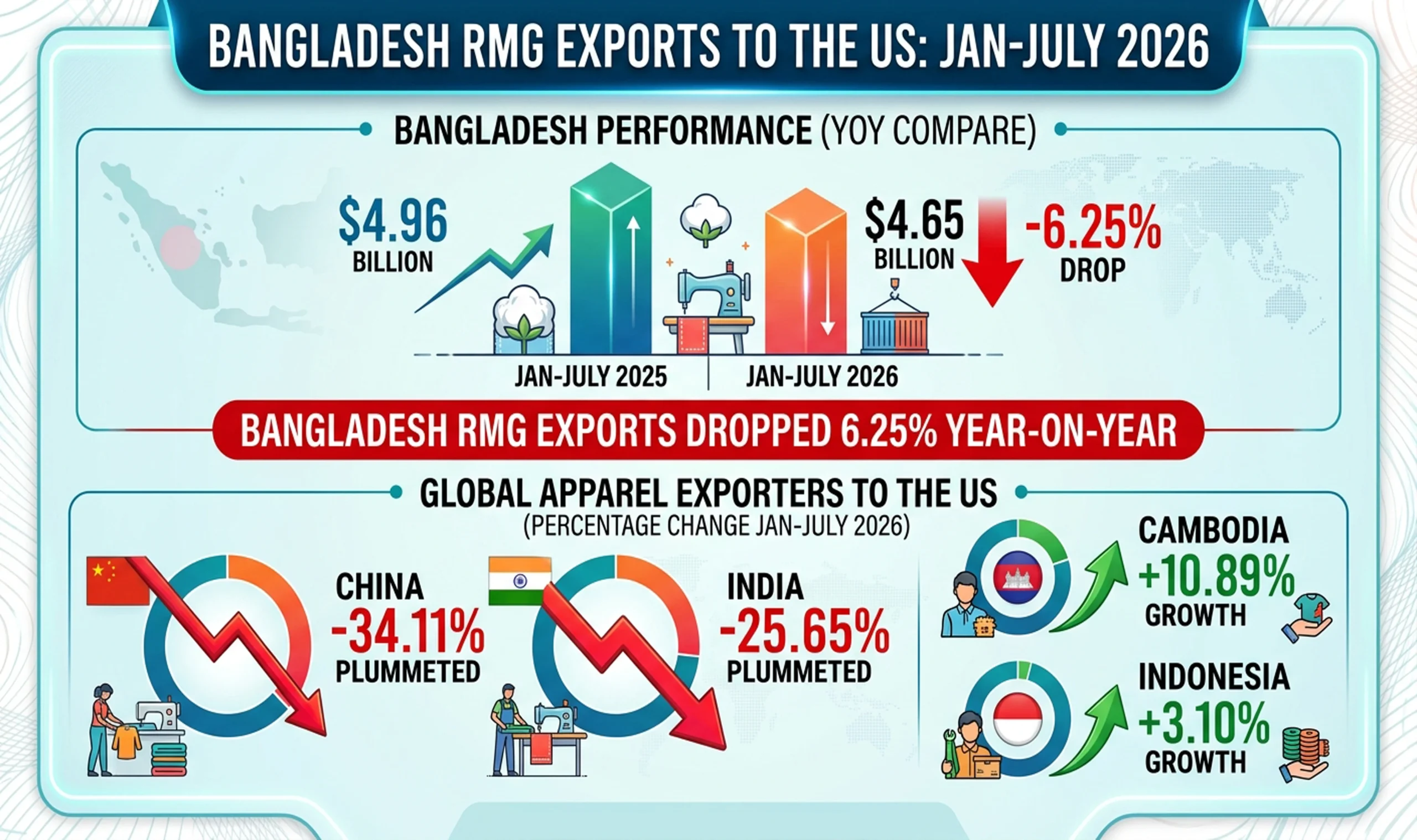
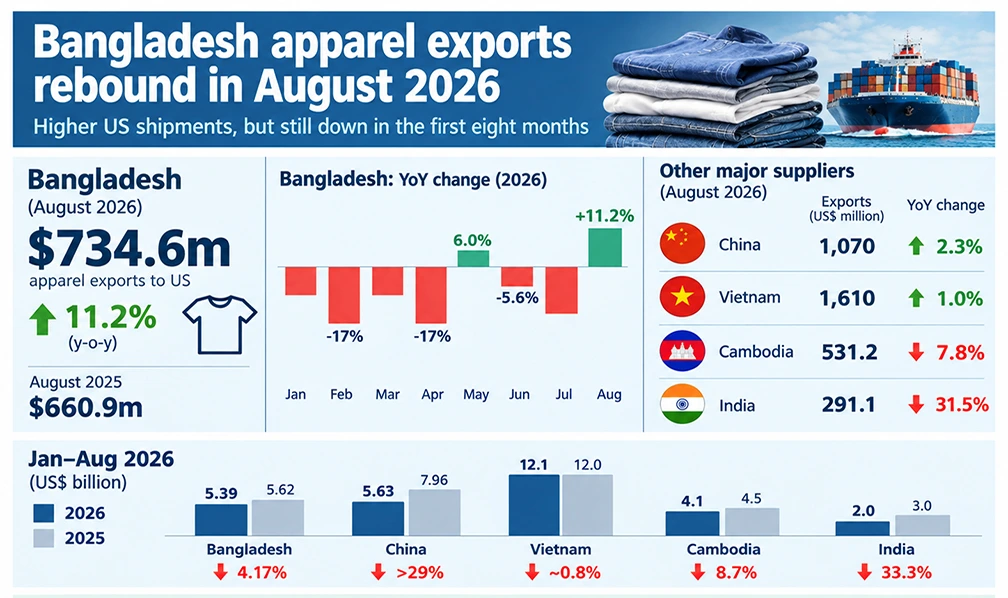
Bangladesh’s ready-made garment (RMG) exports to the United States fell 6.25 per cent year-on-year in the first seven months of 2026, amid continued volatility and growing competition from rival Asian sourcing destinations.

Bangladesh earned $4.65 billion from apparel exports to the US between January and July, down from $4.96 billion in the corresponding period of 2025, according to data released by the US Office of Textiles and Apparel (OTEXA) on September 3.

The export performance remained volatile during the period. Shipments increased 6.03 per cent in May and 5.66 per cent in June, but sharp year-on-year declines of 17.05 per cent in February, 17.14 per cent in April and 10.72 per cent in July weighed heavily on cumulative earnings.

Industry insiders said Bangladesh had failed to capture a significant share of orders displaced from China, while competitors in Southeast Asia, particularly Cambodia and Indonesia, had benefited from the shift.

OTEXA data show a marked divergence in the performance of major Asian apparel suppliers to the US market through July.

China recorded the steepest decline among the major suppliers, with apparel exports to the US falling 34.11 per cent year-on-year to $4.55 billion in January-July 2026, from $6.91 billion in the same period of 2025.

India also experienced a substantial contraction, with shipments falling 25.65 per cent to $2.45 billion from $3.30 billion.

Cambodia, by contrast, emerged as one of the strongest performers in the region. Its apparel exports to the US increased 10.89 per cent to $2.62 billion, compared with $2.36 billion in the corresponding period of 2025.

Indonesia also maintained positive momentum, with apparel shipments rising 3.10 per cent to $2.74 billion during the first seven months of 2026.

Vietnam, the largest apparel supplier among the countries examined, remained relatively stable. Its exports declined just 0.68 per cent year-on-year to $9.37 billion, compared with $9.43 billion in 2025.

Pakistan recorded a 5.44 per cent decline to $1.27 billion during January-July 2026.

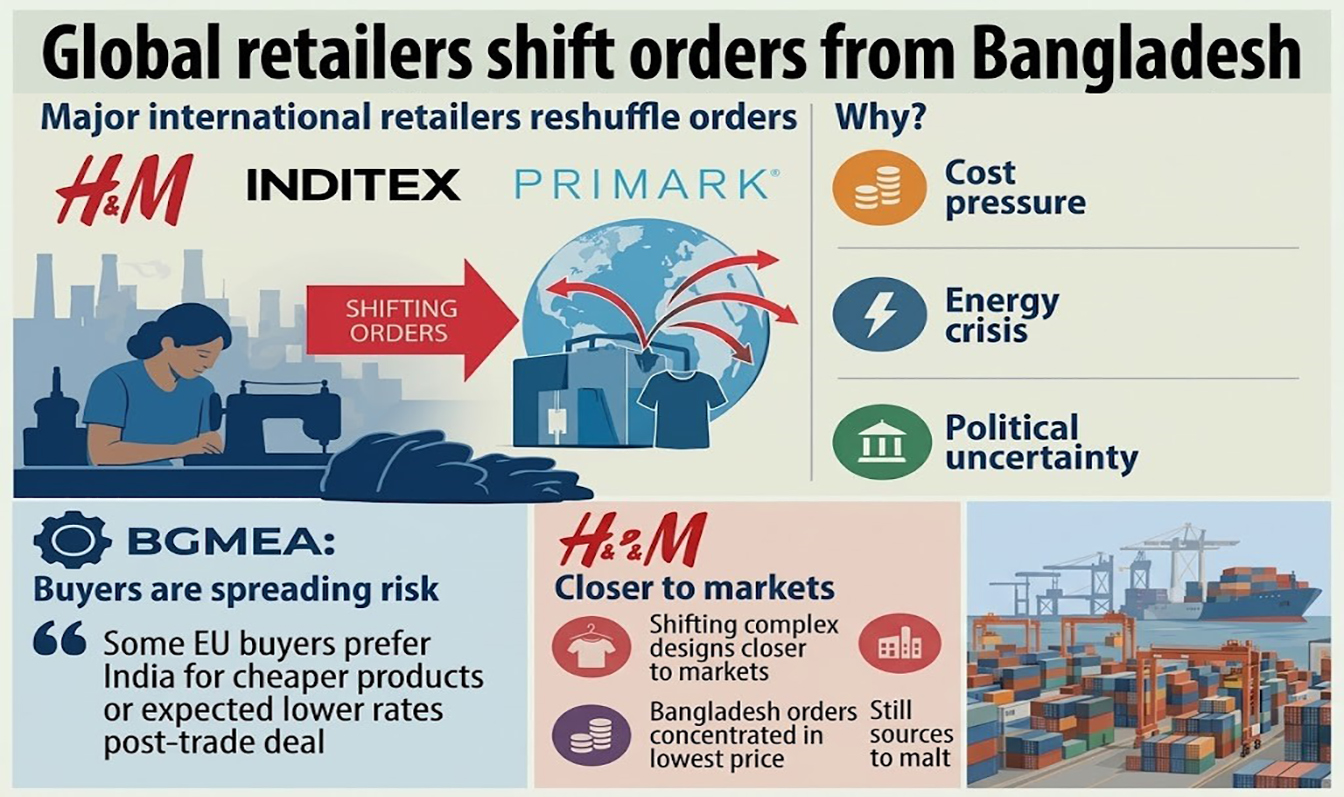
The pronounced divergence reflects an ongoing realignment of apparel supply chains, as US brands and buyers seek to diversify sourcing, manage tariff exposure and reduce dependence on individual production hubs, industry sources said.

Exporters said Vietnam remained the primary alternative to China for higher-value and more complex garment categories, while Cambodia had emerged as a relative winner by absorbing displaced low- to mid-tier orders, particularly in basic woven garments and activewear.

Indonesia has also maintained positive momentum, offering US buyers an alternative sourcing base for mid-market apparel, they said.

Industry insiders attributed Bangladesh’s relatively weak performance to structural limitations in its product mix and supply chain.

China’s retreat has created opportunities particularly in synthetic and technical apparel made from man-made fibres (MMF).

Vietnam and Cambodia have more mature MMF supply chains, whereas Bangladesh remains heavily dependent on cotton-based knitwear, limiting its ability to capture some of the product categories previously supplied by China, they said.

US buyers are also increasingly prioritising supply-chain agility, with Southeast Asian sourcing hubs benefiting from relatively efficient ports and shorter transit times to the US compared with Bangladesh’s longer shipping routes and domestic feeder-port bottlenecks.

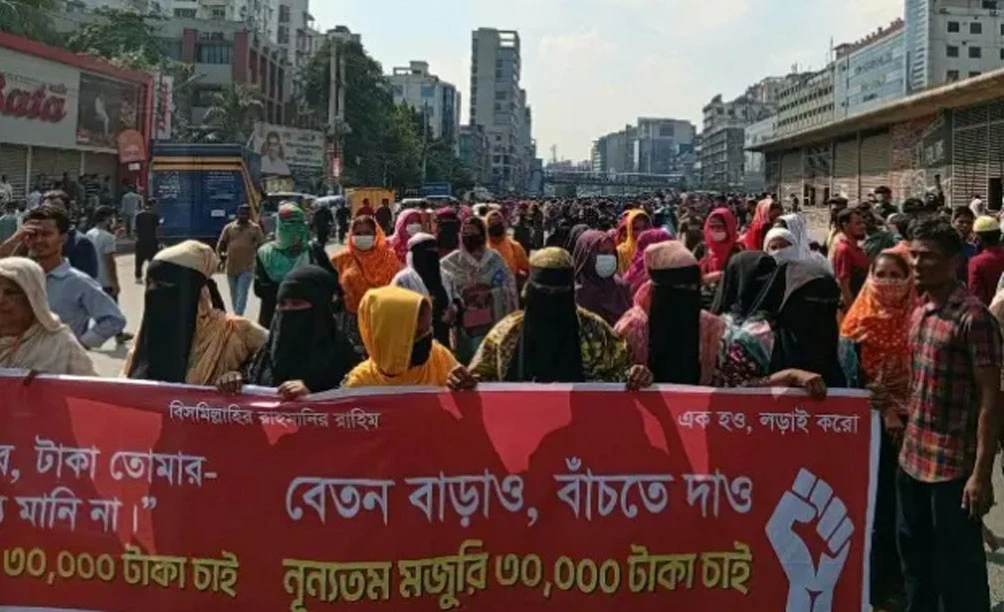
Domestic energy shortages, wage restructuring debates and political-transition pressures in Bangladesh during recent cycles have also contributed to buyer hesitancy, prompting some American brands to hedge sourcing allocations towards Vietnam, Cambodia and Indonesia, industry sources said.

Inamul Haq Khan, senior vice-president of the Bangladesh Garment Manufacturers and Exporters Association (BGMEA), said Bangladesh was still performing marginally better than some other sourcing countries but acknowledged that Cambodia, Vietnam and Indonesia had gained momentum in recent months.

‘Buyers depend on Bangladesh for large work orders because of its capacity, while they prefer those countries mostly for small-sized orders,’ he said.

Inamul also identified Egypt as an emerging competitor, saying buyers could use the country to secure faster deliveries, particularly for goods destined for the European Union.

He also expressed concern over the uncertainty surrounding gas supplies to the garment industry.

‘Being one of the major stakeholders, we are still in the dark as no concrete information related to gas supply is being conveyed by the concerned authorities,’ he said.

The latest US trade data suggest that Bangladesh continues to retain a strong position in large-volume garment manufacturing.

However, its ability to regain momentum in the US market may increasingly depend on diversifying beyond cotton-based products, strengthening MMF capabilities and improving supply-chain reliability.
Bangladesh’s garment exports to US drop 6.25pc as rivals gain

Update Time : 11:38:51 pm, Saturday, 5 September 2026

Bangladesh’s ready-made garment (RMG) exports to the United States fell 6.25 per cent year-on-year in the first seven months of 2026, amid continued volatility and growing competition from rival Asian sourcing destinations.

Bangladesh earned $4.65 billion from apparel exports to the US between January and July, down from $4.96 billion in the corresponding period of 2025, according to data released by the US Office of Textiles and Apparel (OTEXA) on September 3.

The export performance remained volatile during the period. Shipments increased 6.03 per cent in May and 5.66 per cent in June, but sharp year-on-year declines of 17.05 per cent in February, 17.14 per cent in April and 10.72 per cent in July weighed heavily on cumulative earnings.

Industry insiders said Bangladesh had failed to capture a significant share of orders displaced from China, while competitors in Southeast Asia, particularly Cambodia and Indonesia, had benefited from the shift.

OTEXA data show a marked divergence in the performance of major Asian apparel suppliers to the US market through July.

China recorded the steepest decline among the major suppliers, with apparel exports to the US falling 34.11 per cent year-on-year to $4.55 billion in January-July 2026, from $6.91 billion in the same period of 2025.

India also experienced a substantial contraction, with shipments falling 25.65 per cent to $2.45 billion from $3.30 billion.

Cambodia, by contrast, emerged as one of the strongest performers in the region. Its apparel exports to the US increased 10.89 per cent to $2.62 billion, compared with $2.36 billion in the corresponding period of 2025.

Indonesia also maintained positive momentum, with apparel shipments rising 3.10 per cent to $2.74 billion during the first seven months of 2026.

Vietnam, the largest apparel supplier among the countries examined, remained relatively stable. Its exports declined just 0.68 per cent year-on-year to $9.37 billion, compared with $9.43 billion in 2025.

Pakistan recorded a 5.44 per cent decline to $1.27 billion during January-July 2026.

The pronounced divergence reflects an ongoing realignment of apparel supply chains, as US brands and buyers seek to diversify sourcing, manage tariff exposure and reduce dependence on individual production hubs, industry sources said.

Exporters said Vietnam remained the primary alternative to China for higher-value and more complex garment categories, while Cambodia had emerged as a relative winner by absorbing displaced low- to mid-tier orders, particularly in basic woven garments and activewear.

Indonesia has also maintained positive momentum, offering US buyers an alternative sourcing base for mid-market apparel, they said.

Industry insiders attributed Bangladesh’s relatively weak performance to structural limitations in its product mix and supply chain.

China’s retreat has created opportunities particularly in synthetic and technical apparel made from man-made fibres (MMF).

Vietnam and Cambodia have more mature MMF supply chains, whereas Bangladesh remains heavily dependent on cotton-based knitwear, limiting its ability to capture some of the product categories previously supplied by China, they said.

US buyers are also increasingly prioritising supply-chain agility, with Southeast Asian sourcing hubs benefiting from relatively efficient ports and shorter transit times to the US compared with Bangladesh’s longer shipping routes and domestic feeder-port bottlenecks.

Domestic energy shortages, wage restructuring debates and political-transition pressures in Bangladesh during recent cycles have also contributed to buyer hesitancy, prompting some American brands to hedge sourcing allocations towards Vietnam, Cambodia and Indonesia, industry sources said.

Inamul Haq Khan, senior vice-president of the Bangladesh Garment Manufacturers and Exporters Association (BGMEA), said Bangladesh was still performing marginally better than some other sourcing countries but acknowledged that Cambodia, Vietnam and Indonesia had gained momentum in recent months.

‘Buyers depend on Bangladesh for large work orders because of its capacity, while they prefer those countries mostly for small-sized orders,’ he said.

Inamul also identified Egypt as an emerging competitor, saying buyers could use the country to secure faster deliveries, particularly for goods destined for the European Union.

He also expressed concern over the uncertainty surrounding gas supplies to the garment industry.

‘Being one of the major stakeholders, we are still in the dark as no concrete information related to gas supply is being conveyed by the concerned authorities,’ he said.

The latest US trade data suggest that Bangladesh continues to retain a strong position in large-volume garment manufacturing.

However, its ability to regain momentum in the US market may increasingly depend on diversifying beyond cotton-based products, strengthening MMF capabilities and improving supply-chain reliability.