8:56 pm, Wednesday, 16 September 2026

15 fashion giants could help Bangladesh cut 8.59m tonnes of CO₂

  • Bizbd Report
  • Update Time : 07:17:28 pm, Wednesday, 16 September 2026
  • 7

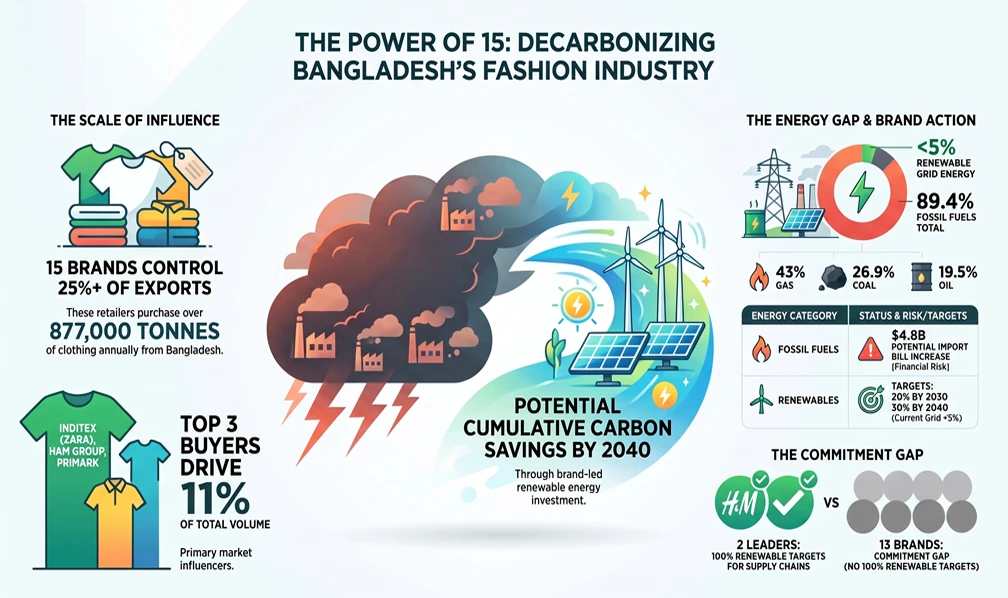
A group of the world’s leading fashion retailers, including H&M Group, Inditex, Primark and Walmart, has the power to steer Bangladesh away from fossil fuels and prevent an estimated 8.59 million tonnes of carbon dioxide emissions by 2040, according to a new report.

The report, Fashion’s Fair Share: Bangladesh Buyers’ Climate Opportunity, was published by the Stand.earth Research Group (SRG), a US-based non-profit that monitors the environmental impact of the global fashion industry.

Drawing on Bangladeshi customs data for 2025, the study found the country exported 3.33 billion kilograms of apparel and textiles over the year. Just 15 major brands were responsible for more than a quarter of that volume — over 877,000 tonnes, or roughly 5.8 million average t-shirts’ worth of clothing.

Inditex, the owner of Zara, was the single largest buyer by weight, followed closely by H&M Group and then Primark. Between them, the three companies accounted for more than 11 per cent of Bangladesh’s total textile exports — over 367 million kilograms.

The researchers calculated that if these 15 companies moved decisively to finance renewable energy infrastructure across Bangladesh’s national grid and garment sector, they could reduce the country’s annual emissions by up to 1.26 million tonnes of CO2 by 2040, with cumulative savings reaching 8.59 million tonnes — comparable to Jamaica’s entire annual emissions output.

Fazlee Shamim Ehsan, executive president of the Bangladesh Knitwear Manufacturers and Exporters Association, welcomed the prospect of greater brand involvement, noting that manufacturer buy-in would improve if brands offered direct financial incentives.

He said the shift towards renewables would continue regardless, but that support from brands would help speed up the process.

Bangladesh currently draws less than 5 per cent of its grid electricity from renewable sources, and a separate survey of nearly 900 export-oriented garment factories in Gazipur and Narayanganj found renewables made up just 3 per cent of energy use on-site.

The government has set targets of 20 per cent renewable power by 2030, rising to 30 per cent by 2040.

Despite their considerable purchasing influence, the report found that most of the 15 brands studied have made only limited concrete pledges.

Only Inditex and H&M Group have committed to 100 per cent renewable electricity targets that extend beyond their own operations into their supply chains, even though ten of the fifteen have set such targets internally.

Just four of the brands — Bestseller, Gap Inc., H&M Group and Marks & Spencer — publicly disclose involvement in supplier financing schemes, such as the Apparel Impact Institute’s Future Supplier Initiative, and none demonstrated strong evidence of offering grants or debt-free financing.

None of the fifteen brands had published a comprehensive climate adaptation policy covering their Bangladesh manufacturing operations.

Only one had a publicly available supplier code specifically addressing heat stress, covering issues such as water access, ventilation, rest breaks and protective equipment — though H&M Group has separately developed similar guidance with the International Labour Organization, IndustriALL and Better Work that has not yet been made public.

Only three companies — H&M Group, Bestseller and Inditex — showed clear evidence of engaging directly with Bangladeshi policymakers on the infrastructure needed to support the transition.

H&M Group, Bangladesh’s second-largest buyer by weight, emerged as the strongest performer against the report’s ‘just energy transition’ criteria. The company matched 48 per cent of its textile supply chain’s electricity consumption with renewable sources in 2025 and financed 24 supplier projects through its own Green Fashion Initiative.

By contrast, the report identified Kontoor Brands, New Yorker, Gildan Activewear, LPP and Pepco Group as showing the widest gaps in climate action — though it stressed that all 15 companies assessed needed to do considerably more.

The findings arrive as Bangladesh’s garment sector contends with a worsening gas and electricity crisis that has forced many factories to operate below capacity, with some suspending operations altogether.

The country’s energy mix remains heavily dependent on imported fossil fuels — 43 per cent gas, 26.9 per cent coal and 19.5 per cent oil, according to the report — leaving it exposed to volatile global prices.

Bangladesh’s annual fossil fuel import bill could rise by as much as $4.8 billion, equivalent to 1.1 per cent of GDP, should oil, gas and coal prices remain elevated.

The report presents the current crisis as a pivotal moment, arguing that fuel shortages and price volatility have strengthened the case for brand intervention just as national climate goals and industry survival are becoming closely aligned.

Rachel Kitchin, senior corporate climate campaigner at Stand.earth, said the 15 brands acting together could change the trajectory of Bangladesh’s energy transition, and argued that buyers must play their part as the sector navigates energy shortages and price instability.

The report builds on an earlier roadmap, Fair Share for the Future: Fashion Brand Roadmap for a Just Energy Transition, published in February 2026 by Stand.earth, Oxfam in Bangladesh and the Bangladesh Center for Workers Solidarity.

That roadmap called on brands to support decarbonisation through accessible financing, fair purchasing practices, policy advocacy and climate adaptation support.

Stand.earth is now urging the 15 brands named in the study to commit to a shared set of actions over the next 18 months as part of its ‘Fashion’s Fair Share’ initiative.

The report also situates its findings within the fashion industry’s wider climate footprint.

Globally, the sector is responsible for around 4 per cent of climate pollution, with emissions rising 7.5 per cent in 2023 and a further 6.3 per cent in 2024, reaching approximately 1 billion tonnes of greenhouse gases annually, according to data from the Apparel Impact Institute cited in t
15 fashion giants could help Bangladesh cut 8.59m tonnes of CO₂

Update Time : 07:17:28 pm, Wednesday, 16 September 2026

A group of the world’s leading fashion retailers, including H&M Group, Inditex, Primark and Walmart, has the power to steer Bangladesh away from fossil fuels and prevent an estimated 8.59 million tonnes of carbon dioxide emissions by 2040, according to a new report.

The report, Fashion’s Fair Share: Bangladesh Buyers’ Climate Opportunity, was published by the Stand.earth Research Group (SRG), a US-based non-profit that monitors the environmental impact of the global fashion industry.

Drawing on Bangladeshi customs data for 2025, the study found the country exported 3.33 billion kilograms of apparel and textiles over the year. Just 15 major brands were responsible for more than a quarter of that volume — over 877,000 tonnes, or roughly 5.8 million average t-shirts’ worth of clothing.

Inditex, the owner of Zara, was the single largest buyer by weight, followed closely by H&M Group and then Primark. Between them, the three companies accounted for more than 11 per cent of Bangladesh’s total textile exports — over 367 million kilograms.

The researchers calculated that if these 15 companies moved decisively to finance renewable energy infrastructure across Bangladesh’s national grid and garment sector, they could reduce the country’s annual emissions by up to 1.26 million tonnes of CO2 by 2040, with cumulative savings reaching 8.59 million tonnes — comparable to Jamaica’s entire annual emissions output.

Fazlee Shamim Ehsan, executive president of the Bangladesh Knitwear Manufacturers and Exporters Association, welcomed the prospect of greater brand involvement, noting that manufacturer buy-in would improve if brands offered direct financial incentives.

He said the shift towards renewables would continue regardless, but that support from brands would help speed up the process.

Bangladesh currently draws less than 5 per cent of its grid electricity from renewable sources, and a separate survey of nearly 900 export-oriented garment factories in Gazipur and Narayanganj found renewables made up just 3 per cent of energy use on-site.

The government has set targets of 20 per cent renewable power by 2030, rising to 30 per cent by 2040.

Despite their considerable purchasing influence, the report found that most of the 15 brands studied have made only limited concrete pledges.

Only Inditex and H&M Group have committed to 100 per cent renewable electricity targets that extend beyond their own operations into their supply chains, even though ten of the fifteen have set such targets internally.

Just four of the brands — Bestseller, Gap Inc., H&M Group and Marks & Spencer — publicly disclose involvement in supplier financing schemes, such as the Apparel Impact Institute’s Future Supplier Initiative, and none demonstrated strong evidence of offering grants or debt-free financing.

None of the fifteen brands had published a comprehensive climate adaptation policy covering their Bangladesh manufacturing operations.

Only one had a publicly available supplier code specifically addressing heat stress, covering issues such as water access, ventilation, rest breaks and protective equipment — though H&M Group has separately developed similar guidance with the International Labour Organization, IndustriALL and Better Work that has not yet been made public.

Only three companies — H&M Group, Bestseller and Inditex — showed clear evidence of engaging directly with Bangladeshi policymakers on the infrastructure needed to support the transition.

H&M Group, Bangladesh’s second-largest buyer by weight, emerged as the strongest performer against the report’s ‘just energy transition’ criteria. The company matched 48 per cent of its textile supply chain’s electricity consumption with renewable sources in 2025 and financed 24 supplier projects through its own Green Fashion Initiative.

By contrast, the report identified Kontoor Brands, New Yorker, Gildan Activewear, LPP and Pepco Group as showing the widest gaps in climate action — though it stressed that all 15 companies assessed needed to do considerably more.

The findings arrive as Bangladesh’s garment sector contends with a worsening gas and electricity crisis that has forced many factories to operate below capacity, with some suspending operations altogether.

The country’s energy mix remains heavily dependent on imported fossil fuels — 43 per cent gas, 26.9 per cent coal and 19.5 per cent oil, according to the report — leaving it exposed to volatile global prices.

Bangladesh’s annual fossil fuel import bill could rise by as much as $4.8 billion, equivalent to 1.1 per cent of GDP, should oil, gas and coal prices remain elevated.

The report presents the current crisis as a pivotal moment, arguing that fuel shortages and price volatility have strengthened the case for brand intervention just as national climate goals and industry survival are becoming closely aligned.

Rachel Kitchin, senior corporate climate campaigner at Stand.earth, said the 15 brands acting together could change the trajectory of Bangladesh’s energy transition, and argued that buyers must play their part as the sector navigates energy shortages and price instability.

The report builds on an earlier roadmap, Fair Share for the Future: Fashion Brand Roadmap for a Just Energy Transition, published in February 2026 by Stand.earth, Oxfam in Bangladesh and the Bangladesh Center for Workers Solidarity.

That roadmap called on brands to support decarbonisation through accessible financing, fair purchasing practices, policy advocacy and climate adaptation support.

Stand.earth is now urging the 15 brands named in the study to commit to a shared set of actions over the next 18 months as part of its ‘Fashion’s Fair Share’ initiative.

The report also situates its findings within the fashion industry’s wider climate footprint.

Globally, the sector is responsible for around 4 per cent of climate pollution, with emissions rising 7.5 per cent in 2023 and a further 6.3 per cent in 2024, reaching approximately 1 billion tonnes of greenhouse gases annually, according to data from the Apparel Impact Institute cited in t