Bizbd Report
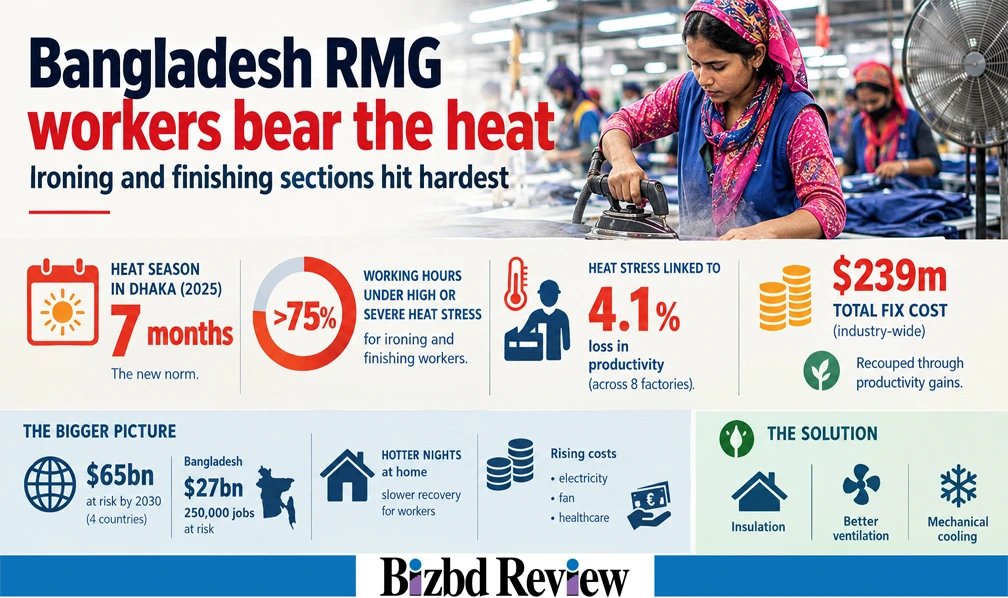
Workers in the ironing and finishing sections of Bangladesh’s garment factories are spending more than three-quarters of their working hours under high or severe heat stress, according to a new report from Cornell University’s Global Labor Institute (GLI) that quantifies, for the first time, both the human and financial toll of extreme heat on South Asia’s largest export industry.
The report, ‘Six Seasons, Four Summers,’ launched on September 21, found that Dhaka’s 2025 heat season stretched to seven months – a duration the authors describe as ‘the new norm’ – with temperatures inside factories consistently exceeding those outdoors.
The research team, working with BRAC University, YGEN Engineering, and the Bangladesh Centre for Worker Solidarity, installed electronic temperature and humidity sensors in eight factories and 37 workers’ homes over a full year – the first study of its kind to track heat exposure both on the factory floor and after workers return home.
The findings were stark: heat stress was linked to an average 4.1 per cent loss in working-time productivity across the eight factories studied, with ironing and finishing sections, among the hottest areas in any garment plant, bearing the heaviest exposure.
Despite the risk, surveys found workers frequently continued working through dangerously high heat.
Yet the report’s central finding is one of opportunity as much as alarm. Engineering assessments determined that targeted interventions – roof insulation, improved ventilation, and mechanical cooling – could substantially cut heat exposure while paying for themselves through productivity gains within one to four years.
Scaled across Bangladesh’s entire apparel export sector, the researchers estimate the total capital cost of remediation at $239 million, just 0.2 per cent of the industry’s 2025 export revenue.
Even under a conservative headwinds scenario accounting for higher capital and energy costs and more modest productivity gains, the average payback period across the eight factories studied was 2.9 years; in a worst-case scenario, just over four years.
The report builds on GLI’s 2023 ‘Higher Ground?’ study, conducted with asset manager Schroders, which projected that extreme heat and flooding could put $65 billion in apparel exports at risk across Bangladesh, Cambodia, Pakistan, and Vietnam by 2030, a 22 per cent loss in export earnings, while costing the region nearly one million potential new jobs.
For Bangladesh alone, that earlier analysis put $27 billion in exports and 250,000 jobs at risk.
The new research also tracked conditions inside workers’ homes, finding that rising nighttime temperatures are limiting recovery after long shifts in hot factories.
Surveys found workers reporting that they had to borrow money, pawn belongings, or cut other spending to cover rising electricity, fan, and healthcare costs during the hottest months.
‘The problem is urgent, and we already know what can be done to reduce heat stress,’ said Jason Judd, GLI’s executive director.
He called the business case for action clear from both an operational and worker-safety standpoint, but said the harder question is one of shared responsibility: ‘The challenge now is deciding how to share the costs fairly and scaling these solutions across the industry.’
Judd pointed to mechanisms like the International Accord as a framework for coordinating action among brands, manufacturers, workers, and government.
Tareq Ahmed Robin, managing director of YGEN Engineering in Dhaka, said solutions need to be tailored to each factory.
‘There is no one-size-fits-all solution to heat stress. Every factory is different, so measures need to reflect the factory’s design and production processes. The important thing is to start now,’ he said.
Kalpona Akter, executive director of the Bangladesh Centre for Worker Solidarity, called for workload adjustments as temperatures rise, underscoring that technical fixes alone will not address the immediate strain on workers during peak heat periods.