3:17 pm, Saturday, 19 September 2026

Bangladesh RMG renewable use stuck at 3pc, far off 2030 target

  • Bizbd Report
  • Update Time : 12:33:16 pm, Saturday, 19 September 2026
  • 14

Renewable energy uptake in Bangladesh’s export-oriented readymade garment sector remains at just 3 per cent, leaving the industry well short of its 2030 target and facing growing pressure to meet emerging EU sustainability requirements, according to a new policy brief.

The sector, which employs about 3 million workers and accounts for the bulk of the country’s merchandise export earnings, remains heavily dependent on grid and captive power, the brief found.

The brief, titled ‘Powering Compliance: Evidence and Recommendations for Renewable Energy Adoption in Bangladesh’s RMG Sector,’ was released in June by the Centre for Entrepreneurship Development (CED) at BRAC University.

It draws on factory-level energy data gathered under Phase II of the Mapped in Bangladesh (MiB) census, conducted between November 2023 and May 2024 across 878 factories in Gazipur and Narayanganj.

The findings paint a stark picture of an industry still overwhelmingly dependent on fossil fuels.

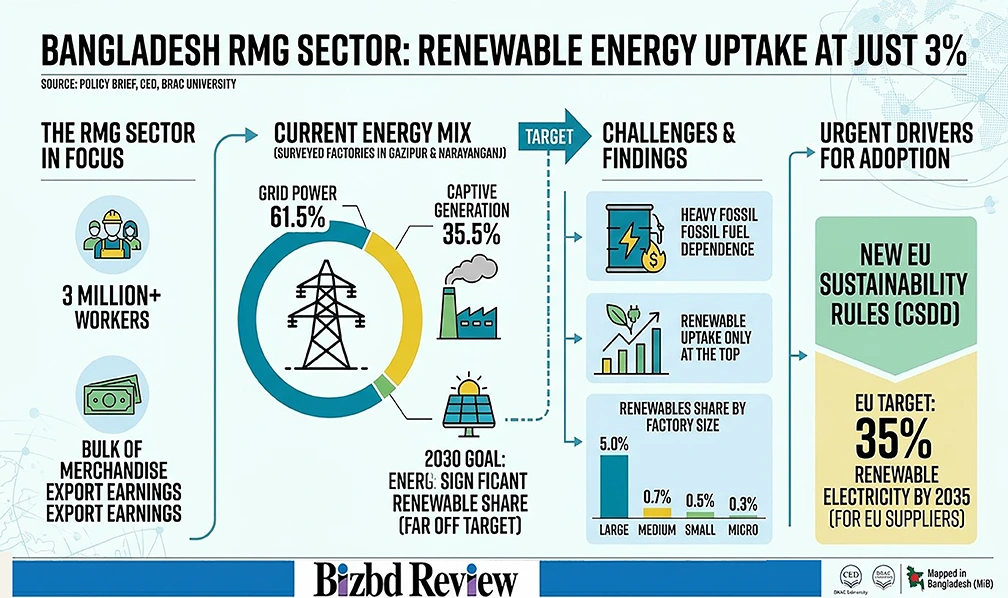
According to the study, the national grid supplies 61.5 per cent of factory energy consumption, captive generation accounts for 35.5 per cent, and renewable energy — sourced exclusively from solar panels — makes up just 3 per cent.

As much as 80 per cent of surveyed factories source virtually none of their energy from renewables, with 67 per cent using no renewable technology at all.

‘The renewable energy transition is happening only at the top,’ the report notes, pointing out that small and medium enterprises remain almost entirely tied to the grid, with renewable shares below 1 per cent.

Large factories fare somewhat better, sourcing 5 per cent of their energy from renewables and drawing nearly half their total consumption from non-grid sources, while medium factories manage only 0.7 per cent and small and micro units trail at 0.5 per cent and 0.3 per cent, respectively.

The stakes have been raised by the European Union’s Corporate Sustainability Due Diligence Directive, in force since 2024, which requires RMG factories supplying European markets to source 35 per cent of their electricity from renewables by 2035.

With the current renewable share at just 3 per cent and solar investment cycles typically running seven to 12 years, the report warns that ‘the practical window for action is the next two to three years’ to close a 32-percentage-point gap.

Researchers found the industry’s carbon footprint is compounded by the composition of both grid and captive power.

Bangladesh’s national grid draws 39.76 per cent of its generation from gas, 27.88 per cent from heavy fuel oil and 23.05 per cent from coal — a sharp shift from 2005, when gas alone supplied 86 per cent of generation.

Captive power, meanwhile, runs 60 per cent on gas and 40 per cent on oil. Together, the two districts surveyed emit roughly 40 million kilograms of CO₂ per month, with Gazipur’s 616 factories emitting more than three times as much as Narayanganj’s 262 factories.

Yet the brief argues the sector’s rooftop solar potential remains largely untapped. Of 155.07 million square feet of total factory floor space surveyed, only 9.07 million square feet has been identified as suitable for solar installation.

Full utilisation of that space, researchers calculated, could push the sector’s renewable share to 13 per cent and cut total CO₂ emissions by nearly 10 per cent.

The findings were discussed at a policy dialogue held on May 19 this year, bringing together the minister of power, energy and mineral resources, officials from SREDA, BIDA, BGMEA, BKMEA, Bangladesh Bank, the Asian Development Bank, UNIDO and the Embassy of Denmark alongside factory owners.

Twelve policy recommendations emerged from the dialogue, targeting government, development partners, industry associations, international buyers, academia and factories themselves.

Chief among the recommendations to government is resolving what the report calls a ‘contradiction’ between stated solar policy and actual import costs. While the FY2025-26 budget reduced duty on solar panels and inverters, cables, connectors and mounting structures still draw between 40 and 93 per cent in duties, and storage batteries roughly 62 per cent.

‘Financing complexity due to taxation means we have to incur a 63 per cent tax on solar imports,’ one industry participant was quoted as saying at the dialogue. ‘That is why we cannot support factories technically with any discounted margin.’

The report also calls for a dedicated fiscal incentive for rooftop and distributed solar — noting that the existing National Board of Revenue tax holiday applies only to utility-scale, build-own-operate power plants– and for the Bangladesh Energy Regulatory Commission and SREDA to fast-track net metering approvals and extend them to export processing zones, which currently exclude a significant cluster of factories from the mechanism.

For development partners, the brief recommends piloting ‘solar-as-a-service’ financing models with first-loss guarantees to make renewable investment bankable for small and medium factories, alongside credit guarantee mechanisms from Bangladesh Bank to open commercial lending channels that researchers say remain ‘functionally closed’ to SMEs despite the existence of facilities such as IDCOL’s rooftop solar financing package.

Trade bodies BGMEA and BKMEA have been urged to convert MiB’s data into quantified policy demands rather than waiting for government to act first, while international buyers are called on to back their renewable energy targets with structured supply-chain financing instead of shifting transition costs onto smaller suppliers.

On land, the report proposes designating riverside, khas and char land near Gazipur and Narayanganj as government-backed ‘Solar Hubs’ that could supply power to factories lacking rooftop space — a particularly urgent option for Narayanganj, where 89 per cent of surveyed factories are micro, small or medium enterprises.

The brief further recommends forming a dedicated RMG Energy Transition Taskforce, chaired by the ministry of power with SREDA as secretariat, to coordinate the finance, land, grid and tax approvals currently scattered across different agencies, and setting up an independent, multi-stakeholder watchdog body to publish an annual ‘State of RMG Energy Transition’ report tracking factory-level progress.

‘We are still considering solar as CSR,’ a participant told the dialogue. ‘We have to use it more strategically — and for that, we need credible data and someone to hold us accountable.’

Bangladesh RMG renewable use stuck at 3pc, far off 2030 target

Update Time : 12:33:16 pm, Saturday, 19 September 2026

Renewable energy uptake in Bangladesh’s export-oriented readymade garment sector remains at just 3 per cent, leaving the industry well short of its 2030 target and facing growing pressure to meet emerging EU sustainability requirements, according to a new policy brief.

The sector, which employs about 3 million workers and accounts for the bulk of the country’s merchandise export earnings, remains heavily dependent on grid and captive power, the brief found.

The brief, titled ‘Powering Compliance: Evidence and Recommendations for Renewable Energy Adoption in Bangladesh’s RMG Sector,’ was released in June by the Centre for Entrepreneurship Development (CED) at BRAC University.

It draws on factory-level energy data gathered under Phase II of the Mapped in Bangladesh (MiB) census, conducted between November 2023 and May 2024 across 878 factories in Gazipur and Narayanganj.

The findings paint a stark picture of an industry still overwhelmingly dependent on fossil fuels.

According to the study, the national grid supplies 61.5 per cent of factory energy consumption, captive generation accounts for 35.5 per cent, and renewable energy — sourced exclusively from solar panels — makes up just 3 per cent.

As much as 80 per cent of surveyed factories source virtually none of their energy from renewables, with 67 per cent using no renewable technology at all.

‘The renewable energy transition is happening only at the top,’ the report notes, pointing out that small and medium enterprises remain almost entirely tied to the grid, with renewable shares below 1 per cent.

Large factories fare somewhat better, sourcing 5 per cent of their energy from renewables and drawing nearly half their total consumption from non-grid sources, while medium factories manage only 0.7 per cent and small and micro units trail at 0.5 per cent and 0.3 per cent, respectively.

The stakes have been raised by the European Union’s Corporate Sustainability Due Diligence Directive, in force since 2024, which requires RMG factories supplying European markets to source 35 per cent of their electricity from renewables by 2035.

With the current renewable share at just 3 per cent and solar investment cycles typically running seven to 12 years, the report warns that ‘the practical window for action is the next two to three years’ to close a 32-percentage-point gap.

Researchers found the industry’s carbon footprint is compounded by the composition of both grid and captive power.

Bangladesh’s national grid draws 39.76 per cent of its generation from gas, 27.88 per cent from heavy fuel oil and 23.05 per cent from coal — a sharp shift from 2005, when gas alone supplied 86 per cent of generation.

Captive power, meanwhile, runs 60 per cent on gas and 40 per cent on oil. Together, the two districts surveyed emit roughly 40 million kilograms of CO₂ per month, with Gazipur’s 616 factories emitting more than three times as much as Narayanganj’s 262 factories.

Yet the brief argues the sector’s rooftop solar potential remains largely untapped. Of 155.07 million square feet of total factory floor space surveyed, only 9.07 million square feet has been identified as suitable for solar installation.

Full utilisation of that space, researchers calculated, could push the sector’s renewable share to 13 per cent and cut total CO₂ emissions by nearly 10 per cent.

The findings were discussed at a policy dialogue held on May 19 this year, bringing together the minister of power, energy and mineral resources, officials from SREDA, BIDA, BGMEA, BKMEA, Bangladesh Bank, the Asian Development Bank, UNIDO and the Embassy of Denmark alongside factory owners.

Twelve policy recommendations emerged from the dialogue, targeting government, development partners, industry associations, international buyers, academia and factories themselves.

Chief among the recommendations to government is resolving what the report calls a ‘contradiction’ between stated solar policy and actual import costs. While the FY2025-26 budget reduced duty on solar panels and inverters, cables, connectors and mounting structures still draw between 40 and 93 per cent in duties, and storage batteries roughly 62 per cent.

‘Financing complexity due to taxation means we have to incur a 63 per cent tax on solar imports,’ one industry participant was quoted as saying at the dialogue. ‘That is why we cannot support factories technically with any discounted margin.’

The report also calls for a dedicated fiscal incentive for rooftop and distributed solar — noting that the existing National Board of Revenue tax holiday applies only to utility-scale, build-own-operate power plants– and for the Bangladesh Energy Regulatory Commission and SREDA to fast-track net metering approvals and extend them to export processing zones, which currently exclude a significant cluster of factories from the mechanism.

For development partners, the brief recommends piloting ‘solar-as-a-service’ financing models with first-loss guarantees to make renewable investment bankable for small and medium factories, alongside credit guarantee mechanisms from Bangladesh Bank to open commercial lending channels that researchers say remain ‘functionally closed’ to SMEs despite the existence of facilities such as IDCOL’s rooftop solar financing package.

Trade bodies BGMEA and BKMEA have been urged to convert MiB’s data into quantified policy demands rather than waiting for government to act first, while international buyers are called on to back their renewable energy targets with structured supply-chain financing instead of shifting transition costs onto smaller suppliers.

On land, the report proposes designating riverside, khas and char land near Gazipur and Narayanganj as government-backed ‘Solar Hubs’ that could supply power to factories lacking rooftop space — a particularly urgent option for Narayanganj, where 89 per cent of surveyed factories are micro, small or medium enterprises.

The brief further recommends forming a dedicated RMG Energy Transition Taskforce, chaired by the ministry of power with SREDA as secretariat, to coordinate the finance, land, grid and tax approvals currently scattered across different agencies, and setting up an independent, multi-stakeholder watchdog body to publish an annual ‘State of RMG Energy Transition’ report tracking factory-level progress.

‘We are still considering solar as CSR,’ a participant told the dialogue. ‘We have to use it more strategically — and for that, we need credible data and someone to hold us accountable.’