11:23 pm, Friday, 10 July 2026

EPB charts $46.6b RMG target in proposed $58b FY27 export plan

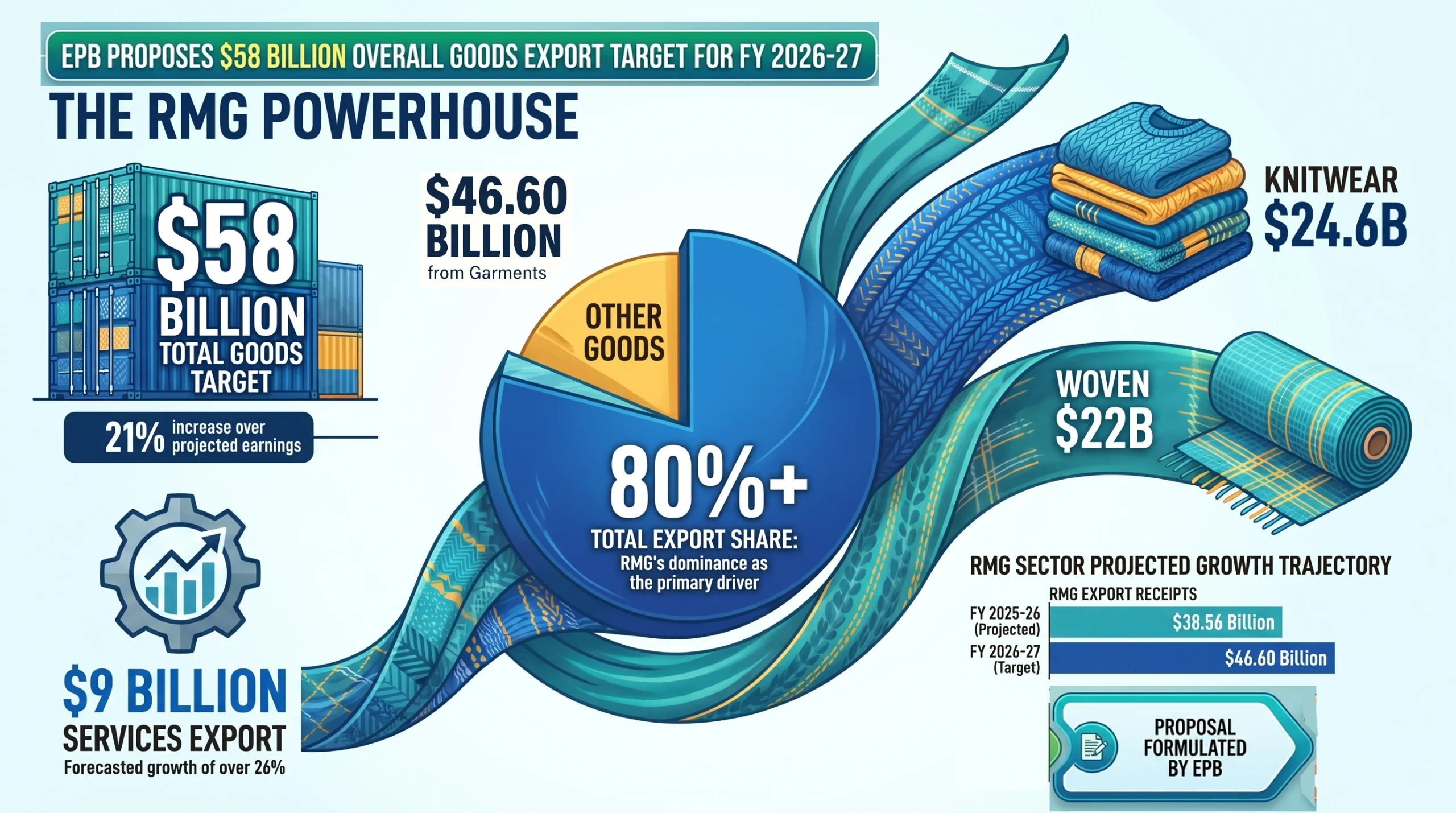
The Export Promotion Bureau (EPB) has proposed an overall goods export target of $58 billion for the financial year 2026-27, marking a 21 per cent rise on this year’s projected earnings, according to bureau officials.

Of that figure, $46.60 billion, equivalent to a 20.84 per cent increase, is expected to come from the readymade garment (RMG) sector, which the EPB forecasts will account for more than 80 per cent of the country’s total export receipts.

The bureau has also pencilled in a further $9.0 billion from services exports, projecting growth of over 26 per cent.

Within the proposed RMG figure, the EPB has earmarked $24.60 billion from knitwear and $22 billion from woven garments for FY27.

The bureau expects RMG receipts to close out the current 2025-26 financial year at $38.56 billion, against an original overall export target for goods of $55 billion set for the outgoing fiscal year.

The bureau expects RMG receipts to close out the 2025-26 financial year at $38.56 billion, against the original goods export target of $55 billion set for the financial year.

EPB officials said the proposal would be submitted to the commerce ministry on June 28, following a stakeholder meeting held on June 23.

EPB vice-chairman Mohammad Hasan Arif said the draft had been prepared in consultation with most major stakeholders, though he declined to give further details, adding that the proposal would be sent to the ministry early next week.

Industry pushes back on RMG target

Garment sector leaders have described the $46.6 billion RMG target as overly ambitious, arguing that, given current global market conditions, the target should instead be set at around 10 per cent above this year’s actual export earnings.

EPB officials said the $46.6 billion figure had been proposed with an eye on the country’s longer-term ambition of reaching $100 billion in RMG exports by 2030, arguing that the sector should think ambitiously in order to work towards that goal.

Bangladesh Garment Manufacturers and Exporters Association (BGMEA) called the target very ambitious given the existing strain on gas and electricity supplies.

A BGMEA representative said the industry had the marketing capability, production capacity and infrastructure to meet the target, but that many factories were unable to operate at full capacity because of deteriorating energy supply.

‘With existing gas and electricity supply, the target is very ambitious,’ the representative said, calling for energy supply to be brought up to a reasonable level if the target is to be achieved.

Headwinds from global crises

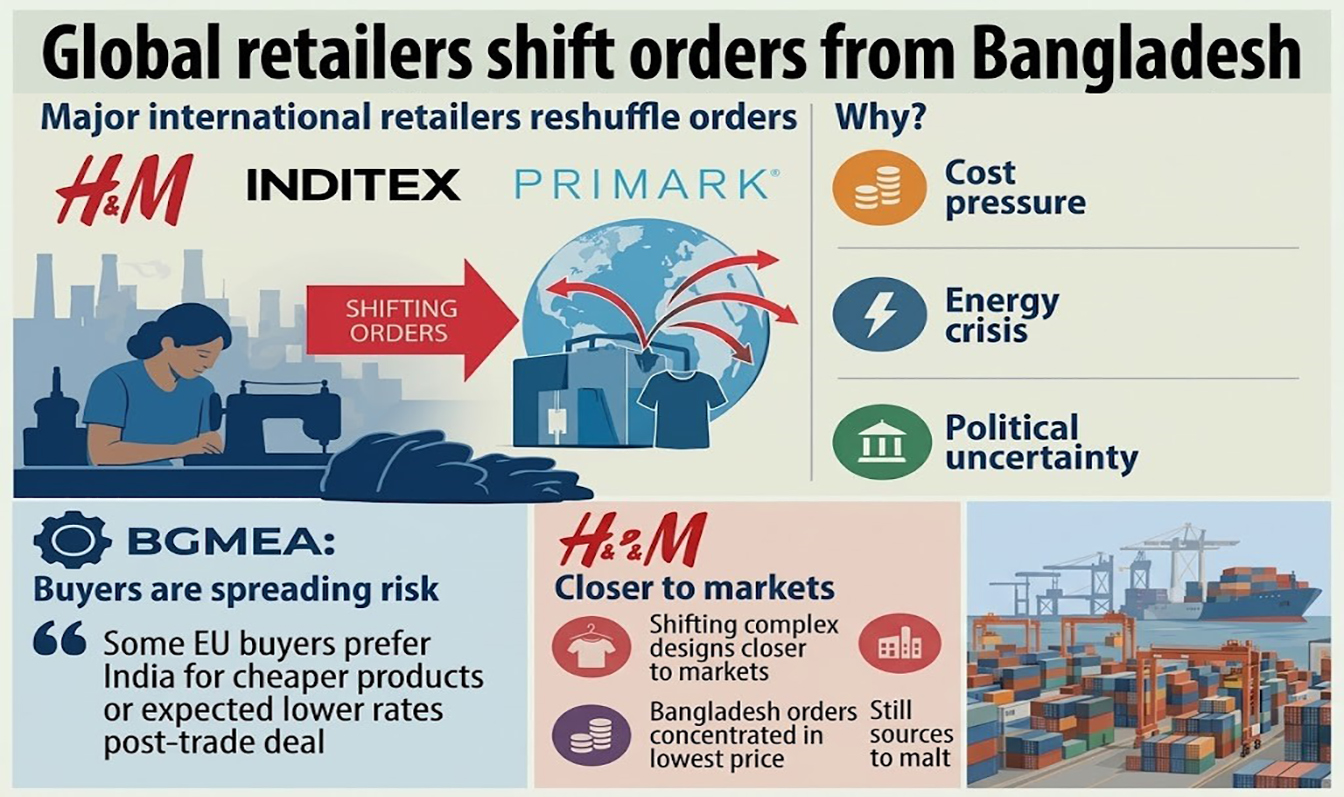
Industry sources pointed to a string of external shocks weighing on Bangladesh’s export performance, including the economic fallout from conflicts involving the US, Israel and Iran, wider unrest in the Middle East, and the prolonged effects of the Russia-Ukraine war.

High inflation across developed and developing economies has eroded consumer purchasing power, they said, while foreign buyers have suspended or held back work orders and pushed for lower prices. Export restrictions affecting shipments to India, linked to port curbs, have added to the pressure.

A volatile year for exports

Bangladesh’s export earnings turned negative on a year-on-year basis in August 2025, falling 2.93 per cent, largely on the back of weaker RMG shipments.

Further declines followed in subsequent months, 4.61 per cent in September, 7.43 per cent in October, 5.58 per cent in November, 14.25 per cent in December, 0.50 per cent in January, 2026, 12.03 per cent in February, 18.07 per cent in March and 7.07 per cent in May.

July and April, by contrast, saw growth of 24 per cent and 32 per cent respectively.

For the July-May period of FY2025-26, Bangladesh earned $43.79 billion from merchandise exports, down 2.55 per cent year-on-year from $44.94 billion in the same period the previous year, according to EPB data.

The bureau projects total exports will reach $47.82 billion by the end of June, against $48.28 billion in FY2024-25.
EPB charts $46.6b RMG target in proposed $58b FY27 export plan

Update Time : 01:02:07 pm, Saturday, 27 June 2026

The Export Promotion Bureau (EPB) has proposed an overall goods export target of $58 billion for the financial year 2026-27, marking a 21 per cent rise on this year’s projected earnings, according to bureau officials.

Of that figure, $46.60 billion, equivalent to a 20.84 per cent increase, is expected to come from the readymade garment (RMG) sector, which the EPB forecasts will account for more than 80 per cent of the country’s total export receipts.

The bureau has also pencilled in a further $9.0 billion from services exports, projecting growth of over 26 per cent.

Within the proposed RMG figure, the EPB has earmarked $24.60 billion from knitwear and $22 billion from woven garments for FY27.

The bureau expects RMG receipts to close out the current 2025-26 financial year at $38.56 billion, against an original overall export target for goods of $55 billion set for the outgoing fiscal year.

The bureau expects RMG receipts to close out the 2025-26 financial year at $38.56 billion, against the original goods export target of $55 billion set for the financial year.

EPB officials said the proposal would be submitted to the commerce ministry on June 28, following a stakeholder meeting held on June 23.

EPB vice-chairman Mohammad Hasan Arif said the draft had been prepared in consultation with most major stakeholders, though he declined to give further details, adding that the proposal would be sent to the ministry early next week.

Industry pushes back on RMG target

Garment sector leaders have described the $46.6 billion RMG target as overly ambitious, arguing that, given current global market conditions, the target should instead be set at around 10 per cent above this year’s actual export earnings.

EPB officials said the $46.6 billion figure had been proposed with an eye on the country’s longer-term ambition of reaching $100 billion in RMG exports by 2030, arguing that the sector should think ambitiously in order to work towards that goal.

Bangladesh Garment Manufacturers and Exporters Association (BGMEA) called the target very ambitious given the existing strain on gas and electricity supplies.

A BGMEA representative said the industry had the marketing capability, production capacity and infrastructure to meet the target, but that many factories were unable to operate at full capacity because of deteriorating energy supply.

‘With existing gas and electricity supply, the target is very ambitious,’ the representative said, calling for energy supply to be brought up to a reasonable level if the target is to be achieved.

Headwinds from global crises

Industry sources pointed to a string of external shocks weighing on Bangladesh’s export performance, including the economic fallout from conflicts involving the US, Israel and Iran, wider unrest in the Middle East, and the prolonged effects of the Russia-Ukraine war.

High inflation across developed and developing economies has eroded consumer purchasing power, they said, while foreign buyers have suspended or held back work orders and pushed for lower prices. Export restrictions affecting shipments to India, linked to port curbs, have added to the pressure.

A volatile year for exports

Bangladesh’s export earnings turned negative on a year-on-year basis in August 2025, falling 2.93 per cent, largely on the back of weaker RMG shipments.

Further declines followed in subsequent months, 4.61 per cent in September, 7.43 per cent in October, 5.58 per cent in November, 14.25 per cent in December, 0.50 per cent in January, 2026, 12.03 per cent in February, 18.07 per cent in March and 7.07 per cent in May.

July and April, by contrast, saw growth of 24 per cent and 32 per cent respectively.

For the July-May period of FY2025-26, Bangladesh earned $43.79 billion from merchandise exports, down 2.55 per cent year-on-year from $44.94 billion in the same period the previous year, according to EPB data.

The bureau projects total exports will reach $47.82 billion by the end of June, against $48.28 billion in FY2024-25.