Bizbd Report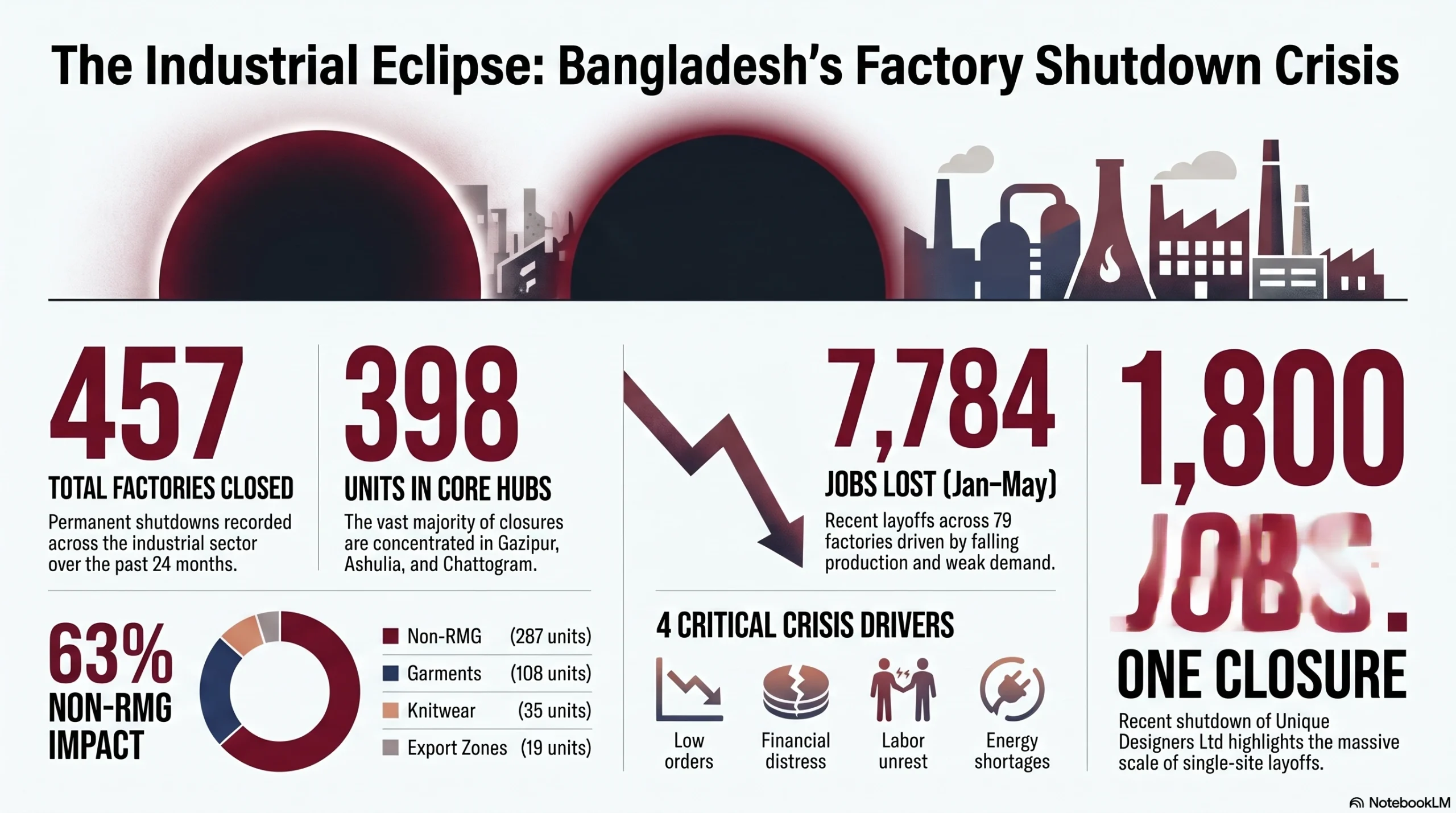
A total of 457 industrial units, including textile and garment factories, have permanently closed over the past two years due to a combination of insufficient work orders, financial distress among owners, labour unrest and an ongoing energy crisis, according to law enforcement agency data.
The majority of the closed factories, 398 units, were located in Gazipur, Ashulia and Chattogram, the data showed.
Of the 457 closed units, 287 were non-readymade garment (non-RMG) factories.
The rest were affiliated with key industry bodies, including the Bangladesh Garment Manufacturers and Exporters Association (BGMEA) with 108 factories, the Bangladesh Knitwear Manufacturers and Exporters Association (BKMEA) with 35, the Bangladesh Textile Mills Association (BTMA) with eight, and the Bangladesh Export Processing Zones Authority (BEPZA) with 19 units.
On June 23, Unique Designers Ltd and Unique Washing and Dyeing Ltd in Gazipur announced permanent closure after being temporarily shut on June 16, citing financial difficulties.
The decision resulted in the loss of around 1,800 jobs, according to law enforcement sources.
The data also shows that 79 factories laid off 7,784 workers in the five months to May 31, driven by falling production, weak order flows, sluggish global demand and reduced competitiveness.
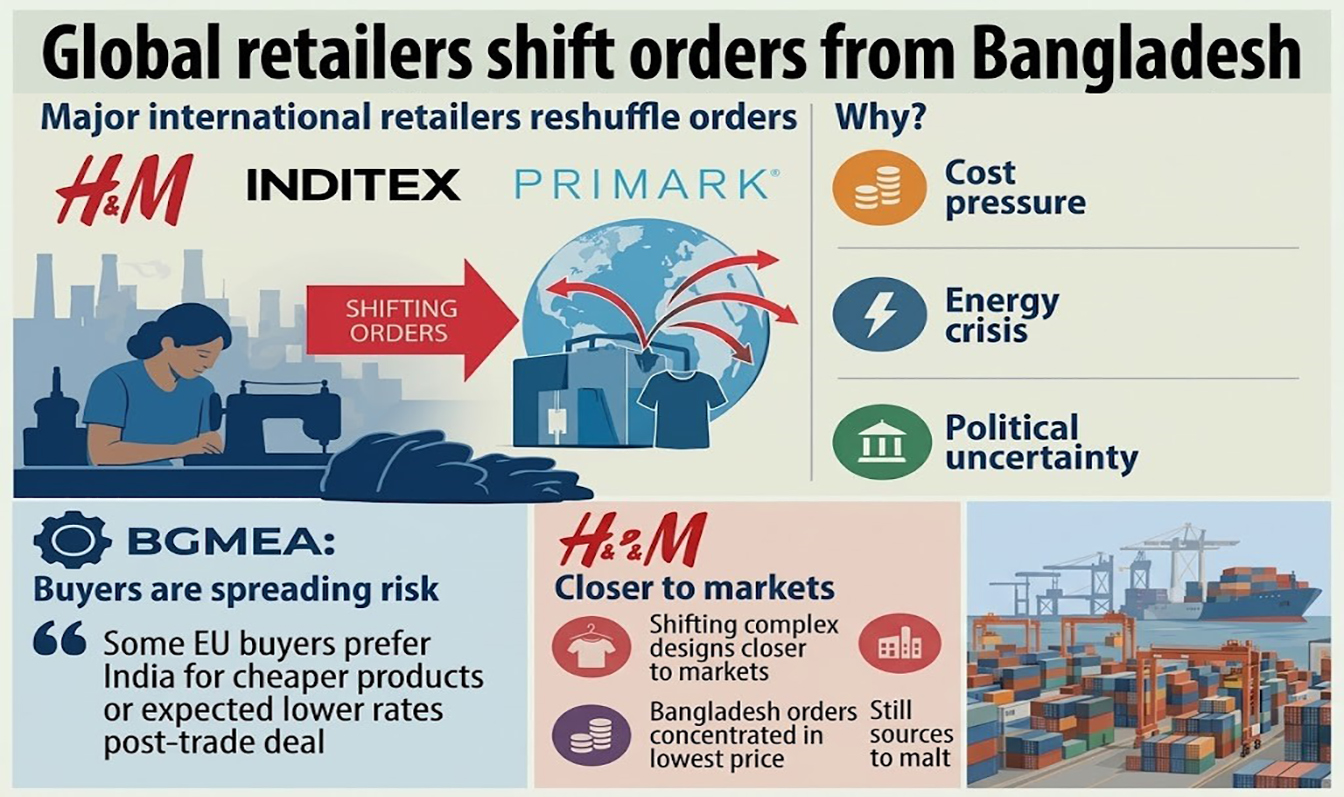
Industry stakeholders said the closures were caused by a mix of domestic and global factors, including declining international demand, bankruptcy of overseas buyers, political instability, banking complications, factory relocations, raw material shortages, and the impact of global conflicts and geopolitical tensions.
They said that the newly elected government has taken steps to support the reopening of closed factories, including financial assistance schemes.
Bangladesh Bank has introduced a Tk 200 billion pre-finance scheme aimed at reviving large industrial and service-sector enterprises that have shut down or are operating below capacity due to working capital shortages.
A further Tk 50 billion scheme has been introduced for cottage, micro, small and medium enterprises (CMSMEs).
The central bank has also instructed apparel trade bodies to submit detailed information on closed and partially closed factories.
However, concerns were raised at a Bangladesh Garment Manufacturers and Exporters Association (BGMEA) meeting on June 14, where member factories said many small and medium enterprises may not be able to access the support due to eligibility conditions set by the central bank.
BGMEA President Mahmud Hasan Khan said not all closed factories could be reopened as many lacked operational capacity, while others had poor credit information bureau (CIB) records.
He cited several reasons behind the closures, including weak global demand, shortage of orders, inefficiency in some factories, bankruptcy among foreign buyers, and delays in shipments caused by political instability or natural disasters.
BGMEA Vice President Shehab Udduza Chowdhury told The Financial Express that around 200 closed and 123 partially closed factories have expressed interest in accessing the government’s financial support packages.
He said priority should be given to units operating below capacity, as working capital support could quickly boost employment and export earnings.
Shehab Udduza said that many SMEs, which most need assistance, are unable to access funds due to collateral requirements.
He urged the government to consider lending at a 7 per cent interest rate for CMSMEs and to allow loan rescheduling with minimal down payment requirements.
The BGMEA president said two audit firms will inspect interested factories and submit reports to the association, which will then recommend eligible units to the central bank based on their findings.