11:23 pm, Friday, 10 July 2026

Bangladesh’s exports slip 0.58pc in FY26 amid global headwinds

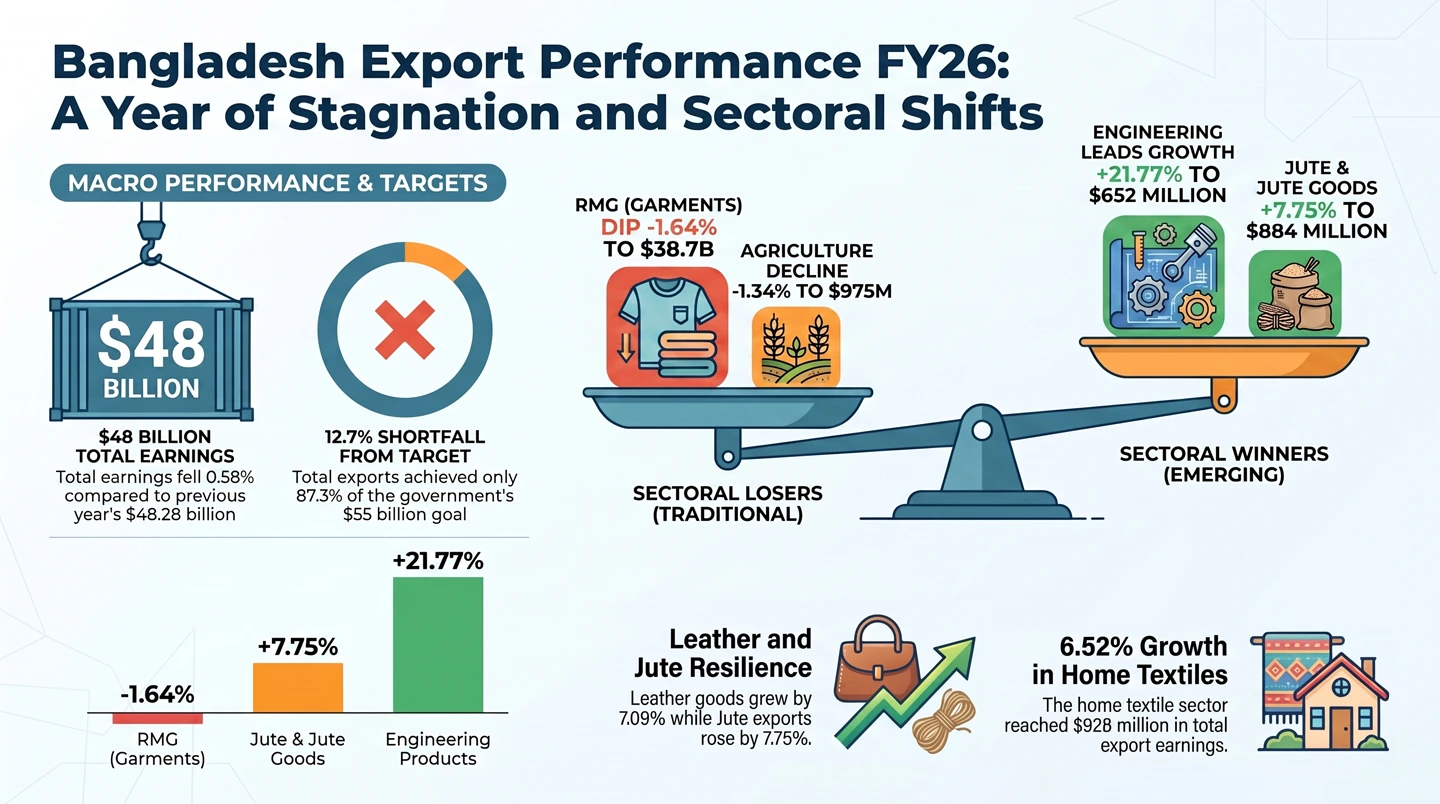
Bangladesh’s export earnings remained virtually flat in the just-concluded financial year 2025-26, declining by 0.58 per cent to $48 billion from $48.28 billion in the previous year, as geopolitical tensions, uncertainty over United States tariff policies, rising production costs and weakening demand in key markets weighed on overseas shipments.

Data released by the Export Promotion Bureau on July 2 showed that merchandise exports fell well short of the government’s target of $55 billion, achieving only about 87.3 per cent of the goal.

Despite the marginal annual decline, the EPB said the export sector had demonstrated resilience in the face of geopolitical conflicts, global inflationary pressures, supply chain disruptions, volatility in energy markets and subdued consumer demand across several major economies.

‘The export sector’s ability to maintain earnings near the previous year’s level reflects its underlying strength and adaptability,’ the state-owned agency said.

Exporters, however, attributed the weaker performance to a combination of external and domestic challenges.

They said continuing geopolitical conflicts, uncertainty surrounding US tariff measures, disruptions to sourcing and production planning, and intensified competition in the European Union market after China redirected more exports to the region had all undermined Bangladesh’s export growth.

Business leaders also pointed to severe domestic constraints, including acute gas shortages, high borrowing costs and rising utility tariffs, which eroded manufacturers’ competitiveness.

The EPB data showed that Bangladesh’s exports declined in four of its 10 largest overseas markets during FY26.

Shipments to Germany, France, Italy and India contracted, while exports to the remaining six leading destinations posted positive growth.

The ready-made garment (RMG) industry, which accounts for more than 80 per cent of Bangladesh’s export earnings, also experienced a difficult year.

Export earnings from the sector declined 1.64 per cent to $38.7 billion from $39.35 billion in FY25.

Within the sector, knitwear exports fell 2.53 per cent to $20.62 billion, while woven garment exports slipped 0.61 per cent to $18.07 billion.

However, exports rebounded strongly in June. Total export earnings increased 25.91 per cent year-on-year to $4.42 billion, while the RMG sector earned $3.38 billion, up 21.52 per cent from the same month a year earlier.

Bangladesh Garment Manufacturers and Exporters Association president Mahmud Hasan Khan, said June’s strong growth largely reflected a weak base effect, as Eid-ul-Azha had fallen during the corresponding period in 2025, reducing production and shipments that month.

He said the annual decline underscored persistent challenges, particularly uncertainty over US tariff policies and stronger competition in the European market.

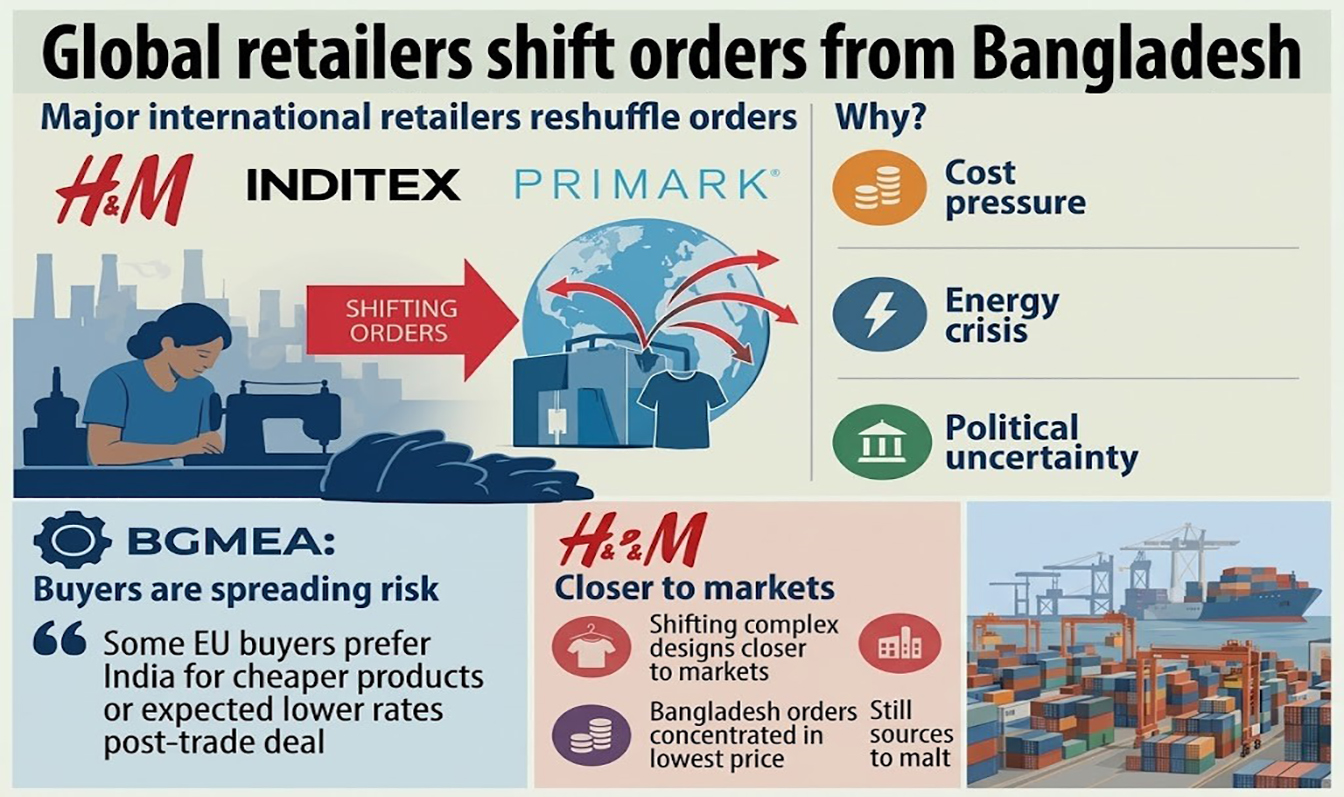
According to him, India and Vietnam continued to benefit from their respective free trade agreements with the EU, eroding Bangladesh’s competitiveness in one of its largest export destinations.

BGMEA president also highlighted the domestic energy crisis, particularly chronic gas shortages, which forced factories to operate below capacity, reducing productivity and increasing financial pressure on manufacturers.

Imports of capital machinery for the garment and textile industries have also declined in recent months, signalling weaker investment and slower capacity expansion, he said.

Mahmud Hasan said that the cost of doing business had risen sharply, citing bank lending rates exceeding 14-15 per cent, repeated electricity tariff increases and annual wage hikes.

These combined pressures, he said, had forced many manufacturers into financial distress, with a significant number already shutting down operations.

Echoing those concerns, Bangladesh Knitwear Manufacturers and Exporters Association Executive President Fazlee Shamim Ehsan said export earnings had suffered because of weak global demand and low prices offered by international buyers despite substantial increases in wages and production costs, including yarn, dyes, chemicals and energy.

He said many factories had incurred losses or ceased operations, contributing to the country’s overall export slowdown.

Among other major export sectors, agricultural products declined 1.34 per cent to $975 million during FY26.

In contrast, several sectors registered healthy growth. Jute and jute goods exports rose 7.75 per cent to $884 million, leather and leather goods increased 7.09 per cent to $1.23 billion, and home textile exports grew 6.52 per cent to $928 million.

Engineering products recorded the strongest growth among the major sectors, rising 21.77 per cent to $652 million from $536 million in the previous fiscal year.

The United States remained Bangladesh’s largest export destination, with exports increasing 4.09 per cent to $9.05 billion.

Germany, the country’s second-largest export market, recorded the steepest decline among the top 10 destinations, with exports falling 10.81 per cent to $4.72 billion from $5.29 billion a year earlier.

Exports to France declined 9.22 per cent to $2.19 billion, while shipments to Italy dropped 7.25 per cent to $1.54 billion. Exports to neighbouring India edged down 1.02 per cent to $1.75 billion.

The decline in these important European markets offset gains elsewhere.

Exports to Spain rose 6.74 per cent to $3.79 billion, while shipments to the Netherlands increased 4.90 per cent to $2.47 billion.

Exports to Great Britain grew modestly by 1.03 per cent to $4.67 billion.

Poland emerged as the fastest-growing destination among Bangladesh’s top 10 export markets, with exports surging 9.58 per cent to $2 billion, while exports to Canada increased 4.08 per cent to $1.52 billion.
Bangladesh’s exports slip 0.58pc in FY26 amid global headwinds

Update Time : 09:18:13 pm, Thursday, 2 July 2026

Bangladesh’s export earnings remained virtually flat in the just-concluded financial year 2025-26, declining by 0.58 per cent to $48 billion from $48.28 billion in the previous year, as geopolitical tensions, uncertainty over United States tariff policies, rising production costs and weakening demand in key markets weighed on overseas shipments.

Data released by the Export Promotion Bureau on July 2 showed that merchandise exports fell well short of the government’s target of $55 billion, achieving only about 87.3 per cent of the goal.

Despite the marginal annual decline, the EPB said the export sector had demonstrated resilience in the face of geopolitical conflicts, global inflationary pressures, supply chain disruptions, volatility in energy markets and subdued consumer demand across several major economies.

‘The export sector’s ability to maintain earnings near the previous year’s level reflects its underlying strength and adaptability,’ the state-owned agency said.

Exporters, however, attributed the weaker performance to a combination of external and domestic challenges.

They said continuing geopolitical conflicts, uncertainty surrounding US tariff measures, disruptions to sourcing and production planning, and intensified competition in the European Union market after China redirected more exports to the region had all undermined Bangladesh’s export growth.

Business leaders also pointed to severe domestic constraints, including acute gas shortages, high borrowing costs and rising utility tariffs, which eroded manufacturers’ competitiveness.

The EPB data showed that Bangladesh’s exports declined in four of its 10 largest overseas markets during FY26.

Shipments to Germany, France, Italy and India contracted, while exports to the remaining six leading destinations posted positive growth.

The ready-made garment (RMG) industry, which accounts for more than 80 per cent of Bangladesh’s export earnings, also experienced a difficult year.

Export earnings from the sector declined 1.64 per cent to $38.7 billion from $39.35 billion in FY25.

Within the sector, knitwear exports fell 2.53 per cent to $20.62 billion, while woven garment exports slipped 0.61 per cent to $18.07 billion.

However, exports rebounded strongly in June. Total export earnings increased 25.91 per cent year-on-year to $4.42 billion, while the RMG sector earned $3.38 billion, up 21.52 per cent from the same month a year earlier.

Bangladesh Garment Manufacturers and Exporters Association president Mahmud Hasan Khan, said June’s strong growth largely reflected a weak base effect, as Eid-ul-Azha had fallen during the corresponding period in 2025, reducing production and shipments that month.

He said the annual decline underscored persistent challenges, particularly uncertainty over US tariff policies and stronger competition in the European market.

According to him, India and Vietnam continued to benefit from their respective free trade agreements with the EU, eroding Bangladesh’s competitiveness in one of its largest export destinations.

BGMEA president also highlighted the domestic energy crisis, particularly chronic gas shortages, which forced factories to operate below capacity, reducing productivity and increasing financial pressure on manufacturers.

Imports of capital machinery for the garment and textile industries have also declined in recent months, signalling weaker investment and slower capacity expansion, he said.

Mahmud Hasan said that the cost of doing business had risen sharply, citing bank lending rates exceeding 14-15 per cent, repeated electricity tariff increases and annual wage hikes.

These combined pressures, he said, had forced many manufacturers into financial distress, with a significant number already shutting down operations.

Echoing those concerns, Bangladesh Knitwear Manufacturers and Exporters Association Executive President Fazlee Shamim Ehsan said export earnings had suffered because of weak global demand and low prices offered by international buyers despite substantial increases in wages and production costs, including yarn, dyes, chemicals and energy.

He said many factories had incurred losses or ceased operations, contributing to the country’s overall export slowdown.

Among other major export sectors, agricultural products declined 1.34 per cent to $975 million during FY26.

In contrast, several sectors registered healthy growth. Jute and jute goods exports rose 7.75 per cent to $884 million, leather and leather goods increased 7.09 per cent to $1.23 billion, and home textile exports grew 6.52 per cent to $928 million.

Engineering products recorded the strongest growth among the major sectors, rising 21.77 per cent to $652 million from $536 million in the previous fiscal year.

The United States remained Bangladesh’s largest export destination, with exports increasing 4.09 per cent to $9.05 billion.

Germany, the country’s second-largest export market, recorded the steepest decline among the top 10 destinations, with exports falling 10.81 per cent to $4.72 billion from $5.29 billion a year earlier.

Exports to France declined 9.22 per cent to $2.19 billion, while shipments to Italy dropped 7.25 per cent to $1.54 billion. Exports to neighbouring India edged down 1.02 per cent to $1.75 billion.

The decline in these important European markets offset gains elsewhere.

Exports to Spain rose 6.74 per cent to $3.79 billion, while shipments to the Netherlands increased 4.90 per cent to $2.47 billion.

Exports to Great Britain grew modestly by 1.03 per cent to $4.67 billion.

Poland emerged as the fastest-growing destination among Bangladesh’s top 10 export markets, with exports surging 9.58 per cent to $2 billion, while exports to Canada increased 4.08 per cent to $1.52 billion.