Bizbd Report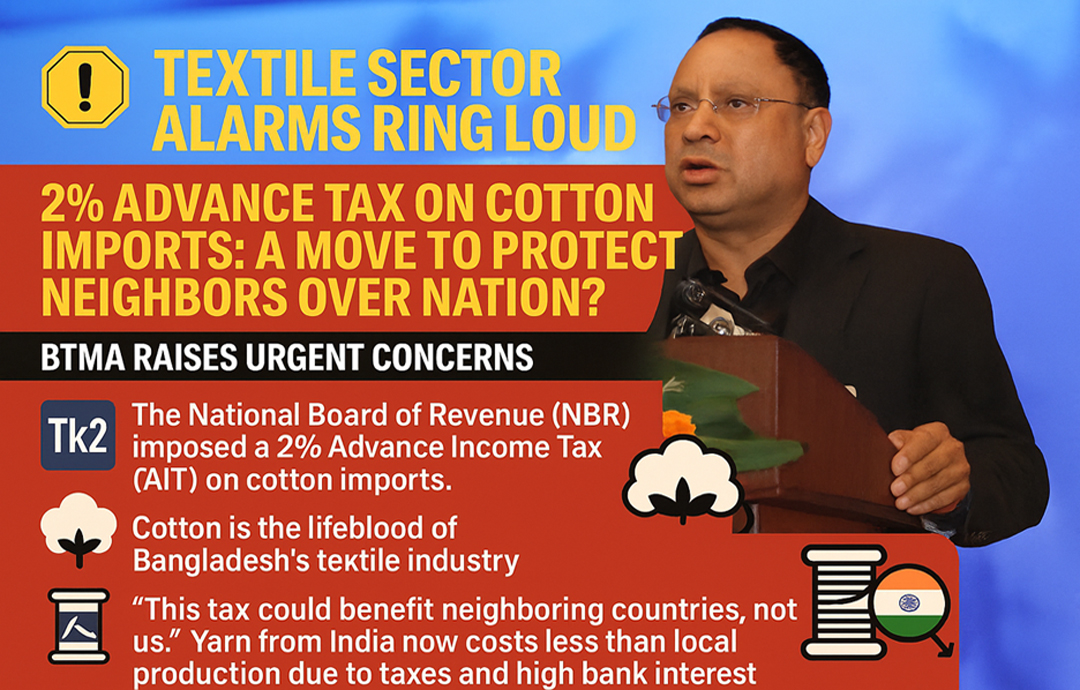
Bangladesh Textile Mills Association (BTMA) has issued a stern warning to the interim government, demanding the immediate withdrawal of the newly imposed 2 per cent advance income tax (AIT) on imported cotton.
Industry leaders cautioned that failure to reverse the measure by Monday could lead to widespread shutdowns of textile units, further destabilising a sector already facing mounting operational pressures.
Speaking at a press conference held at the Crystal Palace Hall of Gulshan Club in the capital on Saturday, BTMA President Shawkat Aziz Russell criticised the government’s recent fiscal policies, describing them as ‘economically damaging and dangerously short-sighted.’
He said that the imposition of AIT on cotton, which had previously been exempt from such levies, came at a time when local mills were grappling with soaring production costs, a liquidity crunch, and structural vulnerabilities.
The tax was introduced through a recent Statutory Regulatory Order (SRO) issued by the National Board of Revenue, which imposed a blanket 2 per cent AIT on the import of over 150 essential and capital goods, including cotton, wheat, fuel and fertilisers.
While the move may have been intended to bolster tax collection, industry insiders argue that it poses an existential threat to Bangladesh’s primary textile sector, a pillar of the country’s economy contributing over 85 per cent of national export earnings and involving more than $23 billion in private investment.
Russell pointed out that many mills were already operating at less than 50 per cent capacity due to a critical shortage of gas and electricity.
He explained that, with bank interest rates reaching as high as 18 per cent and an added 2 per cent AIT now being deducted at the import stage, textile businesses were facing an unsustainable erosion of working capital.
‘With each cotton consignment, businesses will have to pay advance taxes that they may never recover. This is not only inefficient but could completely dry up our liquidity in less than three years,’ he warned.
Russell also expressed frustration over the government’s failure to extend the reduced corporate tax rate for the textile sector, which expired on June 30.
He urged that the 12 per cent rate—currently applicable to the Ready-Made Garment (RMG) sector—be applied equally to textile mills until at least June 2028.
Another pressing concern voiced at the press event was the recent increase in specific tax on locally produced yarn, which was raised from Tk 3 to Tk 5 per kilogram.
Industry leaders warned this hike would make domestic yarn more expensive than imports, forcing buyers to turn to foreign suppliers—primarily India—whose textile sectors benefit from extensive government subsidies and policy support.
BTMA Vice President Saleudh Zaman Khan alleged that vested interests were working against the sector, calling recent policies ‘a deliberate attempt to dismantle the country’s textile industry.’
BTMA Director Abdullah Al Mamun revealed that many mill owners were already preparing to sell off assets as operational sustainability becomes increasingly unviable.
Director Rajeeb Haider criticised what he described as ‘policy double standards’ between Bangladesh and neighbouring India, noting that while India had consistently protected its domestic textile sector through incentives and restrictions, Bangladesh seemed to be doing the opposite by opening the door to foreign competition.
He warned that continued import dependency would eventually turn the country into a dumping ground for foreign textiles.
Another BTMA Director Mohd Khorshed Alam claimed that five to six years ago, a consultancy firm from a neighbouring country gathered sensitive financial data from Bangladeshi mills under the guise of offering support—an act he now suspects was part of a long-term plan to weaken the local sector.
Outside of BTMA, business leaders from the knitwear and terry towel sub-sectors also expressed alarm.
Hossain Mehmood, President of the Bangladesh Terry Towel and Linen Manufacturers and Exporters Association, said that sourcing cotton from the US had become a strategic option due to recent reciprocal tariffs. However, the newly imposed AIT would now render that path economically unfeasible.
In response to the multifaceted crisis, BTMA reiterated its core demands: immediate withdrawal of the 2 per cent AIT on imported cotton, reinstatement of the 12 per cent reduced corporate tax rate for textile-related businesses until 2028 and reversal of the Tk 5 per kilogram specific tax on domestically produced yarn.
BTMA has also expressed willingness to engage in immediate dialogue with the interim government to resolve the matter constructively.
‘We are not adversaries of the government. We are partners in the country’s economic development. But if our concerns continue to be ignored, the consequences for the textile sector—and for Bangladesh—could be irreversible, Russell concluded.