12:36 pm, Friday, 16 January 2026
CLIMATE-DRIVEN CRISIS

Bangladesh RMG sector could lose 68% exports, 1.27m jobs by 2050

  • Bizbd Report
  • Update Time : 01:56:41 pm, Thursday, 11 December 2025
  • 234

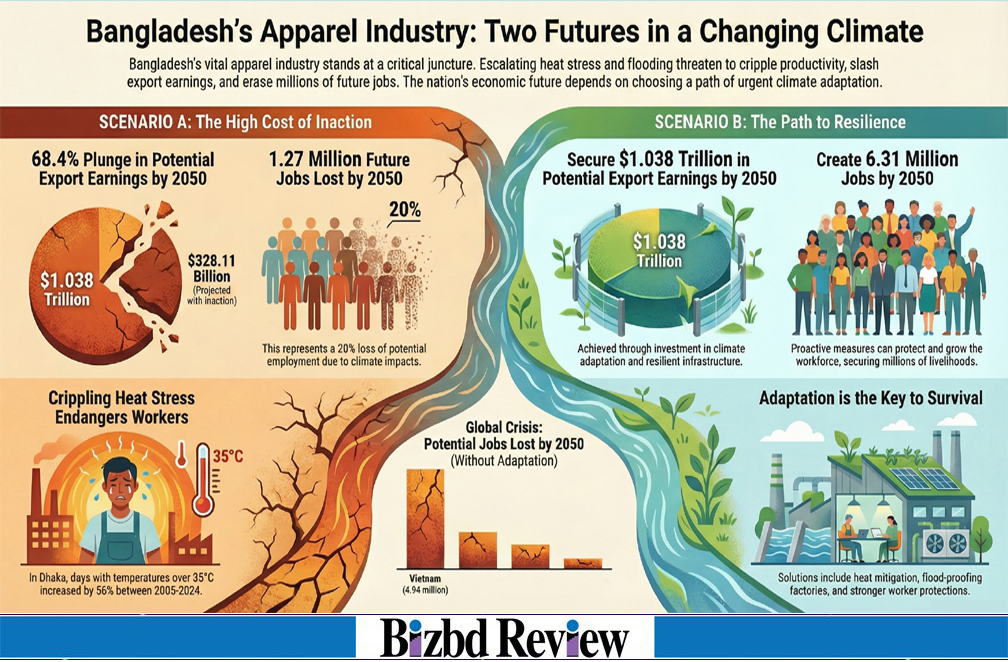
Bangladesh’s apparel sector is heading towards a climate-driven crisis, as escalating heat stress could slash potential export earnings by 68.4 per cent—from $1.038 trillion to $328.11 billion—and put 1.27 million future jobs at risk by 2050 without urgent adaptation measures.

The country’s $46.55 billion apparel industry, which employs 4.5 million workers directly, is facing unprecedented threats from climate change, according to a recent report by the International Labour Organization (ILO) and International Finance Corporation (IFC), titled The Heat is On: How heat stress impacts the apparel industry, jobs, and worker health.

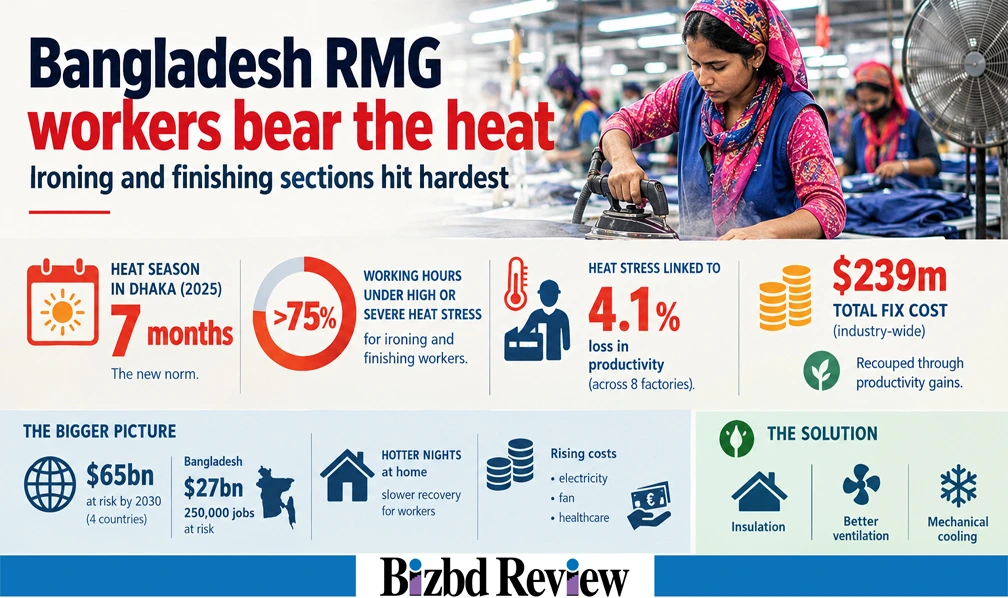
Heat stress is already affecting the health, productivity, and livelihoods of workers in major apparel-producing nations, undermining earnings for manufacturers and investors while jeopardising the welfare of millions of employees worldwide, including those indirectly employed across the industry, it mentioned.

Prepared in collaboration with Cornell University’s Global Labor Institute (GLI), the report identified Bangladesh’s principal production hubs, Dhaka and Chattogram, as highly vulnerable by 2030 due to a combination of extreme heat and intense flooding.

The findings are stark: without decisive climate adaptation, the nation faces losses amounting to billions of dollars in export revenue and millions of potential jobs.

Bangladesh has experienced a rapid rise in dangerously hot days, which directly impact worker health and factory output.

According to the report, In Dhaka, the number of days with temperatures of 35 degrees celsius or more increased by 56.1 per cent between the periods of 2005–2009 and 2020–2024.

Projections using the Wet Bulb Globe Temperature (WBGT) index, which factors in humidity, indicate that Dhaka could experience 64.81 days above the moderate heat stress threshold of 30.5°C WBGT by 2030, rising to 104.48 days by 2050.

In Chattogram, the forecast is 50.10 days by 2030, climbing to 84.86 days by 2050.

This heat has measurable effects on productivity, with moderate-effort manufacturing output estimated to fall by 1.5 per cent for every 1°C increase above 25°C WBGT.

The report said that rising temperatures are compounded by intensifying rainfall and flooding, a persistent hazard for Bangladesh’s low-lying terrain.

Analysis of the 30 heaviest rainfall days in Dhaka showed average daily precipitation increasing from 41.5 mm during 2005–2009 to 42.2 mm in 2020–2024, peaking at 46.5 mm between 2015 and 2019.

Severe riverine floods, classified as ‘once-in-a-century’ events, could affect approximately 27 per cent of the country’s manufacturing facilities, with inundation levels of 0.5 metres or more.

Such disruptions damage machinery and materials while endangering workers’ safety and their ability to travel to factories.

Economic projections in the report draw a stark contrast between scenarios with and without adaptation.

By 2030, Bangladesh could achieve $122.01 billion in apparel export earnings with climate adaptation.

Without intervention, earnings are expected to drop to $95.35 billion, a 21.85 per cent decline driven by reduced worker productivity during extreme heat, flood-related disruptions, and damage to infrastructure.

By 2050, the situation becomes far more severe. Under adaptive measures, export earnings could reach $1.038 trillion, but without adaptation, it is projected to plunge to $328.11 billion, a 68.4 per cent loss of potential revenue.

Job creation in the apparel sector is equally threatened. In 2030, the climate-adaptive scenario anticipates 4.83 million jobs, while a no-adaptation pathway predicts only 4.58 million, a deficit of 250,000 positions or 5.18 per cent of potential employment.

By 2050, the gap widens sharply: the adaptive model projects 6.31 million jobs, whereas without adaptation only 5.05 million jobs will exist, meaning 1.27 million positions could vanish, equivalent to a 20.05 per cent loss of potential employment.

Temperature trends in Bangladesh and other global apparel hubs further illustrate the crisis.

Across 23 major production centres, the number of days exceeding 35°C has surged over the past two decades.

Dhaka recorded a 56 per cent increase, Phnom Penh 226 per cent, Ho Chi Minh City 158 per cent, and Colombo 600 per cent.

When humidity is factored in through WBGT measurements, the risks intensify.

Once WBGT exceeds 32°C, workers face significant hazards, including heat exhaustion, heatstroke, and kidney injury.

Cornell researchers also observed growing heat-stress waves, periods of three or more consecutive high-stress days, across key cities, with Dhaka showing a notable increase since 2023.

Among the 21 apparel production centres studied, Bangladesh is ranked as the most climate-vulnerable.

High exposure combined with low climate readiness amplifies the threat. Social protection coverage is below average at 22 per cent, while manufacturing wages are low, averaging PPP$389.11.

Recognising these vulnerabilities, Bangladesh is moving towards formal regulation to safeguard its workforce.

The government plans to introduce heat stress indicators and maximum temperature thresholds through a new regulation, Praskas, alongside the Occupational Safety and Health Law expected in 2026.

The climate crisis extends beyond Bangladesh. Cambodia’s garment sector, central to its export economy, could see a reduction from 0.94 million jobs to 0.89 million by 2030 under a no-adaptation scenario, and up to 560,000 jobs lost by 2050, a 32.66 per cent decline.

Pakistan faces similarly stark projections, with potential employment falling from 5.37 million to 3.51 million by 2050, a loss of 1.85 million jobs or 34.53 per cent.

Viet Nam, one of the fastest-growing garment exporters, faces the largest absolute losses.

Without adaptation, projected employment drops from 11.70 million under adaptive conditions to 6.75 million, a deficit of 4.94 million jobs or 42.26 per cent of potential employment.

Across these four countries, the combined impact is immense. In 2030, job creation is expected to fall from 13.9 million to 12.96 million, a loss of 940,000 positions or 6.76 per cent.

By 2050, the total deficit reaches 8.63 million jobs, representing 34.41 per cent of potential employment, highlighting the urgent need for adaptation and investment in climate-resilient infrastructure and worker protections.

The report warneds that inaction could devastate Bangladesh’s apparel sector, leading to lower productivity, falling earnings, and major job losses.

Proactive adaptation—through heat mitigation, climate-resilient factories, better social protections, and regulations—could protect millions of livelihoods and preserve the industry’s global role.
CLIMATE-DRIVEN CRISIS

Bangladesh RMG sector could lose 68% exports, 1.27m jobs by 2050

Update Time : 01:56:41 pm, Thursday, 11 December 2025

Bangladesh’s apparel sector is heading towards a climate-driven crisis, as escalating heat stress could slash potential export earnings by 68.4 per cent—from $1.038 trillion to $328.11 billion—and put 1.27 million future jobs at risk by 2050 without urgent adaptation measures.

The country’s $46.55 billion apparel industry, which employs 4.5 million workers directly, is facing unprecedented threats from climate change, according to a recent report by the International Labour Organization (ILO) and International Finance Corporation (IFC), titled The Heat is On: How heat stress impacts the apparel industry, jobs, and worker health.

Heat stress is already affecting the health, productivity, and livelihoods of workers in major apparel-producing nations, undermining earnings for manufacturers and investors while jeopardising the welfare of millions of employees worldwide, including those indirectly employed across the industry, it mentioned.

Prepared in collaboration with Cornell University’s Global Labor Institute (GLI), the report identified Bangladesh’s principal production hubs, Dhaka and Chattogram, as highly vulnerable by 2030 due to a combination of extreme heat and intense flooding.

The findings are stark: without decisive climate adaptation, the nation faces losses amounting to billions of dollars in export revenue and millions of potential jobs.

Bangladesh has experienced a rapid rise in dangerously hot days, which directly impact worker health and factory output.

According to the report, In Dhaka, the number of days with temperatures of 35 degrees celsius or more increased by 56.1 per cent between the periods of 2005–2009 and 2020–2024.

Projections using the Wet Bulb Globe Temperature (WBGT) index, which factors in humidity, indicate that Dhaka could experience 64.81 days above the moderate heat stress threshold of 30.5°C WBGT by 2030, rising to 104.48 days by 2050.

In Chattogram, the forecast is 50.10 days by 2030, climbing to 84.86 days by 2050.

This heat has measurable effects on productivity, with moderate-effort manufacturing output estimated to fall by 1.5 per cent for every 1°C increase above 25°C WBGT.

The report said that rising temperatures are compounded by intensifying rainfall and flooding, a persistent hazard for Bangladesh’s low-lying terrain.

Analysis of the 30 heaviest rainfall days in Dhaka showed average daily precipitation increasing from 41.5 mm during 2005–2009 to 42.2 mm in 2020–2024, peaking at 46.5 mm between 2015 and 2019.

Severe riverine floods, classified as ‘once-in-a-century’ events, could affect approximately 27 per cent of the country’s manufacturing facilities, with inundation levels of 0.5 metres or more.

Such disruptions damage machinery and materials while endangering workers’ safety and their ability to travel to factories.

Economic projections in the report draw a stark contrast between scenarios with and without adaptation.

By 2030, Bangladesh could achieve $122.01 billion in apparel export earnings with climate adaptation.

Without intervention, earnings are expected to drop to $95.35 billion, a 21.85 per cent decline driven by reduced worker productivity during extreme heat, flood-related disruptions, and damage to infrastructure.

By 2050, the situation becomes far more severe. Under adaptive measures, export earnings could reach $1.038 trillion, but without adaptation, it is projected to plunge to $328.11 billion, a 68.4 per cent loss of potential revenue.

Job creation in the apparel sector is equally threatened. In 2030, the climate-adaptive scenario anticipates 4.83 million jobs, while a no-adaptation pathway predicts only 4.58 million, a deficit of 250,000 positions or 5.18 per cent of potential employment.

By 2050, the gap widens sharply: the adaptive model projects 6.31 million jobs, whereas without adaptation only 5.05 million jobs will exist, meaning 1.27 million positions could vanish, equivalent to a 20.05 per cent loss of potential employment.

Temperature trends in Bangladesh and other global apparel hubs further illustrate the crisis.

Across 23 major production centres, the number of days exceeding 35°C has surged over the past two decades.

Dhaka recorded a 56 per cent increase, Phnom Penh 226 per cent, Ho Chi Minh City 158 per cent, and Colombo 600 per cent.

When humidity is factored in through WBGT measurements, the risks intensify.

Once WBGT exceeds 32°C, workers face significant hazards, including heat exhaustion, heatstroke, and kidney injury.

Cornell researchers also observed growing heat-stress waves, periods of three or more consecutive high-stress days, across key cities, with Dhaka showing a notable increase since 2023.

Among the 21 apparel production centres studied, Bangladesh is ranked as the most climate-vulnerable.

High exposure combined with low climate readiness amplifies the threat. Social protection coverage is below average at 22 per cent, while manufacturing wages are low, averaging PPP$389.11.

Recognising these vulnerabilities, Bangladesh is moving towards formal regulation to safeguard its workforce.

The government plans to introduce heat stress indicators and maximum temperature thresholds through a new regulation, Praskas, alongside the Occupational Safety and Health Law expected in 2026.

The climate crisis extends beyond Bangladesh. Cambodia’s garment sector, central to its export economy, could see a reduction from 0.94 million jobs to 0.89 million by 2030 under a no-adaptation scenario, and up to 560,000 jobs lost by 2050, a 32.66 per cent decline.

Pakistan faces similarly stark projections, with potential employment falling from 5.37 million to 3.51 million by 2050, a loss of 1.85 million jobs or 34.53 per cent.

Viet Nam, one of the fastest-growing garment exporters, faces the largest absolute losses.

Without adaptation, projected employment drops from 11.70 million under adaptive conditions to 6.75 million, a deficit of 4.94 million jobs or 42.26 per cent of potential employment.

Across these four countries, the combined impact is immense. In 2030, job creation is expected to fall from 13.9 million to 12.96 million, a loss of 940,000 positions or 6.76 per cent.

By 2050, the total deficit reaches 8.63 million jobs, representing 34.41 per cent of potential employment, highlighting the urgent need for adaptation and investment in climate-resilient infrastructure and worker protections.

The report warneds that inaction could devastate Bangladesh’s apparel sector, leading to lower productivity, falling earnings, and major job losses.

Proactive adaptation—through heat mitigation, climate-resilient factories, better social protections, and regulations—could protect millions of livelihoods and preserve the industry’s global role.