Bizbd Report
Shipments to America plunge 11.21 per cent in the first four months of 2026, with analysts pointing to the US-Iran war, energy bottlenecks, and Bangladesh’s slow pivot away from cotton basics as key drivers of the deteriorating competitiveness.
Bangladesh’s garment exports to the United States, its largest single export destination, continued to weaken during the first four months of 2026, posting a double-digit decline while key competitors Vietnam and Cambodia expanded their presence in the American market.
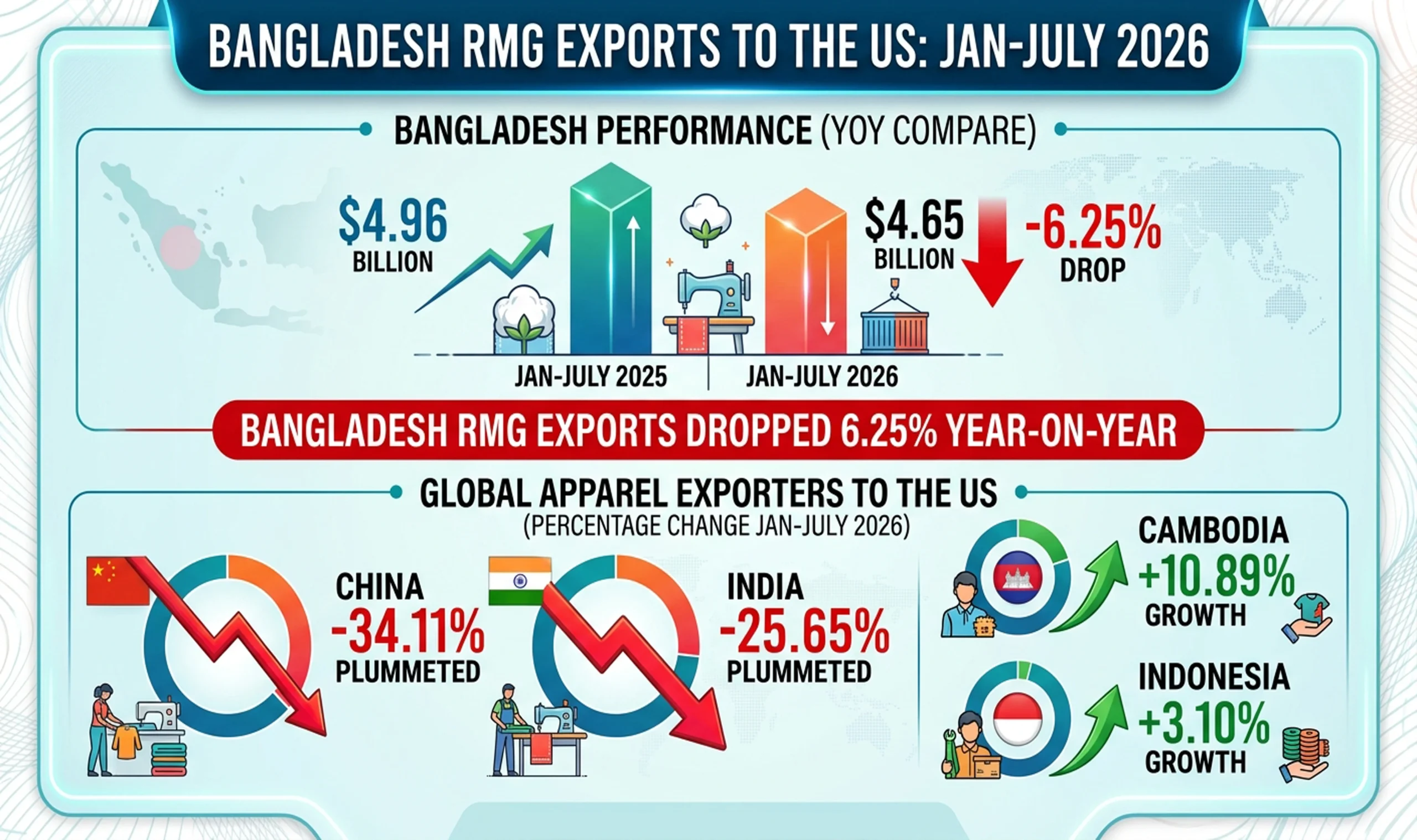
According to data released on Tuesday by the US Office of Textiles and Apparel (OTEXA), Bangladesh exported apparel worth $2.64 billion to the United States between January and April 2026, down 11.21 per cent from $2.98 billion during the same period a year earlier.
In volume terms, exports fell by around 9 per cent to 890.17 million square metres from 978.32 million square metres in the corresponding period of 2025.
The downward trend persisted throughout the period. Export growth was marginally negative in January before the decline accelerated to 17.18 per cent in February and 8.08 per cent in March.
In April, shipments dropped 17.21 per cent year-on-year to $627 million from $757.37 million.
AK Azad, managing director of Ha-Meem Group, attributed part of the decline to the economic fallout from the ongoing conflict involving Iran, which he said had pushed up global food and energy prices, forcing American consumers to prioritise essential spending over discretionary purchases such as clothing.
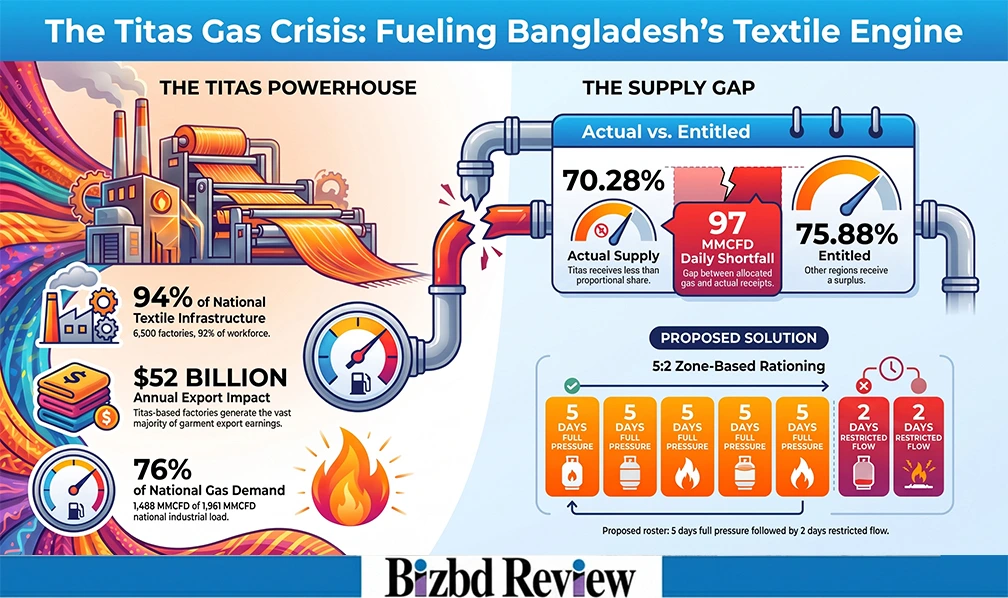
He also pointed to a range of structural challenges undermining Bangladesh’s competitiveness, including high energy costs, unreliable gas supplies, elevated bank lending rates and rising labour expenses, all of which have increased production costs.
Azad said Vietnam continued to enjoy a competitive advantage through its stronger capacity in higher-value man-made fibre (MMF)-based garments, shorter lead times and easier access to both Chinese and locally produced fabrics.
He said that India was also becoming increasingly competitive and attracting orders that might otherwise have gone to Bangladesh.
He stressed the need for Bangladesh to diversify into MMF-based apparel, improve productivity and worker efficiency, reduce wastage and strengthen design capabilities to increase its share of the global market.
Azad also urged the government to introduce policy measures aimed at lowering production costs.
M Masrur Reaz, chairman and chief executive of Policy Exchange Bangladesh, said a combination of US tariff uncertainty, geopolitical tensions linked to the Iran conflict and persistent domestic gas shortages had contributed to the decline in garment exports across major markets, including the United States and the European Union.
He said that global demand had weakened amid mounting economic uncertainty, while Bangladesh’s supply capacity had also been affected by the closure of hundreds of factories.
The OTEXA data showed notable shifts in global sourcing patterns. Vietnam retained its position as the leading apparel supplier to the US market for a third consecutive month, recording a 1.33 per cent increase in export value to US$5.15 billion and a 2.69 per cent rise in shipment volume to 1.52 billion square metres.
China, meanwhile, slipped to third place among US apparel suppliers. Its exports to the United States fell by 50.16 per cent to $2.17 billion, while shipment volume declined by 38 per cent to 1.51 billion square metres, reflecting the impact of heightened trade tensions and higher tariffs.
India also experienced a slowdown, with apparel exports to the US declining by 28 per cent to $1.43 billion and shipment volumes falling by about 23.49 per cent to 422 million square metres during the January-April period.
Overall, US apparel imports declined by 11.9 per cent year-on-year to $23 billion in the first four months of 2026, highlighting continued weakness in consumer demand amid inflationary pressures and cautious household spending.
Industry observers say the challenging global environment, coupled with domestic supply-side constraints, is likely to keep pressure on Bangladesh’s garment sector unless competitiveness improves and market conditions stabilise.