6:23 am, Sunday, 12 July 2026

Bangladesh export receipts drop 7pc in May

Merchandise-export receipts fell 7.07 per cent year-on-year to $4.40 billion in May, reversing April’s brief rebound, as Eid production shutdowns and shrinking global demand weighed on the readymade garment sector. Earnings for the first eleven months of FY2025-26 are now 2.55 per cent below the same period a year earlier.

Bangladesh’s merchandise-export earnings declined again in May 2026, slipping 7.07 per cent year-on-year after a brief recovery in April, as a prolonged slump in the country’s dominant readymade garment (RMG) sector continued to suppress overall trade performance.

The country received $4.40 billion in export receipts last month, down from $4.73 billion in May 2025, according to data published on Wednesday by the Export Promotion Bureau (EPB).

The figures extend a near-unbroken run of year-on-year contractions that has persisted across most of the current fiscal year.

For the July–May period of fiscal year 2025-26, Bangladesh earned a cumulative $43.79 billion, reflecting a 2.55 per cent year-on-year fall against $44.94 billion recorded in the corresponding eleven months of FY2024-25.

The negative-growth trajectory began in earnest in August 2025, when exports fell 2.93 per cent.

Subsequent months brought steeper declines: 4.61 per cent in September, 7.43 per cent in October, 5.58 per cent in November, 14.25 per cent in December, 0.50 per cent in January, 12.03 per cent in February, and a sharp 18.07 per cent contraction in March.

The series was punctuated by two standout advances–exports in July 2025 and April 2026 surged by more than 24 per cent and 32 per cent respectively, owing in part to base effects from weak performances in the equivalent months of the prior year.

Readymade garments, which account for the overwhelming share of Bangladesh’s foreign-exchange earnings, fetched $3.59 billion in May 2026–an 8.29 per cent decline on the $3.91 billion earned in May 2025, EPB data show.

Over the eleven-month period, the RMG sector contributed $35.31 billion to total export receipts, still the largest single earner but representing a 3.41 per cent negative growth.

Within the clothing segment, knitwear exports fell 4.26 per cent to $18.78 billion while woven-

Mohammad Hatem, president of the Bangladesh Knitwear Manufacturers and Exporters Association (BKMEA), attributed May’s poor performance principally to the Eid-ul-Azha holidays, which fell in the final week of the month and brought production to a halt.

He noted that April’s strong growth was itself a base effect—April 2025 had similarly been disrupted by a week-long holiday, making year-on-year comparisons flattering for April 2026.

Looking ahead, Hatem warned that the coming months were unlikely to offer much improvement.

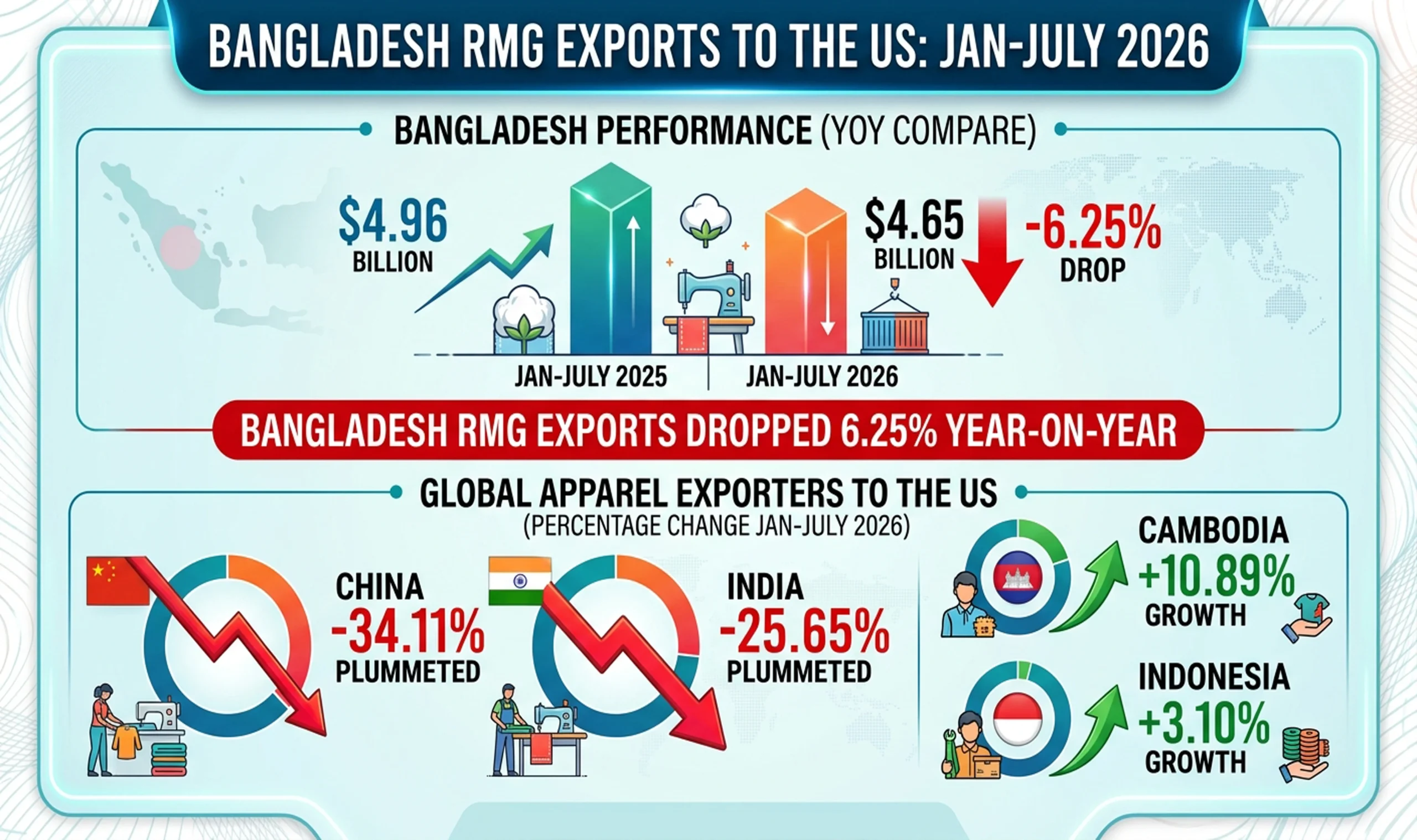
He cited shrinking global demand driven by multiple factors: ongoing tensions over United States tariff policy, instability in the Middle East curbing consumer spending, and a broader reduction in work-order placements by international buyers.

‘The US tariffs also changed the overall market dimension with decline in sales there and so decrease in placing work orders,’ he said.

Outside the garment sector, the picture was mixed over the July- May period.

Home-textile exports rose 3.48 per cent to $853.26 million, up from $824.58 million a year earlier.

Leather and leather goods earned $1.09 billion, a gain of 3.74 per cent.

Jute and jute-goods shipments edged up 3.17 per cent to $793.36 million, while frozen and live fish exports recorded only slight growth, reaching $412.11 million.

Pharmaceutical exports performed strongly, climbing 10.73 per cent to $217.67 million.

However, agriculture exports contracted 4.51 per cent to $885.77 million, adding to the broadly cautious tone of the trade data.

In the fiscal year 2024-25, Bangladesh’s total export earnings reached $48.28 billion, of which RMG accounted for $39.34 billion.

The current year’s eleven-month cumulative figure of $43.79 billion suggests the full-year FY2025-26 total will fall short of that benchmark unless a substantial recovery materialises in June.

Bangladesh export receipts drop 7pc in May

Update Time : 09:06:22 pm, Wednesday, 3 June 2026
Merchandise-export receipts fell 7.07 per cent year-on-year to $4.40 billion in May, reversing April’s brief rebound, as Eid production shutdowns and shrinking global demand weighed on the readymade garment sector. Earnings for the first eleven months of FY2025-26 are now 2.55 per cent below the same period a year earlier.

Bangladesh’s merchandise-export earnings declined again in May 2026, slipping 7.07 per cent year-on-year after a brief recovery in April, as a prolonged slump in the country’s dominant readymade garment (RMG) sector continued to suppress overall trade performance.

The country received $4.40 billion in export receipts last month, down from $4.73 billion in May 2025, according to data published on Wednesday by the Export Promotion Bureau (EPB).

The figures extend a near-unbroken run of year-on-year contractions that has persisted across most of the current fiscal year.

For the July–May period of fiscal year 2025-26, Bangladesh earned a cumulative $43.79 billion, reflecting a 2.55 per cent year-on-year fall against $44.94 billion recorded in the corresponding eleven months of FY2024-25.

The negative-growth trajectory began in earnest in August 2025, when exports fell 2.93 per cent.

Subsequent months brought steeper declines: 4.61 per cent in September, 7.43 per cent in October, 5.58 per cent in November, 14.25 per cent in December, 0.50 per cent in January, 12.03 per cent in February, and a sharp 18.07 per cent contraction in March.

The series was punctuated by two standout advances–exports in July 2025 and April 2026 surged by more than 24 per cent and 32 per cent respectively, owing in part to base effects from weak performances in the equivalent months of the prior year.

Readymade garments, which account for the overwhelming share of Bangladesh’s foreign-exchange earnings, fetched $3.59 billion in May 2026–an 8.29 per cent decline on the $3.91 billion earned in May 2025, EPB data show.

Over the eleven-month period, the RMG sector contributed $35.31 billion to total export receipts, still the largest single earner but representing a 3.41 per cent negative growth.

Within the clothing segment, knitwear exports fell 4.26 per cent to $18.78 billion while woven-

Mohammad Hatem, president of the Bangladesh Knitwear Manufacturers and Exporters Association (BKMEA), attributed May’s poor performance principally to the Eid-ul-Azha holidays, which fell in the final week of the month and brought production to a halt.

He noted that April’s strong growth was itself a base effect—April 2025 had similarly been disrupted by a week-long holiday, making year-on-year comparisons flattering for April 2026.

Looking ahead, Hatem warned that the coming months were unlikely to offer much improvement.

He cited shrinking global demand driven by multiple factors: ongoing tensions over United States tariff policy, instability in the Middle East curbing consumer spending, and a broader reduction in work-order placements by international buyers.

‘The US tariffs also changed the overall market dimension with decline in sales there and so decrease in placing work orders,’ he said.

Outside the garment sector, the picture was mixed over the July- May period.

Home-textile exports rose 3.48 per cent to $853.26 million, up from $824.58 million a year earlier.

Leather and leather goods earned $1.09 billion, a gain of 3.74 per cent.

Jute and jute-goods shipments edged up 3.17 per cent to $793.36 million, while frozen and live fish exports recorded only slight growth, reaching $412.11 million.

Pharmaceutical exports performed strongly, climbing 10.73 per cent to $217.67 million.

However, agriculture exports contracted 4.51 per cent to $885.77 million, adding to the broadly cautious tone of the trade data.

In the fiscal year 2024-25, Bangladesh’s total export earnings reached $48.28 billion, of which RMG accounted for $39.34 billion.

The current year’s eleven-month cumulative figure of $43.79 billion suggests the full-year FY2025-26 total will fall short of that benchmark unless a substantial recovery materialises in June.