Bizbd Report
Washington proposes duties of up to 12.5 per cent on Bangladeshi imports under Section 301 of the Trade Act, as industry leaders urge Dhaka to mount a robust legal and diplomatic defence ahead of July hearings.
The United States has proposed additional import duties of between 10 and 12.5 per cent on goods from Bangladesh and 59 other economies, following a federal investigation into what Washington alleges is a systemic failure to prohibit and effectively enforce bans on products made with forced labour.
The Office of the United States Trade Representative issued the formal notification on Jun 2, declaring that the acts, policies and practices of all 60 investigated economies were actionable under Section 301(b) of the US Trade Act of 1974 – a provision designed to counter unfair foreign trade practices that burden or restrict American commerce.
The USTR has opened a public comment period until July 6, with hearings scheduled to begin the following day. Parties wishing to appear must submit requests by June 22.
Bangladesh already faces product-specific tariffs of around 15 per cent or more on certain exports to the United States.
In addition, a universal baseline tariff of 10 per cent, imposed through executive authority, is currently in place and is scheduled to expire on July 24, 2025.
The latest proposal would add another 12.5 per cent Section 301 duty on top of existing tariffs if approved.
Under the USTR proposal, countries that have already enacted a forced labour import prohibition, or have committed to enforce such measures through a reciprocal trade agreement, would face an additional 10 per cent duty.
All remaining economies would be subject to a higher proposed rate of 12.5 per cent.
Bangladesh was listed among 54 economies that, according to the USTR, have failed both to enact and to effectively enforce prohibitions on the importation of forced labour goods.
The list includes major trading nations such as China, Australia, India, Japan, South Korea, the United Kingdom, the European Union members, and Vietnam, among others.
US Trade Representative Jamieson Greer was unequivocal in his justification for the action.
‘The failure of our most important trading partners to address the importation of goods made with forced labour is unacceptable,’ he said.
‘This creates a dynamic where American workers are forced to compete globally on an unlevel playing field.’
Commerce Minister Khandakar Abdul Muktadir confirmed that Bangladesh had already submitted a formal response to the March investigations, and stressed that no final decision on imposing the tariffs had yet been taken.
‘If any action is eventually taken, Bangladesh will respond appropriately,’ he said, adding that the government intended to present comprehensive data and evidence to demonstrate that the country does not support forced labour in any form.
Bangladesh Garment Manufacturers and Exporters Association (BGMEA) president Mahmud Hasan Khan echoed the call for evidence-based engagement, arguing that Washington must specify precisely which goods or supply chains it believes to be tainted by forced labour before sweeping trade measures can be justified.
The readymade garment sector, the backbone of Bangladesh’s export economy, has expressed serious concern.
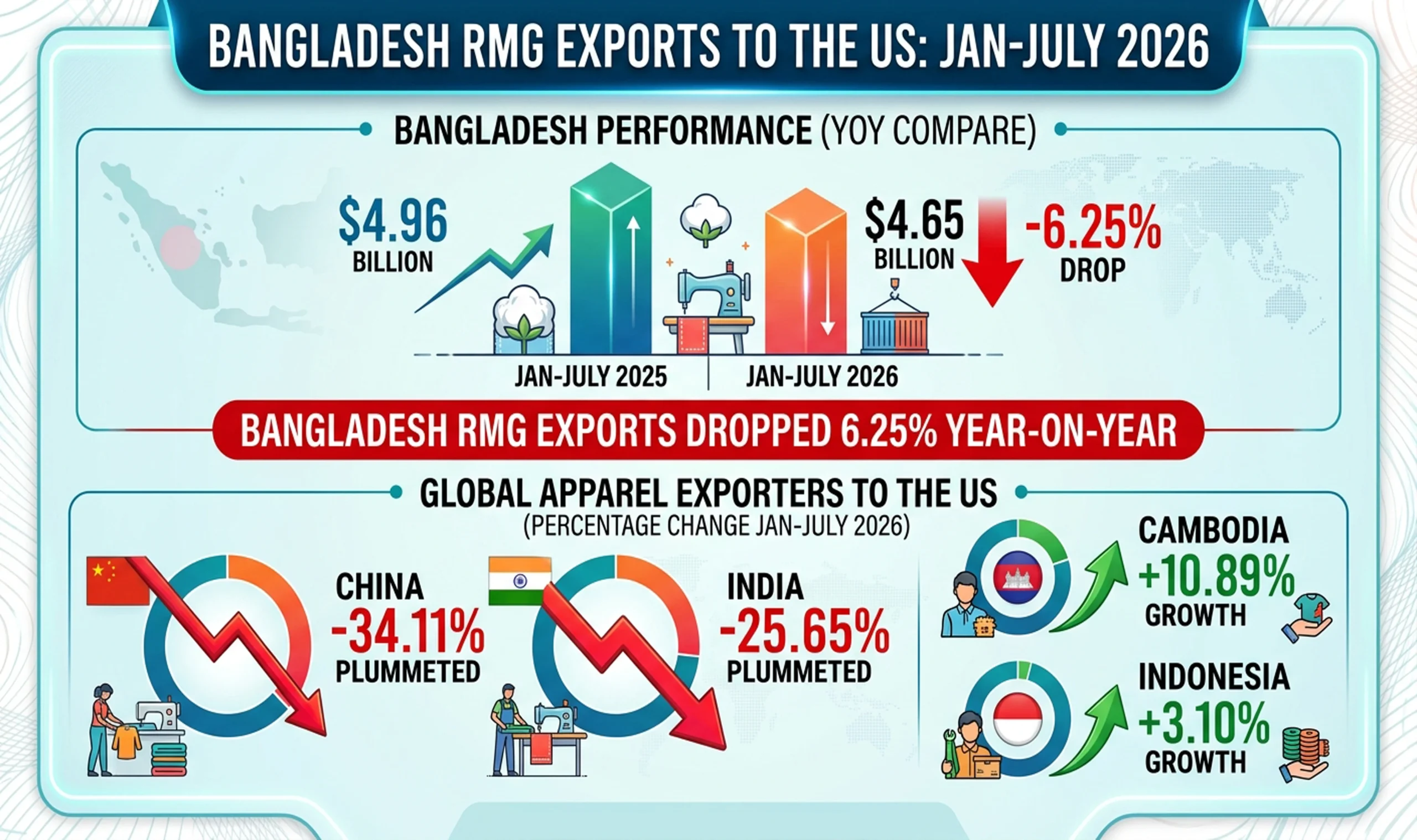
The country’s apparel industry, which accounts for more than 80 per cent of total export earnings, relies heavily on the American market.
Any escalation in tariff costs could squeeze margins at a time when the sector is already navigating domestic political instability and softening global demand.
Economist M Abdur Razzaque, chairman of RAPID, offered a measured but pointed critique of the US approach.
He warned that the USTR proposal reflects ‘a growing tendency to use tariff threats to advance regulatory norms that have not been established through multilateral agreement.’
While acknowledging that combating forced labour is a legitimate and widely shared objective, he cautioned that making market access conditional on a US-preferred regulatory model risks undermining the Most-Favoured-Nation-based trading system and further fragmenting global trade governance.
The USTR has also proposed a textile mechanism that would allow a set volume of apparel and textile imports from selected economies to enter the United States at a reduced Section 301 tariff rate — a provision that could offer Bangladesh a partial relief route should the duties ultimately be imposed.
With public hearings set to begin on 7 July and the comment window closing days earlier, Bangladesh has a narrow window to build its case.
Trade analysts say the government must act swiftly to compile credible labour-rights documentation, coordinate with the BGMEA and civil society, and engage directly with the USTR process — both through written submissions and, ideally, through representation at the hearings themselves.
Whether Washington ultimately proceeds with the additional duties will depend not only on the formal legal determinations but also on the diplomatic temperature between the two countries.