Bizbd Report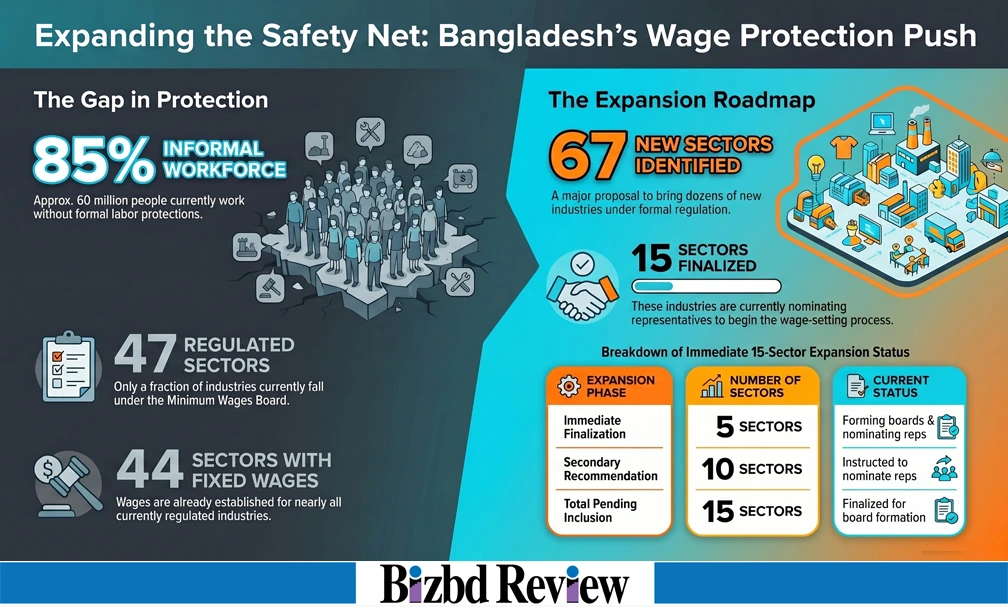
The Minimum Wages Board has identified 67 additional industrial sectors and proposed to bring the sectors under formal wage regulation to expand labour protections and formalise employment across Bangladesh.
In a recent letter sent to the labour ministry, wages board chairman Mamunur Rashid and secretary Raisha Afroz proposed bringing a wide range of manufacturing, service and transport industries under the country’s minimum wage framework.
Wages board secretary Raisha said that the list of newly identified sectors had been prepared based on the Bangladesh Standard Industrial Classification 2020 published by the Bangladesh Bureau of Statistics and the Survey of Manufacturing Industries 2019 report published in July 2020.
She said the board also considered requests received over the telephone from thee workers and owners for the inclusion of industrial sectors, as well as discussions held during board meetings.
Raisha said that the board had formally sent the identified list of 67 private and individually owned industrial sectors to the labour ministry on February 17 for further action.
Bangladesh Institute of Labour Studies executive director Syed Sultan Uddin Ahmmed welcomed the wage board’s move to bring more sectors under formal wage oversight, describing it as a positive step towards broader labour protection.
He said that such expansion must be anchored in a unified national minimum wage standard to avoid widening inconsistencies across sectors.
The newly identified sectors included shipbuilding, Bangladesh river and sea ports, gas and oxygen cylinder processing, paper and paperboard manufacturing, foam and mattress manufacturing, bicycle manufacturing, privately owned power generation, diaper and sanitary napkin manufacturing, melamine products manufacturing, juice and soft drinks manufacturing, multi-product distribution and dealerships, super shops, courier services, and sericulture and silk.
The sectors also included drama and cinema production houses, private television channels, prayer cap and prayer mat manufacturing, bookbinding, mining and stone quarrying, mobile network operators, care worker services, private insurance, real estate, private kindergartens and coaching centres, circus and fine arts, decorators and catering services, amusement parks, international and domestic organisations, drinking water purification and bottling, and travel agencies and tour management.
Other newly identified sectors are shell product manufacturing, jewellery manufacturing and marketing, musical instruments and sports goods marketing, medical equipment manufacturing, roads and highways construction, demolition and dismantling enterprises, automobile showrooms and spare parts sales, sound recording and FM radio, reinsurance and pension funds, air freight services, floriculture, tobacco and betel leaf production, livestock breeding farms, and sugar and confectionery manufacturing.
The list further included rope and fishing net production, pulp and paper production, bamboo and cane products, paper processing and stationery manufacturing, refined petroleum and chemical manufacturing, agro-chemical production, tyre and tube manufacturing, computer and peripheral equipment manufacturing, distilleries, yarn spinning and fabric weaving, and handloom and textile finishing.
The remaining sectors included electrical motors and transformer manufacturing, electrical wire and cable manufacturing, electrical wiring accessories, automobile and auto-rickshaw manufacturing, lift and manual machinery manufacturing, agricultural and forestry machinery manufacturing, sports goods and toy manufacturing, motor vehicle sales, wholesale trade, cattle feed production, manufacturing of mobile phones and accessories, and inland and maritime passenger and cargo transport services.
Labour ministry officials said that the government had already decided to form minimum wage boards for five of the newly identified sectors and asked the Department of Labour to nominate representatives of employers and workers for the wage-setting process.
The five sectors are shipbuilding, paper and paperboard manufacturing, foam and mattress manufacturing, melamine product manufacturing, and the super shop sector.
Earlier, acting on another recommendation from the Minimum Wages Board, the labour ministry had also instructed the DoL to nominate owner and worker representatives for 10 additional sectors to facilitate wage board formation.
Those sectors included privately owned clinics, hospitals and diagnostic centres, dairy product production and dairy farms, fertiliser factories, electrical and electronic product manufacturers, brick kilns, commercially operated amusement parks, dried fish producers, stone crushing units, privately owned air transport services and IT parks.
The ministry officials said that the 15 sectors would soon be included under the wage board as the decision on the sectors had been finalised.
At present, 47 industrial sectors are under the jurisdiction of the Minimum Wages Board.
Of them, minimum wages have already been fixed for 44 sectors, while wage negotiations are continuing for three newly included sectors, the ceramic industry, battery manufacturing industry, and dyes and chemicals industry.
Sultan Uddin called for a shift towards a data-driven methodology for wage setting, grounded in indicators such as inflation trends, household expenditure patterns, per capita income, and official statistics from the Bangladesh Bureau of Statistics and Bangladesh Bank.
The labour expert demanded the establishment of a national ‘living wage’ framework, moving beyond subsistence-level benchmarks to ensure workers can meet basic needs and maintain dignified living standards.
Rejecting arguments based solely on industrial affordability, Sultan maintained that minimum wage should be treated as a non-negotiable standard of human dignity.
Bangladesh’s labour market remained overwhelmingly informal, with about 85 per cent of the workforce, nearly 60 million people, engaged in jobs without formal protections, according to the Bangladesh Bureau of Statistics Labour Force Survey 2022.
The findings showed that informality was particularly pronounced among women and young people, with 96 per cent of employed women and 92.7 per cent of youth aged 15-27 working outside formal employment structures.
Most of these workers lack access to minimum wages, job security, paid leave or social protection.