Bizbd Report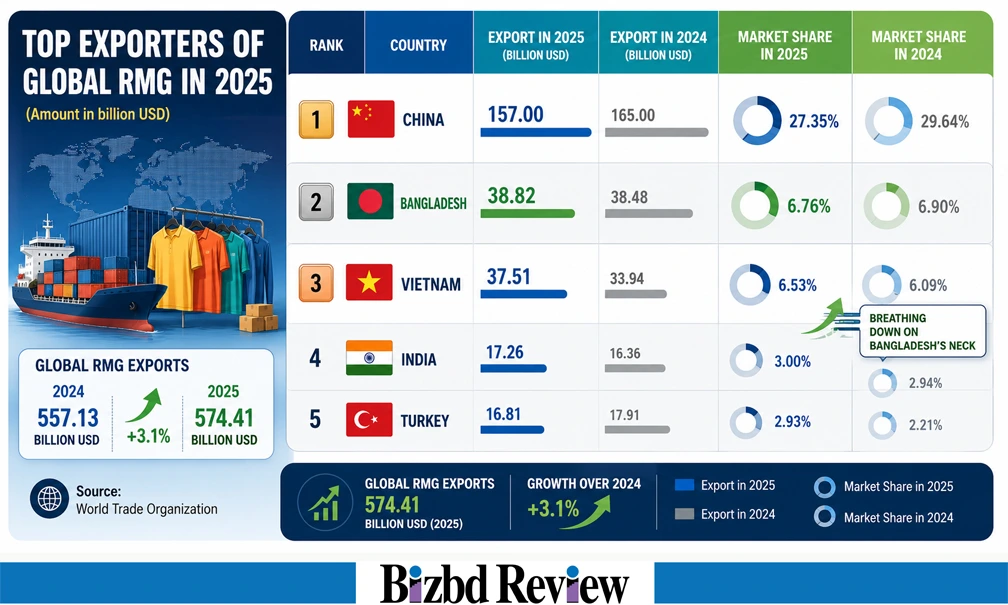
Bangladesh remained the world’s second-largest exporter of readymade garments in 2025, but its grip on that position is looking increasingly fragile, according to new trade statistics released by the World Trade Organisation.
The country’s apparel shipments rose modestly to $38.82 billion in 2025, up less than one percent from $38.48 billion in 2024.
Yet that growth was too slow to keep pace with the overall expansion of world trade, and Bangladesh’s slice of the global apparel pie shrank for the third consecutive year, sliding to 6.76 percent from 6.9 percent in 2024, 7.38 percent in 2023 and 7.87 percent in 2022.
Total global RMG exports reached roughly $575 billion in 2025, per the WTO report, titled World Trade Statistics: Key Insights and Trends in 2025.
Bangladesh has occupied the second position behind China for most of the period since 2009, aside from a brief slip to third place in 2020 when Vietnam edged ahead.
The two nations have been locked in close competition for the runner-up spot ever since.
What is troubling industry watchers now is not the ranking itself but the direction of travel.
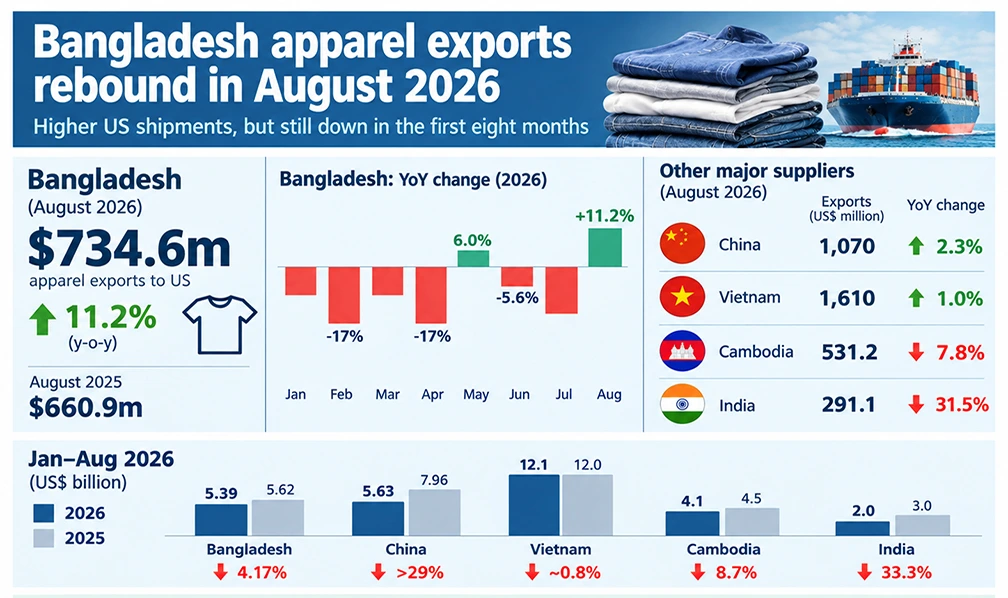
China’s share of the global apparel trade also contracted sharply in 2025– down to 27.35 percent from 29.64 percent, with exports falling nearly 5 percent to $157.11 billion.
In theory, that retreat should have opened the door for competitors to gain ground. Vietnam did exactly that, lifting its share to 6.53 percent on exports of $37.51 billion, a jump of more than 10 percent year-on-year.
Cambodia also grew, with its share rising to 2.01 percent. India climbed to fourth place globally with $17.26 billion in shipments, while Pakistan and Indonesia posted export gains as well.
Bangladesh, by contrast, moved backward. Analysts say that divergence, rivals expanding their footprint while Bangladesh’s share contracts, suggests a structural competitiveness problem rather than a one-off dip.
Fifth-placed Türkiye was the other major exporter to lose ground, its exports falling over 6 percent to $16.81 billion.
Industry leaders point to a difficult year at home. Bangladesh’s apparel sector navigated continued fallout from the 2024 political transition that removed the Awami League government, with factory unrest, labour disputes and closures disrupting production through parts of 2025.
Layered on top of that came new reciprocal tariffs announced by the United States, adding further strain to exporters already contending with high financing costs, energy shortages and port congestion.
Mohammad Hatem, president of the Bangladesh Knitwear Manufacturers and Exporters Association, said the broader apparel market stayed weak globally in 2025, but Bangladesh underperformed relative to its peers.
He linked part of the gap to buyer caution over uncertainty surrounding Bangladesh’s graduation from Least Developed Country status, alongside gas and power shortages that have left many factories running below capacity.
Without significant reform, he warned, Bangladesh could lose its second-place ranking within the next year or two.
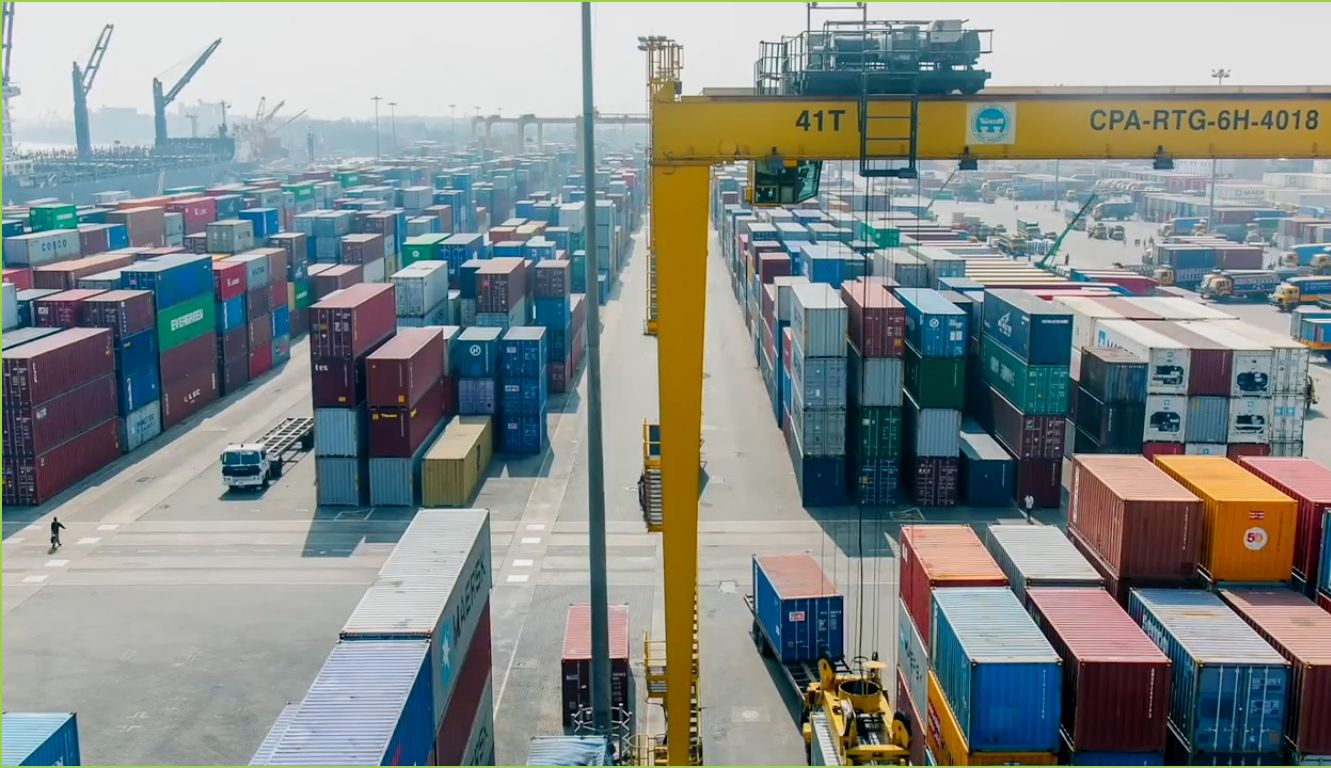
Inamul Haq Khan, senior vice-president of the Bangladesh Garment Manufacturers and Exporters Association, said port inefficiencies are slowing both the import of raw materials and the shipment of finished goods, making the country a harder sell to buyers who evaluate an entire supply chain before placing orders.
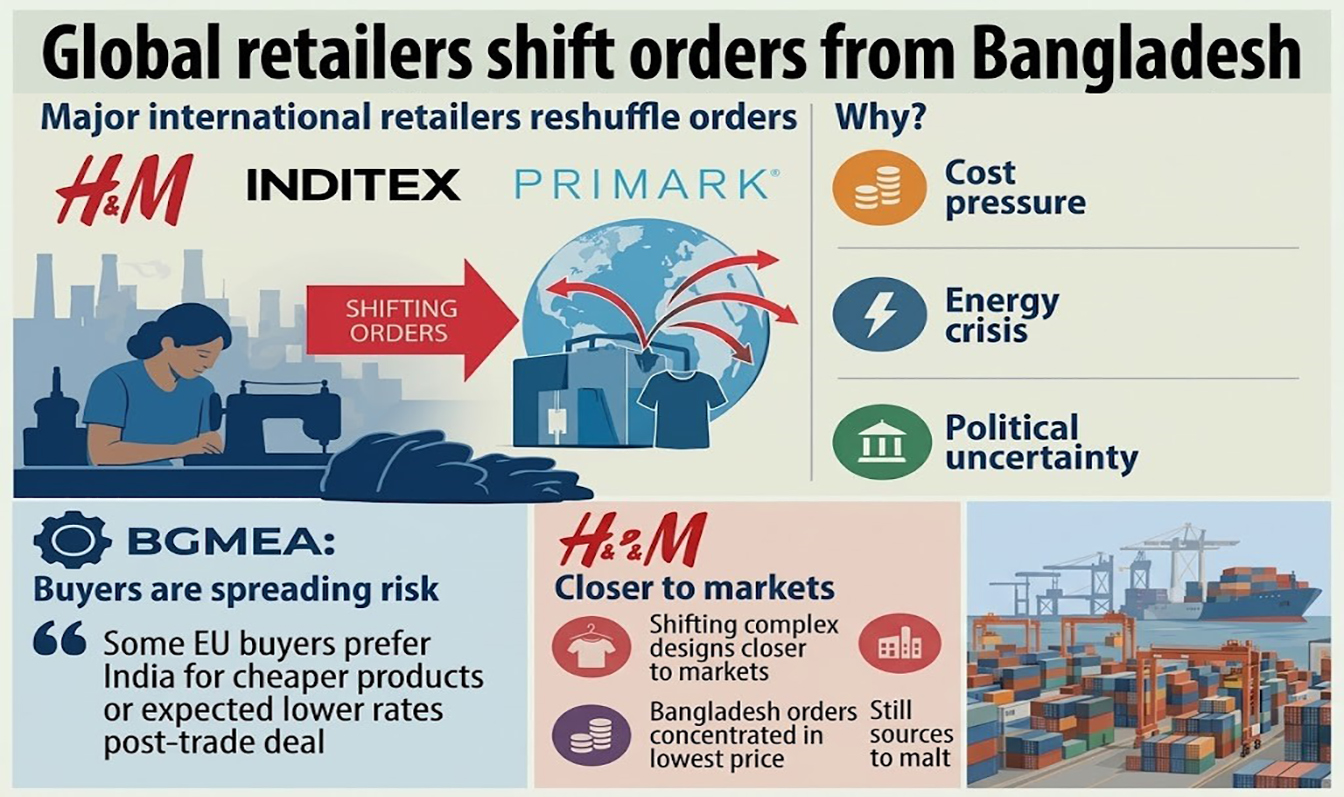
He noted that much of the business leaving China has gone to Vietnam, Cambodia and India rather than Bangladesh, and urged the government to pursue free trade agreements with major export markets within the next three years.
Mustafizur Rahman, a distinguished fellow at the Centre for Policy Dialogue, said the country has made little headway on core competitiveness measures such as lead times, cost of doing business and operational efficiency.
He also flagged a structural mismatch: man-made fibres account for roughly three-quarters of global apparel demand, but only about 30 percent of Bangladesh’s RMG output.
He welcomed new budget provisions extending bonded-warehouse facilities to non-bonded factories, but said the country needs a coordinated push across trade policy, technology, skills and market diversification along with faster progress on trade agreements and efforts to attract more export-oriented foreign investment, an area where he said Vietnam has outperformed Bangladesh.
On the import side, the European Union remained by far the largest buyer of apparel, importing $233.83 billion worth in 2025, up nearly 11 percent and representing a 37 percent global share.
The United States was the second-largest importer at $89.93 billion, though its purchases slipped over 2 percent from the previous year.
Japan, the United Kingdom and South Korea rounded out the top import markets, with the UK posting notably strong growth of nearly 11 percent.
The apparel figures were part of a wider WTO report showing global trade in goods and commercial services climbed 7 percent to $34.65 trillion in 2025, up from 4 percent growth the year before.
Goods trade expanded 6 percent, while services grew faster at 8 percent, pushing services’ share of global trade to 27.6 percent — its highest level since 2005.