Bizbd Report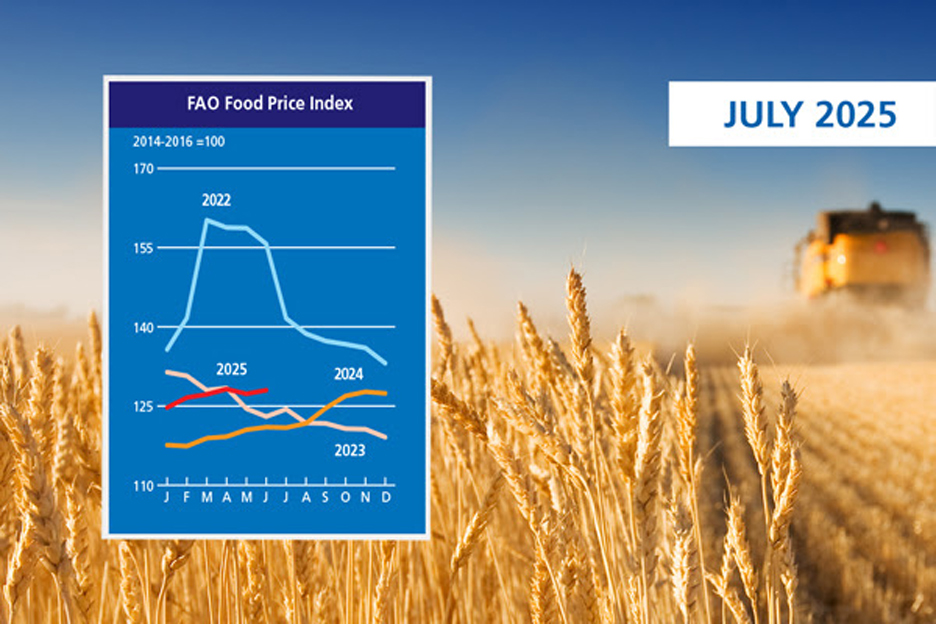
The FAO Food Price Index rose marginally in June 2025, driven by higher international prices for meat, dairy products and vegetable oils, despite declines in cereal and sugar prices.
The index, published monthly by the UN Food and Agriculture Organization (FAO) and a key benchmark for global food commodity prices, averaged 128.0 points in June—an increase of 0.5 percent from May.
While still significantly below its peak in March 2022, the index stood 5.8 percent higher than in June 2024.
Cereal prices declined during the month. The FAO Cereal Price Index fell by 1.5 percent from May, largely due to abundant maize supplies from Argentina and Brazil, which led to a sharp drop in global maize prices.
Sorghum and barley prices also declined. Wheat prices, however, rose amid mounting concerns over hot and dry weather conditions in parts of the European Union, the United States and the Russian Federation.
International rice prices dipped slightly, particularly for Indica varieties, reflecting weaker demand.
Vegetable oil prices saw a notable rise, with the FAO Vegetable Oil Price Index increasing by 2.3 percent from the previous month.
The strongest gains were observed in palm oil, which rose nearly 5 percent on the back of strong global demand.
Soy oil prices also moved higher, fuelled by expectations of increased biofuel use in Brazil and the United States, as well as higher soybean prices in South America.
Rapeseed oil prices firmed due to a tightening global supply outlook, while sunflower oil prices eased slightly thanks to improved production prospects in the Black Sea region.
The FAO Meat Price Index rose by 2.1 percent in June, reaching a new all-time high. Prices for bovine, pig and ovine meats all increased, supported by firm global demand.
In contrast, poultry meat prices continued to decline.
The FAO Dairy Price Index rose by 0.5 percent compared to May. Butter prices reached a new record high amid tight supplies in Oceania and the European Union, combined with strong demand from Asian markets.
Cheese prices increased for the third consecutive month. However, the prices of skim and whole milk powders declined due to subdued global demand and ample availability.
Meanwhile, the FAO Sugar Price Index dropped by 5.2 percent in June, marking the fourth consecutive monthly decline and reaching its lowest level since April 2021.
The fall in prices reflects improved production outlooks in Brazil, India and Thailand, where favourable weather conditions and expanded cultivation areas are expected to result in higher outputs.