Bizbd Report
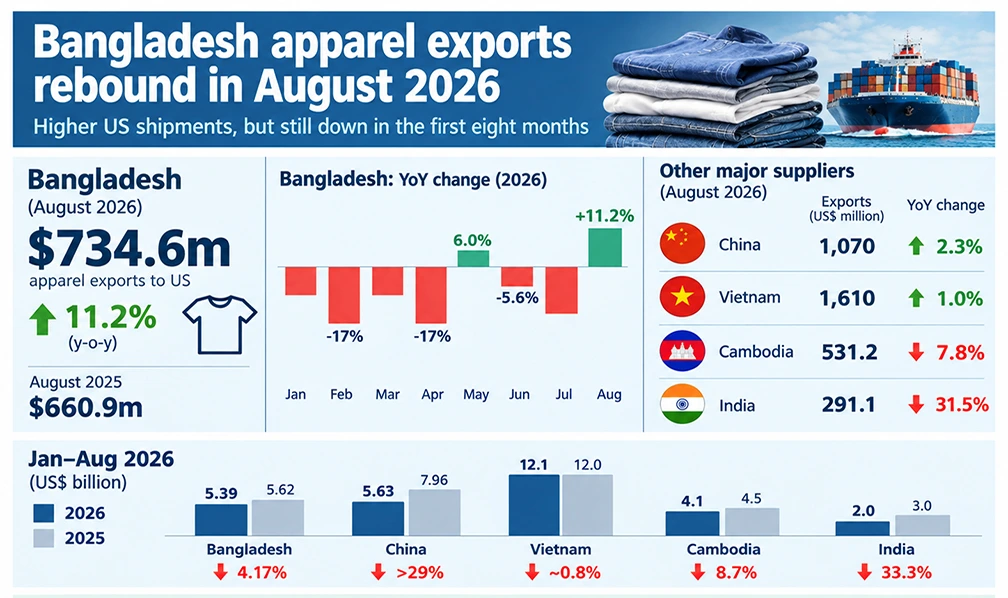
Bangladesh’s readymade garment (RMG) sector exported a total of $8.20 billion worth of apparel to the United States in 2025, its largest market, marking an 11.75 per cent increase over $7.34 billion in 2024.
Shipments in volume terms also rose to 2.66 billion square metres (SME), up 12.36 per cent from 2.36 billion SME the previous year, reflecting robust double-digit growth despite overall declining US imports amid tariff-related tensions and market uncertainty.
Despite sustained annual growth, monthly data revealed fluctuations, with shipments in May, October and November declining by 8.01 per cent, 11.59 per cent, and 14.51 per cent respectively.
Exports recovered in December 2025, posting 3.33 per cent growth in value and 1.39 per cent in volume compared with the same month in 2024.
Overall, US apparel imports declined 1.70 per cent to $77.88 billion, down from $79.23 billion in 2024, while import volume fell by 3.62 per cent to 24.81 billion SME from 25.74 billion SME the previous year.
Shovon Islam, managing director of Sparrow Group, attributed Bangladesh’s export growth to pre-tariff additional work orders and advanced shipments in early 2025, ahead of a new US tariff regime.
‘After the initial 37 per cent tariff, later reduced to 19 per cent for Bangladesh, buyers scaled back orders due to high reciprocal tariffs on other major garment exporters, including China and India,’ he explained.
Shovon said that US buyers’ budgets had shifted to cover higher tariff costs, suppressing overall demand, but expressed optimism that a universal 10-15 per cent tariff following a US high court verdict could stabilise ordering patterns.
‘Risk factors will also improve with the national election and political stability,’ he said.
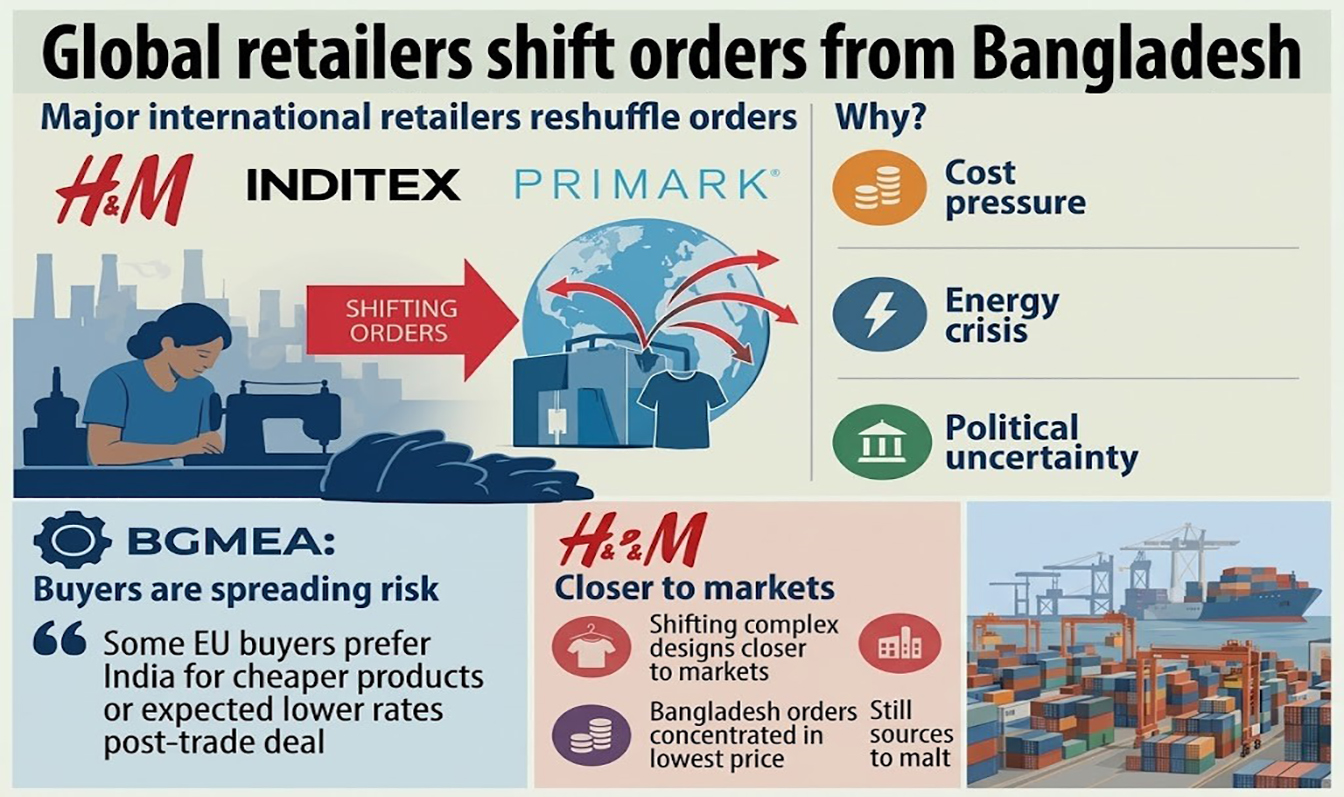
Mahmud Hasan Khan, president of the Bangladesh Garment Manufacturers and Exporters Association (BGMEA), highlighted that Bangladesh benefited from lower reciprocal tariffs compared with China and India, attracting some orders previously directed to those countries.
US imports from China fell 35.61 per cent to $10.64 billion in 2025, while Vietnam became the top exporter to the US, earning $16.74 billion with 11.84 per cent growth.
India and Cambodia recorded $4.94 billion and $4.82 billion respectively, with Cambodia posting the highest growth at 26.95 per cent. Indonesia and Pakistan also saw increases, earning $4.66 billion and $2.39 billion.
BGMEA president cautioned that export growth in February 2026 could slow due to election-related uncertainty, while noting that aggressive pricing by China and India for EU orders may not be sustainable.
‘Bangladesh can gain further if the newly elected government provides policy support, particularly uninterrupted gas and electricity, lower bank interest rates, enhanced Chattogram port efficiency, and a stable law and order environment,’ he said.
AK Azad, managing director of Ha-Meem Group, echoed the view, describing Bangladesh as competitive within the region.
He stressed that sustained double-digit growth depends on supportive government policies and warned that graduating from least developed country (LDC) status in 2026 could affect competitiveness if challenges are not addressed.