Bizbd Report
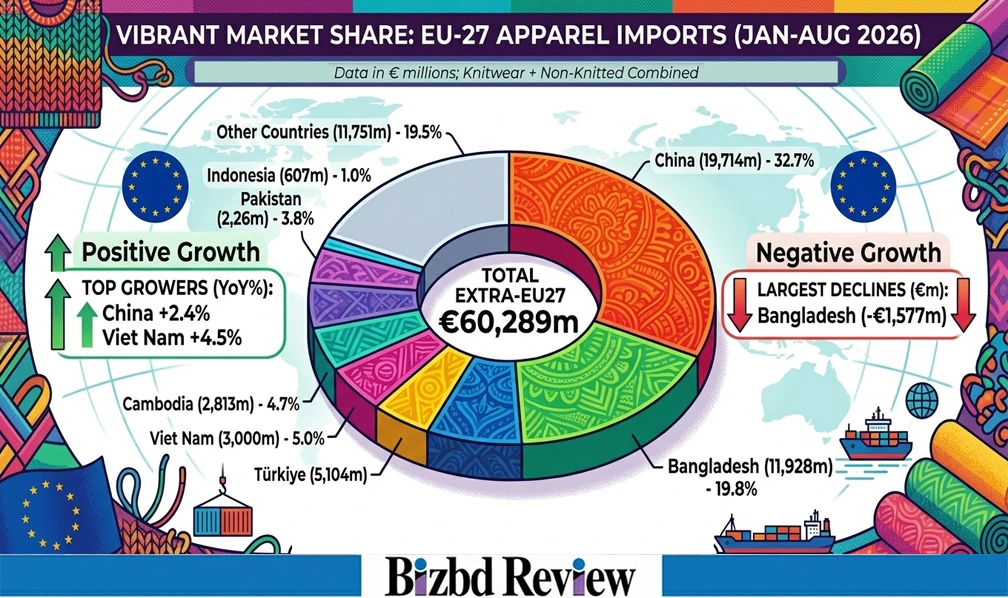
Bangladesh’s apparel exports to the European Union fell sharply in January 2026, dropping 25.3 per cent year-on-year to €1.43 billion from €1.91 billion amid weakening demand across the bloc.
According to data from Eurostat, the statistical office of the EU, released on March 20, the country recorded one of the steepest declines among major suppliers during the period.
Bangladesh’s knitwear exports to the EU fell to €843.3 million from €1.15 billion, a decline of 26.4 per cent, while woven garment shipments dropped to €585.6 million from €766.0 million, down 23.6 per cent.
Overall, EU apparel imports in January 2026 fell by 15.5 per cent to €7.03 billion, down from €8.32 billion a year earlier.
Knitwear imports declined to €3.63 billion from €4.35 billion, a drop of 16.7 per cent, while woven garment imports decreased to €3.41 billion from €3.97 billion, down 14.2 per cent, pointing to a broad-based softening across product categories.
China, the largest supplier, showed relative resilience, with total apparel exports to the EU in January declining 6.9 per cent to €2.22 billion from €2.39 billion.
Knitwear imports by the EU from China fell to €1.16 billion from €1.24 billion, a decrease of 6.5 per cent, while woven garment imports dropped to €1.07 billion from €1.15 billion, down 7.3 per cent.
Vietnam’s total exports to the EU fell 7.3 per cent in January 2026, declining to €362.9 million from €391.6 million.
Knitwear shipments, however, increased to €161.7 million from €156.8 million, up 3.1 per cent, while woven garment exports dropped to €201.2 million from €234.8 million, a decrease of 14.3 per cent.
This mixed performance suggests a gradual shift towards knitwear production and improved competitiveness in that segment.
Turkey faced a sharp contraction, with total exports falling by 29.1 per cent to €620.0 million from €874.7 million.
Knitwear imports declined to €364.6 million from €522.8 million, a steep drop of 30.3 per cent, while woven garments fell to €255.4 million from €351.9 million, down 27.4 per cent.
India recorded a 15.2 per cent decline in total apparel exports to €336.2 million from €396.7 million in the EU market in January.
India’s knitwear exports to the EU fell sharply to €168.6 million from €215.5 million, a decrease of 21.7 per cent, while woven garments showed relative resilience at €167.6 million, down from €181.2 million, a decline of 7.5 per cent.
Cambodia also saw a notable drop in the EU market, with apparel exports declining 25.1 per cent to €313.5 million from €418.6 million in January 2026.
Knitwear shipments fell to €184.9 million from €254.8 million, a decrease of 27.4 per cent, while woven garments declined to €128.6 million from €163.8 million, down 21.5 per cent.
Pakistan experienced a 17.1 per cent fall in total apparel exports to €288.8 million from €348.2 million in the EU in January 2026.
Pakistan’s knitwear shipments declined to €141.2 million from €172.8 million, a drop of 18.3 per cent, while woven garments decreased to €147.6 million from €175.4 million, down 15.8 per cent.
Overall, the January data indicated a challenging trading environment for apparel exporters, with the EU market showing subdued demand across both knitwear and woven segments.