9:39 pm, Friday, 6 November 2026

Bangladesh’s apparel exports to the US fall 4.3pc in nine months

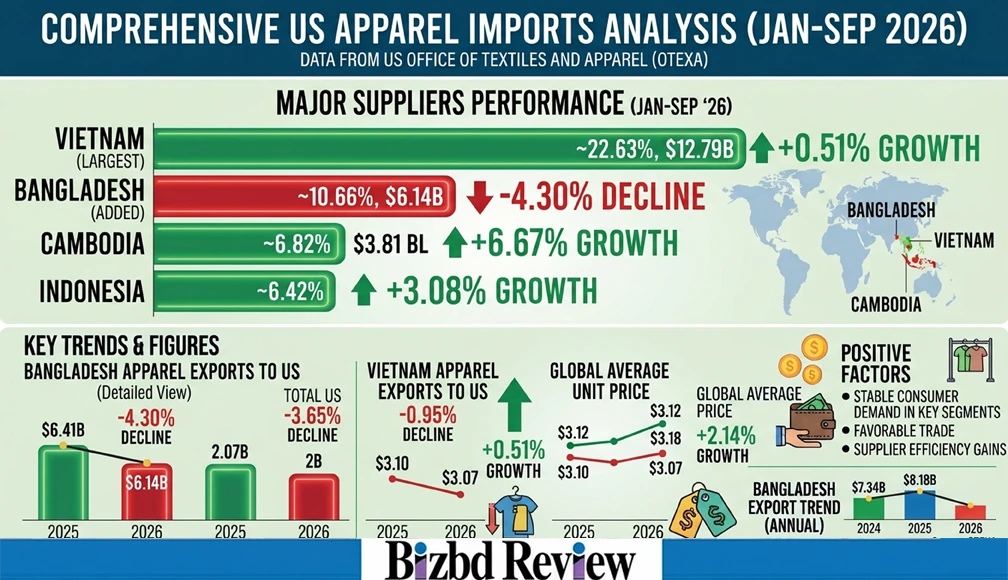
Bangladesh’s readymade garment exports to the United States declined by 4.30 per cent year-on-year to $6.14 billion in the January-September period of 2026, down from $6.41 billion in the same period of 2025, according to the latest data from the US Office of Textiles and Apparel (OTEXA).

Despite the decline, Bangladesh retained its position as the third-largest apparel supplier to the US market, after Vietnam and China, accounting for 10.66 per cent of the country’s total apparel imports by value.

The decline in Bangladesh’s exports came amid a broader contraction in US apparel imports, which fell by 5.76 per cent to $56.68 billion during the nine-month period, compared with $60.14 billion a year earlier.

In volume terms, US apparel imports dropped by 8.10 per cent to 17.80 billion square metre equivalents (SMEs) from 19.37 billion SMEs, indicating weaker demand in the world’s largest apparel import market.

Bangladesh’s shipments to the US also declined in volume, falling by 3.65 per cent to 2 billion SMEs from 2.07 billion SMEs in the corresponding period of the previous year.

More notably, the average unit price of Bangladeshi apparel in the US market decreased by 0.95 per cent to $3.07 per SME from $3.10. In contrast, the global average unit price increased by 2.14 per cent to $3.18 per SME from $3.12.

Consequently, the price gap between Bangladesh and the global average widened from 2 cents to 11 cents per SME, suggesting that Bangladeshi exporters secured lower prices even as the average price paid by US buyers for imported apparel increased.

Exporters attributed the broader slowdown to weaker consumer spending, which has dampened apparel demand and constrained export growth across major supplier countries.

Vietnam remained the largest apparel supplier to the US, with exports rising by 0.51 per cent to $12.79 billion from $12.72 billion a year earlier. Its market share stood at 22.63 per cent.

Although Vietnam’s shipment volume edged down by 0.98 per cent to 3.56 billion SMEs, its average unit price increased by 1.25 per cent to $3.59 per SME.

China retained the second position despite a sharp decline in shipments. Its apparel exports to the US fell by 22.93 per cent to $6.76 billion from $8.77 billion, reducing its market share to 11.61 per cent.

China’s shipment volume decreased by 16.70 per cent to 4.56 billion SMEs, while its average unit price dropped by 7.66 per cent to $1.48 per SME, the steepest price decline among the major suppliers.

Cambodia emerged as the fourth-largest apparel supplier, overtaking Indonesia, as its exports increased by 6.67 per cent to $3.81 billion from $3.57 billion. Its market share rose to 6.82 per cent.

Cambodia’s shipment volume grew by 5.87 per cent to 1.25 billion SMEs, while its average unit price remained almost unchanged at $3.04 per SME.

Indonesia ranked fifth, with exports rising by 3.08 per cent to $3.70 billion from $3.59 billion, securing a 6.42 per cent market share.

Its shipment volume increased by 6.57 per cent to 942.06 million SMEs, although its average unit price declined by 3.52 per cent to $3.93 per SME.

India recorded one of the steepest declines among major suppliers, with its apparel exports to the US falling by 25.03 per cent to $3.07 billion from $4.10 billion. Its market share dropped to 5.28 per cent.

India’s shipment volume decreased by 23.75 per cent to 892.91 million SMEs, while its average unit price fell by 1.88 per cent to $3.44 per SME.

Meanwhile, US apparel imports from Mexico declined by 7.65 per cent to $1.81 billion, while imports from Pakistan fell by 3.40 per cent to $1.74 billion. Their respective market shares stood at 3.26 per cent and 3.15 per cent.

According to OTEXA data, Bangladesh’s apparel exports to the US reached $8.18 billion in 2025, up from $7.34 billion in 2024.

Bangladesh’s apparel exports to the US fall 4.3pc in nine months

Update Time : 03:51:29 am, Friday, 6 November 2026

Bangladesh’s readymade garment exports to the United States declined by 4.30 per cent year-on-year to $6.14 billion in the January-September period of 2026, down from $6.41 billion in the same period of 2025, according to the latest data from the US Office of Textiles and Apparel (OTEXA).

Despite the decline, Bangladesh retained its position as the third-largest apparel supplier to the US market, after Vietnam and China, accounting for 10.66 per cent of the country’s total apparel imports by value.

The decline in Bangladesh’s exports came amid a broader contraction in US apparel imports, which fell by 5.76 per cent to $56.68 billion during the nine-month period, compared with $60.14 billion a year earlier.

In volume terms, US apparel imports dropped by 8.10 per cent to 17.80 billion square metre equivalents (SMEs) from 19.37 billion SMEs, indicating weaker demand in the world’s largest apparel import market.

Bangladesh’s shipments to the US also declined in volume, falling by 3.65 per cent to 2 billion SMEs from 2.07 billion SMEs in the corresponding period of the previous year.

More notably, the average unit price of Bangladeshi apparel in the US market decreased by 0.95 per cent to $3.07 per SME from $3.10. In contrast, the global average unit price increased by 2.14 per cent to $3.18 per SME from $3.12.

Consequently, the price gap between Bangladesh and the global average widened from 2 cents to 11 cents per SME, suggesting that Bangladeshi exporters secured lower prices even as the average price paid by US buyers for imported apparel increased.

Exporters attributed the broader slowdown to weaker consumer spending, which has dampened apparel demand and constrained export growth across major supplier countries.

Vietnam remained the largest apparel supplier to the US, with exports rising by 0.51 per cent to $12.79 billion from $12.72 billion a year earlier. Its market share stood at 22.63 per cent.

Although Vietnam’s shipment volume edged down by 0.98 per cent to 3.56 billion SMEs, its average unit price increased by 1.25 per cent to $3.59 per SME.

China retained the second position despite a sharp decline in shipments. Its apparel exports to the US fell by 22.93 per cent to $6.76 billion from $8.77 billion, reducing its market share to 11.61 per cent.

China’s shipment volume decreased by 16.70 per cent to 4.56 billion SMEs, while its average unit price dropped by 7.66 per cent to $1.48 per SME, the steepest price decline among the major suppliers.

Cambodia emerged as the fourth-largest apparel supplier, overtaking Indonesia, as its exports increased by 6.67 per cent to $3.81 billion from $3.57 billion. Its market share rose to 6.82 per cent.

Cambodia’s shipment volume grew by 5.87 per cent to 1.25 billion SMEs, while its average unit price remained almost unchanged at $3.04 per SME.

Indonesia ranked fifth, with exports rising by 3.08 per cent to $3.70 billion from $3.59 billion, securing a 6.42 per cent market share.

Its shipment volume increased by 6.57 per cent to 942.06 million SMEs, although its average unit price declined by 3.52 per cent to $3.93 per SME.

India recorded one of the steepest declines among major suppliers, with its apparel exports to the US falling by 25.03 per cent to $3.07 billion from $4.10 billion. Its market share dropped to 5.28 per cent.

India’s shipment volume decreased by 23.75 per cent to 892.91 million SMEs, while its average unit price fell by 1.88 per cent to $3.44 per SME.

Meanwhile, US apparel imports from Mexico declined by 7.65 per cent to $1.81 billion, while imports from Pakistan fell by 3.40 per cent to $1.74 billion. Their respective market shares stood at 3.26 per cent and 3.15 per cent.

According to OTEXA data, Bangladesh’s apparel exports to the US reached $8.18 billion in 2025, up from $7.34 billion in 2024.