Bizbd Report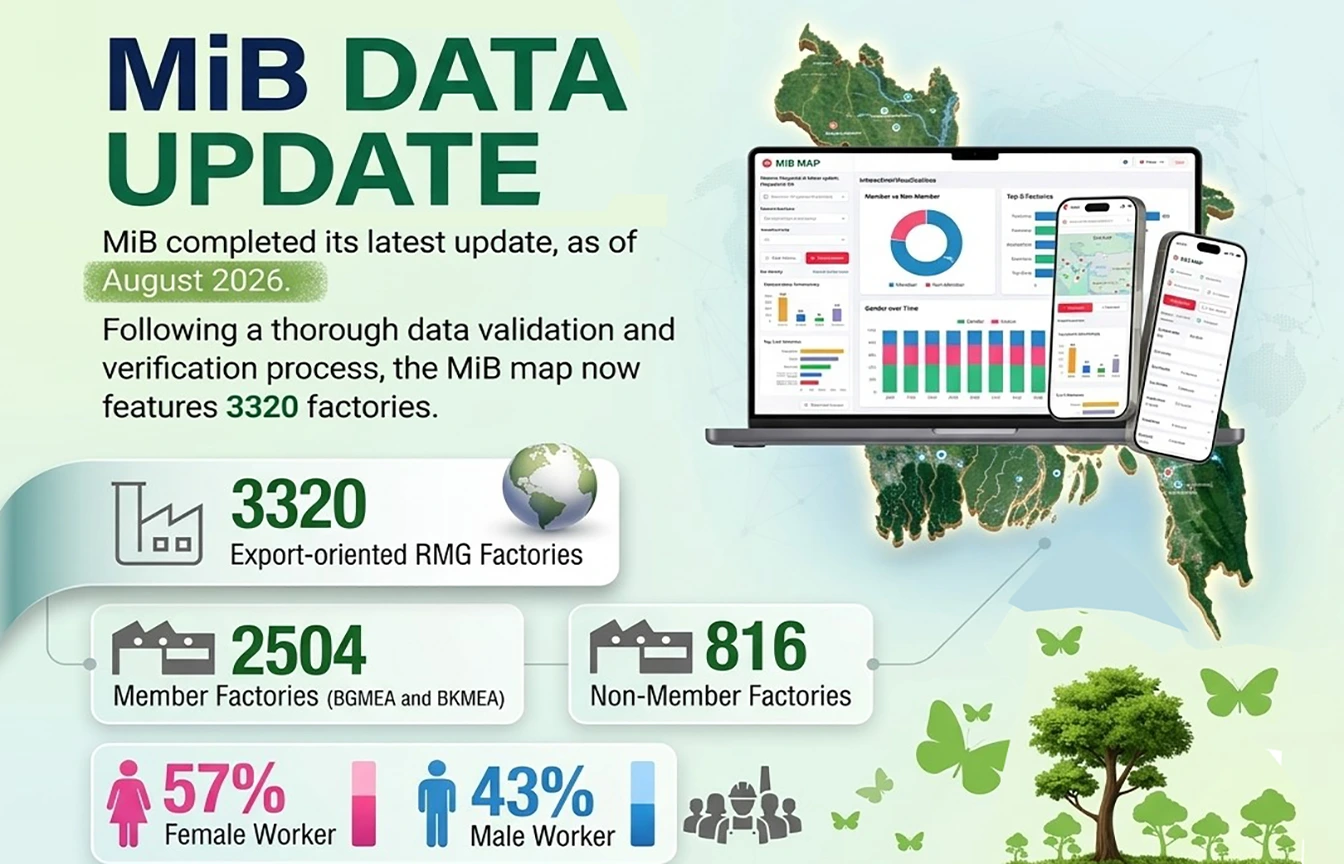
The number of export-oriented readymade garment factories mapped in Bangladesh has remained broadly stable in recent years, while women continue to account for a majority of workers, according to data from Mapped in Bangladesh (MiB).
The latest MiB database lists 3,320 export-oriented RMG factories employing 2,969,068 workers, with women accounting for 57 per cent of the workforce and men for 43 per cent.
The current factory count is only five higher than the 3,315 factories recorded in November 2024, representing an increase of about 0.15 per cent.
The marginal change suggests that the number of mapped factories has remained largely unchanged over the period rather than expanding rapidly.
The comparison, however, needs to be treated with caution, as the November 2024 figure was a census snapshot, while the current MiB platform is a live database that is updated as factory information is verified and revised.
MiB’s historical data show greater fluctuations in the factory count. The organisation mapped 3,630 export-oriented factories in January 2022, while the number rose to more than 3,800 by September 2023.
Its 2022-24 Impact Report subsequently recorded 3,722 factories in its end-period snapshot.
The changes do not necessarily represent the opening or closure of an equivalent number of factories, as MiB’s database tracks active, new and non-operational factories and is periodically updated.
The organisation has also identified frequent factory openings and closures as a challenge in maintaining an accurate industry database.
Employment data similarly show the scale of the industry but are not available as a fully comparable annual series.
MiB’s 2022 gender study covered 2,565,761 workers in 3,212 factories, while its subsequent materials put employment at around 3 million workers.
The latest database records nearly 2.97 million workers, giving an average workforce of about 894 workers per mapped factory, although employment varies substantially between factories.
The gender composition has remained comparatively stable. Women accounted for 58.44 per cent of workers covered by MiB’s 2022 gender study, while the female share was reported at 57 per cent in 2023 and around 58 per cent in the 2024-era data.
The latest figure of 57 per cent indicates that women continue to constitute the majority of RMG workers, but the available MiB data do not establish a sustained increase or decline in the absolute number of female workers.
Nor does the available evidence show a clear upward trend in women’s share of employment. Instead, their proportion has remained within a relatively narrow range of about 57-58 per cent in the comparable MiB data.
MiB’s findings are also significant in relation to the long-standing assumption that women constitute around 80 per cent of Bangladesh’s garment workforce.
Its 2022 analysis found a substantially different distribution, with women making up about 58 per cent and men about 42 per cent of the workers surveyed.
Of the 2,565,761 workers covered by that study, roughly 1.5 million were women and 1.07 million were men.
The figures indicate that women remain central to employment in Bangladesh’s RMG industry, but the workforce is considerably more gender-balanced than the traditional 80:20 estimate.
The latest MiB methodology collects factory-level information directly from management, including employment data disaggregated by sex, alongside information on factory characteristics, products, memberships and other indicators.
The database is intended to improve transparency in the RMG supply chain by providing information on factory locations, employment, buyers, trade association membership, inspections, certifications and other characteristics.
The relatively stable factory count alongside employment of around three million workers also suggests that changes in the sector cannot be assessed simply by counting factories.
Expansion or contraction in individual factories, changes in production capacity, factory consolidation and shifts in employment can alter the industry’s structure without a major change in the overall number of factories.
Overall, the MiB data show that the mapped factory base has fluctuated but remained broadly stable in recent years, while employment covered by the database remains around three million and women consistently account for roughly 57-58 per cent of the workforce.
The figures should nevertheless be interpreted as MiB database snapshots rather than a conventional annual statistical series, as the coverage, survey dates and database status differ across the reporting periods.