7:36 am, Friday, 17 July 2026

Bangladesh’s apparel exports to EU fall by 18.9pc in Jan-May

Bangladesh’s apparel exports to the European Union declined sharply in the first five months of 2026, underperforming almost all of its major competitors as demand weakened across the bloc and rival suppliers proved more resilient in both knitwear and woven garments.

According to Eurostat data released on Thursday, Bangladesh exported apparel worth 7.28 billion euros to the EU during January-May 2026, down 18.9 per cent from 8.97 billion euros in the corresponding period of 2025.

Over the five-month period, the country’s knitwear exports to the EU dropped by 19.8 per cent to 4.16 billion euros from 5.18 billion euros, while woven garment exports declined by 17.6 per cent to 3.12 billion euros from 3.79 billion euros,

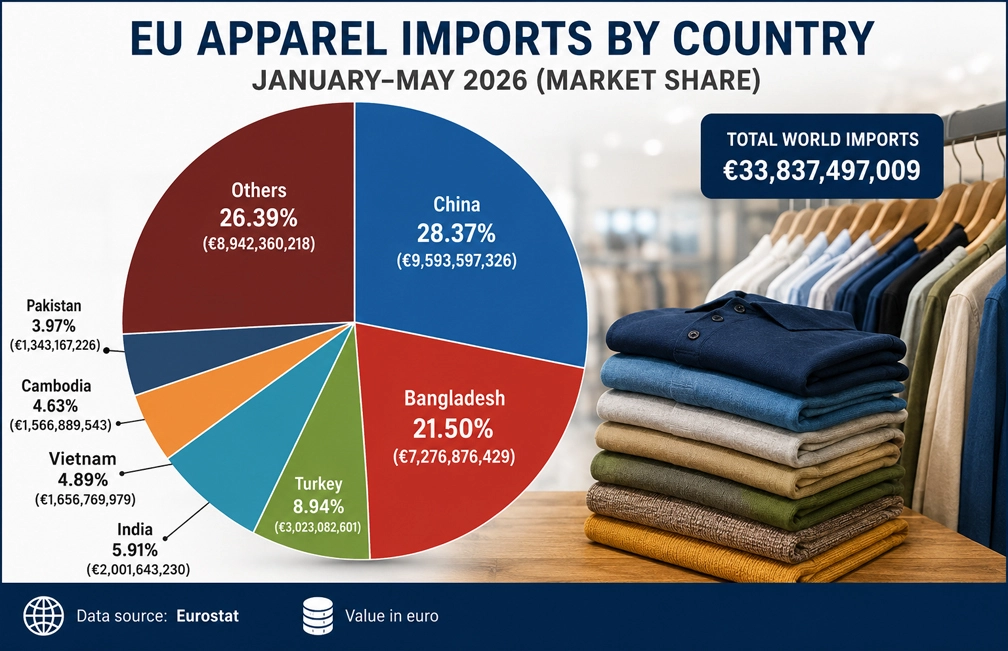
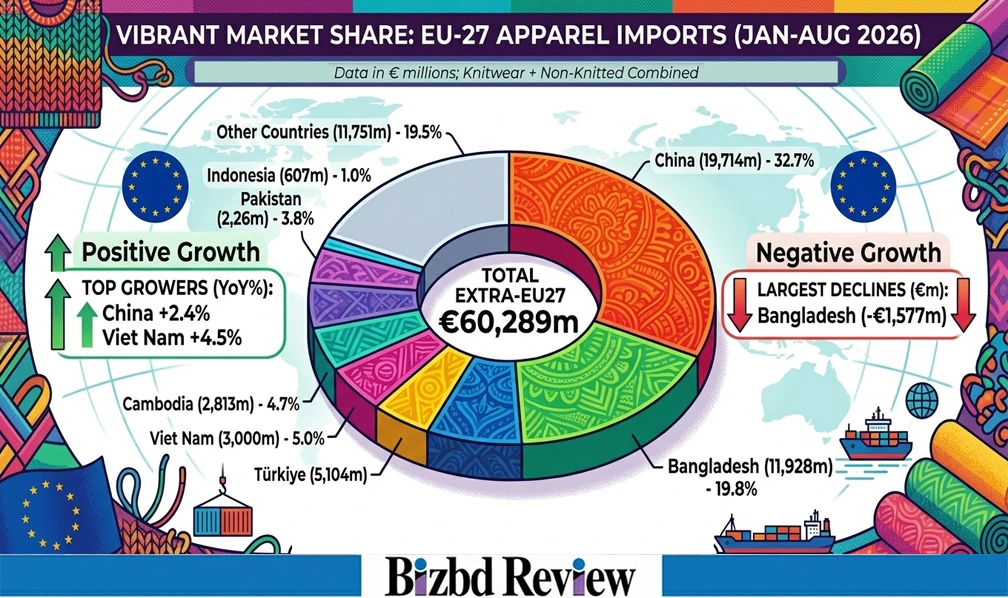
The decline was significantly steeper than the 10.0 per cent contraction in the EU’s overall apparel imports, which fell to 33.84 billion euros from 37.58 billion euros over the same period.

As a result, Bangladesh’s share of total EU apparel imports dropped to 21.5 per cent from 23.9 per cent, reflecting a notable loss of competitiveness in its largest export market.

Although the country retained its position as the EU’s second-largest apparel supplier after China, it recorded one of the steepest declines among the leading exporting countries.

China, the bloc’s largest supplier, exported apparel worth 9.59 billion euros during the five-month period, down only 4.6 per cent from 10.01 billion euros a year earlier.

As its exports declined at a much slower pace than the overall market, China’s share of EU apparel imports increased to 28.4 per cent from 26.6 per cent.

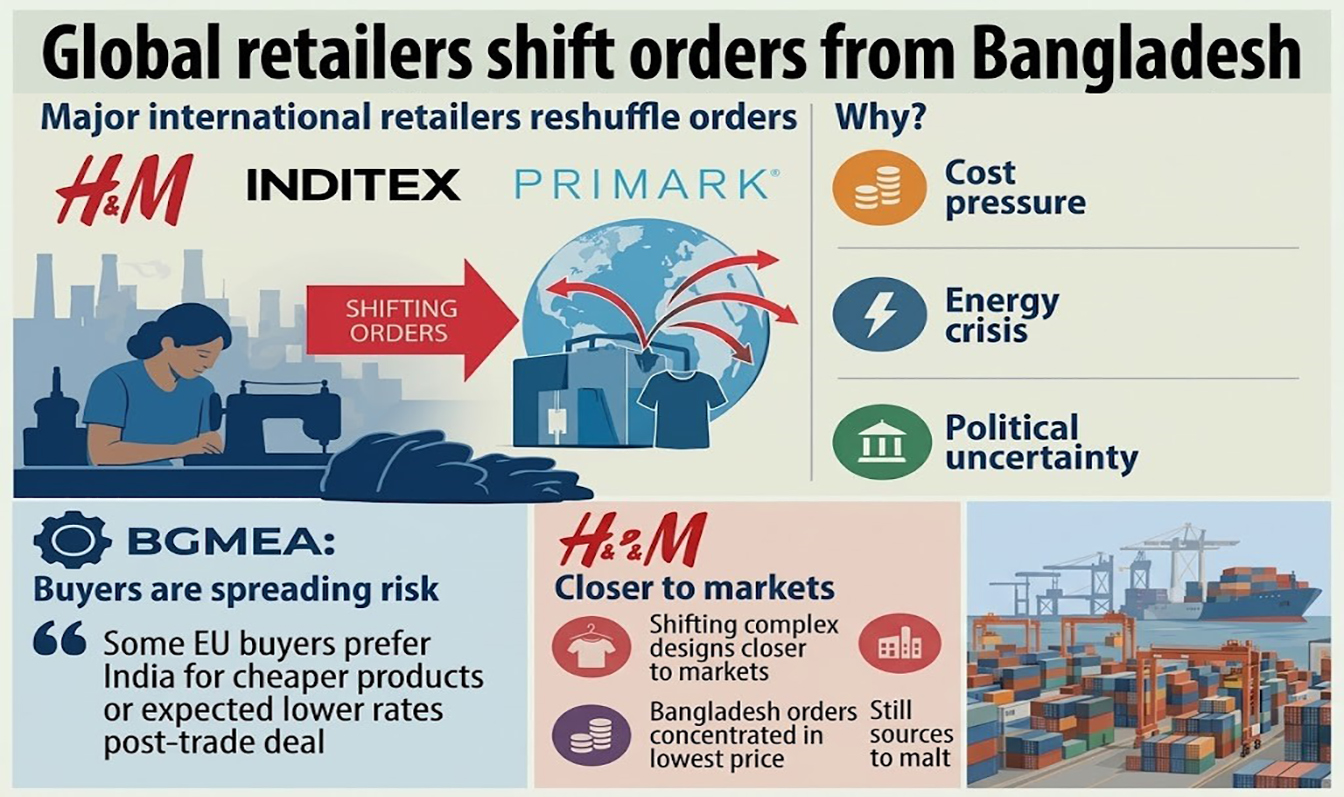
Exporters attributed the contraction in Bangladesh’s apparel exports to the EU to a combination of global market shifts and domestic challenges.

They said that after the United States imposed a 50 per cent tariff on Chinese goods, Chinese manufacturers redirected greater volumes of apparel to the European market at more competitive prices, intensifying competition for Bangladeshi exporters.
Exporters also said that Vietnam further strengthened its foothold in the EU market by continuing to benefit from preferential market access under the EU-Vietnam Free Trade Agreement.

Vietnam posted the strongest performance among the major Asian suppliers. Its exports edged down by just 1.5 per cent to 1.66 billion euros from 1.68 billion euros, enabling it to marginally increase its market share despite subdued consumer demand across Europe.

Turkey, traditionally one of Europe’s largest nearby sourcing destinations, recorded a 15.7 per cent decline in exports to 3.02 billion euros, while India’s shipments fell 13.3 per cent to 2.00 billion euros.

Pakistan’s apparel exports to the EU in the first five months of 2026 contracted by 17.0 per cent to 1.34 billion euros, and Cambodia’s exports declined by 10.8 per cent to 1.57 billion euros.

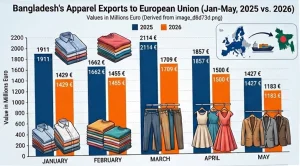
The Eurostat data also showed that Bangladesh’s exports to the EU declined every month during the January-May period.

In January, exports dropped by 25.2 per cent to 1.43 billion euros from 1.91 billion euros a year earlier.

In February, Bangladesh exported apparel worth 1.46 billion euros, down 12.4 per cent from 1.66 billion euros in the same month of 2025.

In March 2026, the country’s apparel exports to the EU decreased by 19.1 per cent to 1.71 billion euros from 2.11 billion euros a year earlier.

In April, apparel exports fell 19.2 per cent year-on-year to 1.50 billion euros from 1.86 billion euros.

The downward trend continued in May, with exports falling 17.1 per cent to 1.18 billion euros from 1.43 billion euros in May 2025.

Bangladesh Knitwear Manufacturers and Exporters Association president Mohammad Hatem told New Age on Thursday that, besides international factors, several domestic constraints had further undermined the country’s competitiveness.

He said persistent gas shortages, labour unrest, high production costs and the banking sector’s unsupportive attitude had disrupted production and shipments, contributing to the decline in exports to the EU.
Bangladesh’s apparel exports to EU fall by 18.9pc in Jan-May

Update Time : 07:53:51 pm, Thursday, 16 July 2026

Bangladesh’s apparel exports to the European Union declined sharply in the first five months of 2026, underperforming almost all of its major competitors as demand weakened across the bloc and rival suppliers proved more resilient in both knitwear and woven garments.

According to Eurostat data released on Thursday, Bangladesh exported apparel worth 7.28 billion euros to the EU during January-May 2026, down 18.9 per cent from 8.97 billion euros in the corresponding period of 2025.

Over the five-month period, the country’s knitwear exports to the EU dropped by 19.8 per cent to 4.16 billion euros from 5.18 billion euros, while woven garment exports declined by 17.6 per cent to 3.12 billion euros from 3.79 billion euros,

The decline was significantly steeper than the 10.0 per cent contraction in the EU’s overall apparel imports, which fell to 33.84 billion euros from 37.58 billion euros over the same period.

As a result, Bangladesh’s share of total EU apparel imports dropped to 21.5 per cent from 23.9 per cent, reflecting a notable loss of competitiveness in its largest export market.

Although the country retained its position as the EU’s second-largest apparel supplier after China, it recorded one of the steepest declines among the leading exporting countries.

China, the bloc’s largest supplier, exported apparel worth 9.59 billion euros during the five-month period, down only 4.6 per cent from 10.01 billion euros a year earlier.

As its exports declined at a much slower pace than the overall market, China’s share of EU apparel imports increased to 28.4 per cent from 26.6 per cent.

Exporters attributed the contraction in Bangladesh’s apparel exports to the EU to a combination of global market shifts and domestic challenges.

They said that after the United States imposed a 50 per cent tariff on Chinese goods, Chinese manufacturers redirected greater volumes of apparel to the European market at more competitive prices, intensifying competition for Bangladeshi exporters.

Exporters also said that Vietnam further strengthened its foothold in the EU market by continuing to benefit from preferential market access under the EU-Vietnam Free Trade Agreement.

Vietnam posted the strongest performance among the major Asian suppliers. Its exports edged down by just 1.5 per cent to 1.66 billion euros from 1.68 billion euros, enabling it to marginally increase its market share despite subdued consumer demand across Europe.

Turkey, traditionally one of Europe’s largest nearby sourcing destinations, recorded a 15.7 per cent decline in exports to 3.02 billion euros, while India’s shipments fell 13.3 per cent to 2.00 billion euros.

Pakistan’s apparel exports to the EU in the first five months of 2026 contracted by 17.0 per cent to 1.34 billion euros, and Cambodia’s exports declined by 10.8 per cent to 1.57 billion euros.

The Eurostat data also showed that Bangladesh’s exports to the EU declined every month during the January-May period.

In January, exports dropped by 25.2 per cent to 1.43 billion euros from 1.91 billion euros a year earlier.

In February, Bangladesh exported apparel worth 1.46 billion euros, down 12.4 per cent from 1.66 billion euros in the same month of 2025.

In March 2026, the country’s apparel exports to the EU decreased by 19.1 per cent to 1.71 billion euros from 2.11 billion euros a year earlier.

In April, apparel exports fell 19.2 per cent year-on-year to 1.50 billion euros from 1.86 billion euros.

The downward trend continued in May, with exports falling 17.1 per cent to 1.18 billion euros from 1.43 billion euros in May 2025.

Bangladesh Knitwear Manufacturers and Exporters Association president Mohammad Hatem told New Age on Thursday that, besides international factors, several domestic constraints had further undermined the country’s competitiveness.

He said persistent gas shortages, labour unrest, high production costs and the banking sector’s unsupportive attitude had disrupted production and shipments, contributing to the decline in exports to the EU.