12:15 am, Saturday, 11 July 2026

Bangladesh unveils 44 investment sites to revive idle state enterprises

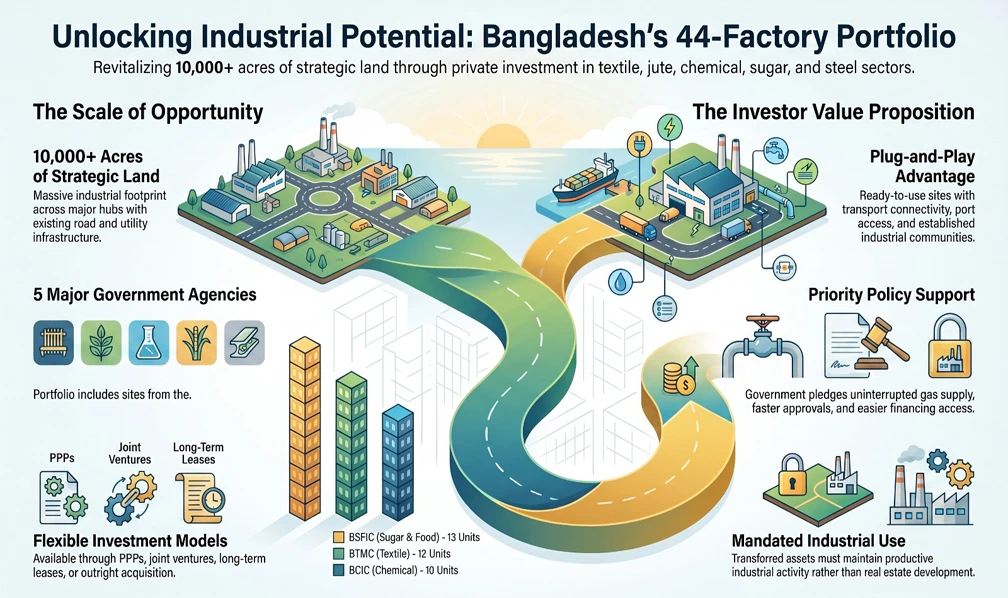
The government has launched a portfolio of 44 investment opportunities aimed at bringing idle and underused state-owned enterprises (SOEs) back into productive use through private capital.

Published by the Bangladesh Investment Development Authority (BIDA), the portfolio spans more than 10,000 acres of strategic industrial land across the country’s major industrial hubs, much of it already connected to roads, utilities and existing infrastructure.

The initiative, spearheaded by BIDA and the Ministry of Industries, opens the door for domestic and foreign investors to revive the factories through a range of models: public-private partnerships, joint ventures, long-term leases or outright acquisition.

To sweeten the offer, the government has pledged policy support including an uninterrupted gas supply, faster regulatory approvals and easier access to financing.

The 44 sites come from five state agencies spanning two ministries: 27 from three corporations under the Ministry of Industries — the Bangladesh Chemical Industries Corporation (BCIC), the Bangladesh Sugar and Food Industries Corporation (BSFIC) and the Bangladesh Steel and Engineering Corporation (BSEC) — and 17 from the Bangladesh Textile Mills Corporation (BTMC) and the Bangladesh Jute Mills Corporation (BJMC), both under the Ministry of Textiles and Jute.

Broken down by corporation, the portfolio comprises 13 factories under the BSFIC, 12 under the BTMC, 10 under the BCIC, five under the BJMC and four under the BSEC. For each site, BIDA has mapped out the available land, transport and port connectivity, and utility facilities, giving prospective investors, in effect, a ready-made starting point rather than a greenfield search.

BIDA’s executive chairman, Chowdhury Ashik Mahmud Bin Harun, said the authority firmly believes the private sector is best placed to run commercial enterprises, with government’s role being to enable rather than compete with private capital.

He described the arrangement as a win-win: investors would gain a plug-and-play setup to grow their businesses, while the state would benefit from job creation and a reduced fiscal burden.

Ashik stressed that the 44 facilities were not chosen at random, noting that they sit on strategic land, many already equipped with utilities, transport access and surrounding industrial communities.

He added that BIDA has been in talks with both local and foreign investors, and that a clear pathway, with transparent structures, faster approvals and coordinated facilitation, would be provided to prospective buyers.

The portfolio follows a high-level meeting held on 20 June between Prime Minister Tarique Rahman and a group of investors, jointly organised by BIDA and the two ministries involved.

At that meeting, business leaders were briefed on the 44 factories, including their locations, infrastructure, transport links and expansion potential, and raised around 50 questions on investment terms, which officials say were addressed on the spot.

The Ministry of Industries has produced a detailed investment guide for its 27 BCIC, BSFIC and BSEC sites, covering not only land location and size but also site-specific feasibility studies, estimated project costs and potential financial returns.

At the closed Khulna Newsprint Mills and Khulna Hardboard Mills complex in Khalishpur, a 47.275-acre site with road, rail and waterway access, four dedicated jetties, and a location 55 kilometres from Mongla Seaport, the ministry has proposed three separate projects on the same land: a jute-stick-based pulp and paper mill, a lithium battery and energy storage plant, and an API and corn-starch complex.

At the Chittagong Chemical Complex in Barabkunda, a 91.19-acre site 41 kilometres from Chittagong seaport with an existing gas connection and a 4MW gas-engine generator in need of renovation, a chloro-alkali and PVC plant has been proposed instead.

BIDA has outlined similarly detailed facilities for the 17 BTMC and BJMC units, including road connectivity, policy support, strategic locations and access to ports and airports.

Economists have broadly welcomed the initiative but urged caution on how it is implemented. Mustafizur Rahman, a distinguished fellow at the Centre for Policy Dialogue, said that leasing out the factories was a positive step, noting that such enterprises were never meant to be run by the state and had relied on public subsidies for years owing to chronic operational inefficiencies.

He cautioned, however, that authorities must ensure leased factories are kept in productive industrial use, arguing that the goal should be sustaining production and safeguarding jobs, and that diverting the sites to non-productive uses, such as real estate development, would set back both industrial output and employment.

Economists have also called on the government to prioritise investors with demonstrated technical and financial capability over simply transferring ownership, and have emphasised that the process must remain transparent and competitive.

BIDA is now working with the relevant corporations to finalise investment guidelines ahead of formally inviting expressions of interest from investors.

Bangladesh unveils 44 investment sites to revive idle state enterprises

Update Time : 12:37:22 am, Monday, 6 July 2026

The government has launched a portfolio of 44 investment opportunities aimed at bringing idle and underused state-owned enterprises (SOEs) back into productive use through private capital.

Published by the Bangladesh Investment Development Authority (BIDA), the portfolio spans more than 10,000 acres of strategic industrial land across the country’s major industrial hubs, much of it already connected to roads, utilities and existing infrastructure.

The initiative, spearheaded by BIDA and the Ministry of Industries, opens the door for domestic and foreign investors to revive the factories through a range of models: public-private partnerships, joint ventures, long-term leases or outright acquisition.

To sweeten the offer, the government has pledged policy support including an uninterrupted gas supply, faster regulatory approvals and easier access to financing.

The 44 sites come from five state agencies spanning two ministries: 27 from three corporations under the Ministry of Industries — the Bangladesh Chemical Industries Corporation (BCIC), the Bangladesh Sugar and Food Industries Corporation (BSFIC) and the Bangladesh Steel and Engineering Corporation (BSEC) — and 17 from the Bangladesh Textile Mills Corporation (BTMC) and the Bangladesh Jute Mills Corporation (BJMC), both under the Ministry of Textiles and Jute.

Broken down by corporation, the portfolio comprises 13 factories under the BSFIC, 12 under the BTMC, 10 under the BCIC, five under the BJMC and four under the BSEC. For each site, BIDA has mapped out the available land, transport and port connectivity, and utility facilities, giving prospective investors, in effect, a ready-made starting point rather than a greenfield search.

BIDA’s executive chairman, Chowdhury Ashik Mahmud Bin Harun, said the authority firmly believes the private sector is best placed to run commercial enterprises, with government’s role being to enable rather than compete with private capital.

He described the arrangement as a win-win: investors would gain a plug-and-play setup to grow their businesses, while the state would benefit from job creation and a reduced fiscal burden.

Ashik stressed that the 44 facilities were not chosen at random, noting that they sit on strategic land, many already equipped with utilities, transport access and surrounding industrial communities.

He added that BIDA has been in talks with both local and foreign investors, and that a clear pathway, with transparent structures, faster approvals and coordinated facilitation, would be provided to prospective buyers.

The portfolio follows a high-level meeting held on 20 June between Prime Minister Tarique Rahman and a group of investors, jointly organised by BIDA and the two ministries involved.

At that meeting, business leaders were briefed on the 44 factories, including their locations, infrastructure, transport links and expansion potential, and raised around 50 questions on investment terms, which officials say were addressed on the spot.

The Ministry of Industries has produced a detailed investment guide for its 27 BCIC, BSFIC and BSEC sites, covering not only land location and size but also site-specific feasibility studies, estimated project costs and potential financial returns.

At the closed Khulna Newsprint Mills and Khulna Hardboard Mills complex in Khalishpur, a 47.275-acre site with road, rail and waterway access, four dedicated jetties, and a location 55 kilometres from Mongla Seaport, the ministry has proposed three separate projects on the same land: a jute-stick-based pulp and paper mill, a lithium battery and energy storage plant, and an API and corn-starch complex.

At the Chittagong Chemical Complex in Barabkunda, a 91.19-acre site 41 kilometres from Chittagong seaport with an existing gas connection and a 4MW gas-engine generator in need of renovation, a chloro-alkali and PVC plant has been proposed instead.

BIDA has outlined similarly detailed facilities for the 17 BTMC and BJMC units, including road connectivity, policy support, strategic locations and access to ports and airports.

Economists have broadly welcomed the initiative but urged caution on how it is implemented. Mustafizur Rahman, a distinguished fellow at the Centre for Policy Dialogue, said that leasing out the factories was a positive step, noting that such enterprises were never meant to be run by the state and had relied on public subsidies for years owing to chronic operational inefficiencies.

He cautioned, however, that authorities must ensure leased factories are kept in productive industrial use, arguing that the goal should be sustaining production and safeguarding jobs, and that diverting the sites to non-productive uses, such as real estate development, would set back both industrial output and employment.

Economists have also called on the government to prioritise investors with demonstrated technical and financial capability over simply transferring ownership, and have emphasised that the process must remain transparent and competitive.

BIDA is now working with the relevant corporations to finalise investment guidelines ahead of formally inviting expressions of interest from investors.