12:16 am, Saturday, 11 July 2026

Bangladesh export growth limited outside RMG sector, study finds

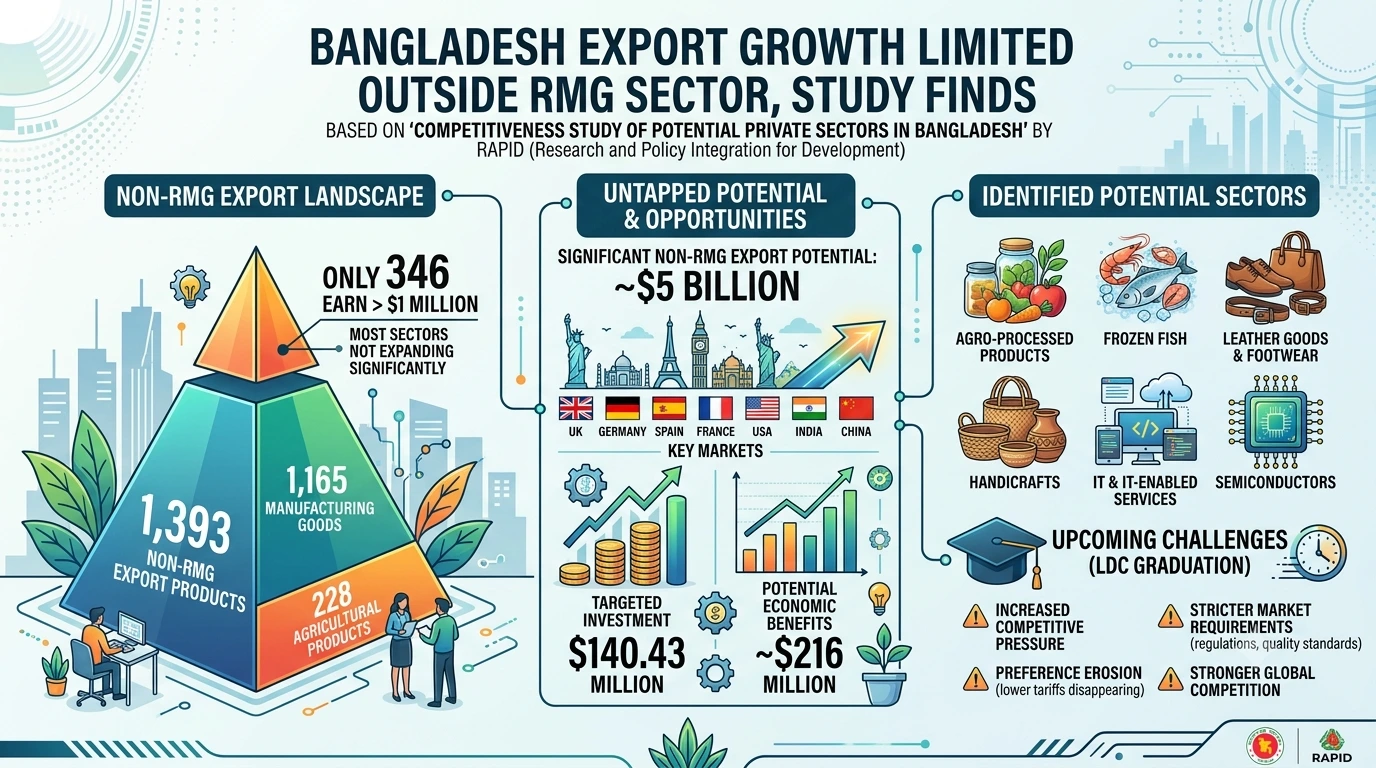
A latest study has found that only 346 out of 1,393 non-readymade garment export products earn more than $1 million, indicating that despite a wide range of exportable goods, most sectors are not expanding significantly.

The study shows that out of the 1,393 products, 1,165 are manufacturing goods and 228 are agricultural products.

The research titled “Competitiveness Study of Potential Private Sectors in Bangladesh” was conducted by Research and Policy Integration for Development (RAPID).

It identified seven potential sectors where targeted investment worth around $140.43 million could generate economic benefits of about $216 million.

The identified sectors are agro-processed products, frozen fish, leather goods and footwear, handicrafts, IT and IT-enabled services, and semiconductors.

The findings were presented at a Development Project Proposal (DPP) consultation workshop held on Tuesday at the CIRDAP auditorium in Dhaka.

Commerce Minister Khandakar Abdul Muktadir attended the event as chief guest, with Commerce Secretary Md Ataur Rahman Khan in the chair.

The study warned that Bangladesh’s graduation from Least Developed Country (LDC) status will increase competitive pressure due to preference erosion, stricter market requirements, and stronger global competition.

It also noted that Bangladesh has significant non-RMG export potential worth around $5 billion in key markets including the UK, Germany, Spain, France, the USA, India, and China.

However, it identified several constraints, including policy-related anti-export bias due to high tariffs, weak trade logistics, high transport costs, customs issues, and difficulties in doing business.

According to the study, a 1 per cent reduction in transport costs could increase export demand from Bangladesh by 7.4 per cent, while full implementation of trade facilitation agreements could reduce trade costs by 11 per cent to 14 per cent.

RAPID Chairman MA Razzaque said Bangladesh’s export concentration is four times higher than the developing country average and above the LDC average, stressing that export expansion and diversification must go together.

He noted that around 85 per cent of export earnings come from the RMG sector, and this concentration has increased further between 2021 and 2024.

Razzaque said that although Bangladesh has many non-RMG products, most are not growing, and initiatives like EC4J could help unlock their export potential.

Commerce Minister Khandakar Abdul Muktadir said Bangladesh has already met the conditions for graduation from LDC status, but the main challenge is to remain competitive globally after graduation.

He stressed the need for skill development, research, innovation, and technology adoption in industry.

He said export earnings could rise from the current $50-55 billion to $150 billion with proper planning, policy support, research, and skilled manpower.

He also said delays in project implementation are a major weakness in development work and stressed the need to complete projects within set deadlines and adapt to technological changes.

The minister called for stronger cooperation between government, private sector, and academia, and for regular evaluation of project outcomes.

Commerce Secretary Md Ataur Rahman Khan said an integrated project worth around Tk 30 billion is being prepared to address post-LDC graduation challenges and boost export capacity.

He asaid that the second phase of the project will include sector-wise action plans based on private sector experience and needs, focusing on recovery, restructuring, and capacity building in line with national budget priorities.
Bangladesh export growth limited outside RMG sector, study finds

Update Time : 11:40:12 pm, Tuesday, 23 June 2026

A latest study has found that only 346 out of 1,393 non-readymade garment export products earn more than $1 million, indicating that despite a wide range of exportable goods, most sectors are not expanding significantly.

The study shows that out of the 1,393 products, 1,165 are manufacturing goods and 228 are agricultural products.

The research titled “Competitiveness Study of Potential Private Sectors in Bangladesh” was conducted by Research and Policy Integration for Development (RAPID).

It identified seven potential sectors where targeted investment worth around $140.43 million could generate economic benefits of about $216 million.

The identified sectors are agro-processed products, frozen fish, leather goods and footwear, handicrafts, IT and IT-enabled services, and semiconductors.

The findings were presented at a Development Project Proposal (DPP) consultation workshop held on Tuesday at the CIRDAP auditorium in Dhaka.

Commerce Minister Khandakar Abdul Muktadir attended the event as chief guest, with Commerce Secretary Md Ataur Rahman Khan in the chair.

The study warned that Bangladesh’s graduation from Least Developed Country (LDC) status will increase competitive pressure due to preference erosion, stricter market requirements, and stronger global competition.

It also noted that Bangladesh has significant non-RMG export potential worth around $5 billion in key markets including the UK, Germany, Spain, France, the USA, India, and China.

However, it identified several constraints, including policy-related anti-export bias due to high tariffs, weak trade logistics, high transport costs, customs issues, and difficulties in doing business.

According to the study, a 1 per cent reduction in transport costs could increase export demand from Bangladesh by 7.4 per cent, while full implementation of trade facilitation agreements could reduce trade costs by 11 per cent to 14 per cent.

RAPID Chairman MA Razzaque said Bangladesh’s export concentration is four times higher than the developing country average and above the LDC average, stressing that export expansion and diversification must go together.

He noted that around 85 per cent of export earnings come from the RMG sector, and this concentration has increased further between 2021 and 2024.

Razzaque said that although Bangladesh has many non-RMG products, most are not growing, and initiatives like EC4J could help unlock their export potential.

Commerce Minister Khandakar Abdul Muktadir said Bangladesh has already met the conditions for graduation from LDC status, but the main challenge is to remain competitive globally after graduation.

He stressed the need for skill development, research, innovation, and technology adoption in industry.

He said export earnings could rise from the current $50-55 billion to $150 billion with proper planning, policy support, research, and skilled manpower.

He also said delays in project implementation are a major weakness in development work and stressed the need to complete projects within set deadlines and adapt to technological changes.

The minister called for stronger cooperation between government, private sector, and academia, and for regular evaluation of project outcomes.

Commerce Secretary Md Ataur Rahman Khan said an integrated project worth around Tk 30 billion is being prepared to address post-LDC graduation challenges and boost export capacity.

He asaid that the second phase of the project will include sector-wise action plans based on private sector experience and needs, focusing on recovery, restructuring, and capacity building in line with national budget priorities.